Reptiles That Start with W: Fascinating Species
Spotting a reptile in the wild is exciting, but naming it can be surprisingly hard. Reptiles that start with W are a perfect example, since the letter covers everything from venomous pit vipers to harmless toad-eaters. Some W species, like the Western diamondback rattlesnake, demand serious respect.
Others, like the Western hognose snake, just put on a good show.
In our research across state wildlife records and herpetological society data, we found over 25 North American reptiles with common names beginning with W as of 2026. This guide focuses on visual identification, not guesswork. You'll learn the exact cues that separate dangerous species from harmless look-alikes.
When you head outside, you'll know what you're looking at before you get close.

Image source: Web (Bing) / pinterest.com (Web image (fair-use with source credit))
Why Visual Identification Matters for "W" Reptiles
When a reptile's common name starts with W, identification gets harder. The letter spans venomous snakes, harmless colubrids, aquatic turtles, and desert lizards. Common names don't follow scientific families, so two animals sharing a W name can be completely unrelated.
The Western banded gecko is a harmless desert dweller. The Western diamondback is one of the most dangerous rattlesnakes in North America. Same first word, opposite risk levels.
Misidentification carries real stakes. Per CDC data, roughly 7,000 to 8,000 venomous snake bites get reported in the United States each year. Many happen because someone assumed a water snake was harmless, or grabbed a juvenile rattlesnake thinking it couldn't inject venom yet.
Visual training prevents those errors.
W reptiles also show up in nearly every US habitat. That means the odds of meeting one in the wild are higher than you'd think. Knowing what you're looking at is the single best safety tool you have.
Quick Answer: The Complete List of Reptiles That Start with W
Reptiles that start with W include Western diamondbacks, hognose snakes, worm snakes, and water moccasins. Water dragons and wood turtles join them. Most W species are snakes.
Some carry venom. The list below covers the full range.
Snakes
- Western diamondback rattlesnake
- Western hognose snake
- Western rat snake
- Water moccasin
- Worm snake
- Western blind snake
- White-lipped python
- Woma python
- Wagler's pit viper
Lizards and skinks
- Western fence lizard
- Western skink
- Western whiptail
- Common wall lizard
Turtles
- Wood turtle
- Western pond turtle
- Western painted turtle
Crocodilians
- West African slender-snouted crocodile
A few quick notes on this list. Water moccasin and cottonmouth are the same species, Agkistrodon piscivorus. Worm snake refers to small burrowing snakes in the genus Carphophis.
Wall lizards are a European group that now has feral populations scattered across North America.
If you'd rather learn about warm-blooded W animals, our mammal letter W list is right here.
How to Use This Guide: Look, Snap, Compare
Field identification follows a simple order. Look first. Photograph second.
Compare third. Skip that order and you rely on memory, which is where mistakes happen.
Look. Note where the animal is before moving closer. Is it basking on a log in a pond? Burrowed in loose soil?
Climbing a rock wall in the desert? Habitat alone eliminates half the species on this list.
Snap. A phone camera is enough. Take at least three photos: the whole animal, a close-up of the head, and the tail. For snakes, try to capture the scale texture on the back.
For turtles, shoot the top shell and the underside.
Compare. Keep this guide open and match the animal against the photos and range notes. When in doubt, upload your images to a community science platform. HerpMapper and iNaturalist both have reviewers who confirm observations quickly.
The Society for the Study of Amphibians and Reptiles (SSAR) maintains official common names, so the terminology here matches standard herpetological checklists. If you enjoy this identification style, wait until you try the letter C edition of this series.
Step-by-Step Visual Cues for Identifying "W" Reptiles
Start with Location and Habitat
Location narrows the list before you even look at the animal. Western diamondbacks live in the arid Southwest, from California across to Texas and down into Mexico. Water moccasins stick to the Southeast's wetlands.
Wood turtles live near ponds and streams in the Northeast and Midwest. If the geography doesn't match, it's probably a different species.
Range maps matter more than photos for tricky pairs. The Western rat snake lives west of the Mississippi. The Eastern rat snake lives east of it.
Even experts struggle with out-of-range sightings.
Check Body Shape and Head Profile
Snake shape tells you a lot, fast. Pit vipers like the Western diamondback have thick bodies and wide, triangular heads that sit clearly above the neck. Rat snakes are slender with a narrow, arrow-shaped head that blends into the body.
Water snakes fall in between, with flat, broad heads that read as wider than the neck but not triangular.
Turtles follow the same logic. Wood turtles have a dome-shaped, sculpted shell. Western pond turtles have a flatter, smoother carapace.
Shell shape alone can usually settle the identification.
Count and Observe Scale Features
Scales are the hidden identifier. Keeled scales have a ridge down the center, which makes the snake feel like sandpaper. Smooth scales feel glossy and dry.
Western rat snakes have weakly keeled scales. Worm snakes are smooth and so shiny they look wet.
Some species have a standout feature. The Western hognose snake has an upturned snout scale, used for digging after toads. The worm snake is so small and featureless that you'll need a magnifier to see its eyes.
These details matter more than color.

Image source: Web (Bing) / quizlet.com (Web image (fair-use with source credit))
Look at Patterns, Color, and Markings
Patterns are the most reliable quick check. Western diamondbacks have dark diamonds with light borders running down the back. Western rat snakes carry large blotches that turn into a striped or saddle pattern near the tail.
Water moccasins are dark, often with banding that fades with age, plus a dark stripe through the eye.
Color alone is not enough. Many harmless species mimic venomous ones. Juvenile water snakes have pale, bold patterns that make them look like copperheads.
Check pattern structure, not just color intensity.
Note Behavior and Movement
Behavior works like a field test. The water moccasin stands its ground, opens its mouth to show the white lining, and holds position. A common water snake dives underwater at the first sign of trouble.
Hognose snakes don't bite. They flatten their neck, hiss loudly, then roll over and play dead. It looks ridiculous, but it works.
Worm snakes don't defend themselves at all. Lift a rock and uncover one, and it coils into a tight ball, holding still and hoping you move on. The same logic applies to the D guide for species like dwarf geckos and desert iguanas.
Key Identifiers: Snakes That Start with W
Western Diamondback vs. Western Rat Snake
These two get confused more often than any other W pair. Both have blotches. Both live in overlapping parts of the South and West.
But the differences are obvious once you know what to look for.
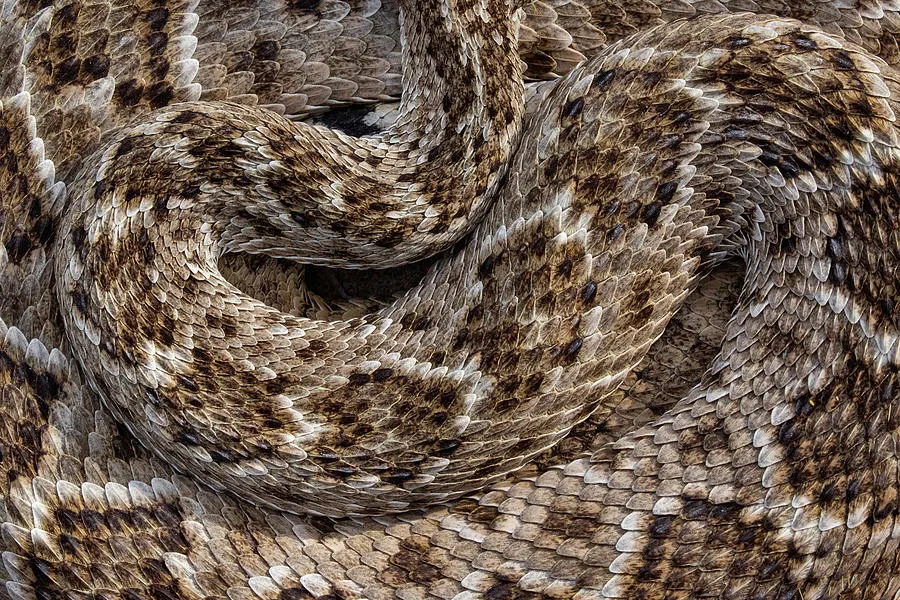
Image source: Web (Bing) / fity.club (Web image (fair-use with source credit))
| Feature | Western diamondback | Western rat snake |
|---|---|---|
| Head shape | Triangular, distinct from neck | Slim, arrow-shaped, blends in |
| Tail | Rattle present | Tapers to a point, no rattle |
| Pattern | Bold dark diamonds with light borders | Large blotches that become stripes near the tail |
| Behavior | Stands ground, rattles when threatened | Flees quickly, climbs trees easily |
| Range | Arid Southwest, west Texas | Central US, often near farmland |
There's one more giveaway. The diamondback has a thick, heavy body and a wide head that looks like a spade. The rat snake looks almost graceful by comparison, with a slim neck and a head that flows into the body.
When in doubt, check the tail. A rattle means venomous. No rattle means you're looking at a harmless constrictor.
Water Moccasin vs. Common Water Snake
This is the most dangerous mix-up in North American herping. The water moccasin, Agkistrodon piscivorus, gets misidentified constantly. Harmless water snakes in the genus Nerodia pay the price.
People kill them by the thousands each year, thinking they're protecting their families.
The differences are clear once you know them. Water moccasins have a blocky, angular head that's wider than the neck. Water snakes have a flat but smooth head profile.
Moccasins swim with their heads held above the water. Water snakes swim with only their heads poking out, body tilted at an angle. Moccasins are thick and heavy-bodied.
Water snakes are slimmer, though they flatten out when scared to look bigger.
The most reliable cue is the mouth. A threatened moccasin opens wide, showing a bright white interior. That's where "cottonmouth" comes from.
Water snakes never do this.
Hognose Snakes, Worm Snakes, and Blind Snakes
These three show how varied W snakes can be.
The Western hognose has an upturned snout that looks like a tiny shovel. It uses that scale to dig after toads in sandy soil. When threatened, it flattens its neck like a cobra and hisses.
If that fails, it rolls onto its back and plays dead, complete with a hanging tongue.
Worm snakes are the opposite of dramatic. These small, smooth, shiny snakes spend their whole lives underground. They're often mistaken for earthworms.
A quick look at the eyes settles it. Worms don't have them.
Blind snakes are even odder. They're tiny, burrowing snakes with eyes reduced to dark spots. They eat ant and termite larvae.
You'll rarely see one unless you flip a heavy rock.
Key Identifiers: Lizards, Skinks, and Geckos That Start with W
The W lizards are easier to identify because you can see them clearly. They don't vanish into the same burrows as snakes.
The Western fence lizard is the classic backyard lizard of the West. It has spiny-looking, keeled scales and a blue patch on each side of the belly. Males flash these patches during push-up displays.
If you see a lizard doing lizard push-ups on a fence post, that's your animal.
The Western skink has a smooth, shiny body and tiny legs. Juveniles have a bright blue tail that stands out in leaf litter. Adults lose some of that color but keep the striped pattern.
Like many skinks, they can drop their tail when grabbed.
The Western whiptail is a fast, lean lizard built for running. It has a long tail, small granular scales, and a pointed snout. It rarely basks in the open.
Instead, it moves constantly through rocky terrain looking for insects.
The common wall lizard isn't native to North America, but it's here. Feral populations live in urban areas of California and around Washington, D.C. They look like small, gray-brown lizards with keeled scales and a long tail.
They climb walls and fences with ease.
If you enjoy this letter-based approach, you might like the mammals starting with M guide for a change of pace.
Turtles and Crocodilians That Start with W
The W turtles are all North American, and each one stands out.
The wood turtle has a sculpted, dome-shaped shell with pyramid-like scutes. It looks like carved wood, which is exactly how it got its name. These turtles are semi-terrestrial.
They wander through forests and meadows near streams, eating berries, worms, and mushrooms.
The Western pond turtle is a small, dark turtle with yellow markings on its neck and legs. It lives in ponds, lakes, and slow rivers along the West Coast. It basks in groups on logs and rocks.
Habitat loss has pushed it onto protected species lists in several states.
The Western painted turtle has a flat, smooth shell with a beautiful red-and-yellow border. It's the western cousin of the painted turtle that spans most of North America. These turtles are almost always near water, and they love basking.
For crocodilians, the W list has just one entry. The West African slender-snouted crocodile lives in tropical rivers and swamps across West Africa. It has an extremely narrow snout and a thin build.
It eats mostly fish. It's also critically endangered, so sightings are rare.
Common Visual Mistakes (and How to Avoid Them)
Everyone misidentifies reptiles sometimes. Even experienced herpers get fooled by juveniles and odd color phases. The goal is to avoid the dangerous errors.
Mistake 1: Assuming color means species. Many snakes change color as they age. Water moccasins start bright with bold bands and slowly turn almost black. Rat snakes do the opposite.
Don't ID by color alone.
Mistake 2: Trusting head shape too fast. Water snakes flatten their heads to look triangular when scared. That mimics pit vipers perfectly. Check the head and the tail, then check the behavior.
Mistake 3: Killing snakes to identify them. People do this constantly with water snakes. If you don't know what it is, keep your distance and photograph it. No ID is worth a bite, and no harmless snake deserves execution.
Mistake 4: Treating "W" as a safe zone. Just because a snake starts with W doesn't mean it's friendly. The Western diamondback and Wagler's pit viper are both dangerous. The letter is random.
The respect isn't.
Quick Reference Table: W Reptiles at a Glance
| Species | Type | Region | Venomous? | Key feature |
|---|---|---|---|---|
| Western diamondback | Rattlesnake | US Southwest | Yes | Diamond back pattern, rattle |
| Water moccasin | Pit viper | US Southeast | Yes | White mouth lining |
| Western hognose | Colubrid | Central US | No | Upturned snout, plays dead |
| Western rat snake | Colubrid | Central US | No | Blotches, climbing skill |
| Worm snake | Colubrid | Eastern US | No | Tiny, shiny, lives underground |
| Western fence lizard | Lizard | Western US | No | Blue belly patches |
| Western skink | Skink | Western US | No | Shiny scales, blue juvenile tail |
| Wood turtle | Turtle | Northeast/Midwest US | No | Sculpted, dome shell |
| Western pond turtle | Turtle | West Coast US | No | Dark shell, yellow neck marks |
| Woma python | Python | Australia | No | Blunt head, banded tail |
| White-lipped python | Python | New Guinea/Australia | No | White upper lip scales |
| Wagler's pit viper | Pit viper | Southeast Asia | Yes | Broad head, green color |
Finding "W" Reptiles in the Wild: Where and When to Look
Timing matters more than skill. Most W reptiles are ectothermic, meaning they warm up from the environment. They're most active when it's warm enough to move but not hot enough to overheat.
Spring is prime time. March through May is when reptiles emerge from brumation, the reptile version of hibernation. They spend hours basking in the open.
That's the easiest time to spot them.
Midday in summer is a dead zone. Desert reptiles like the Western diamondback retreat to shade. Water turtles soak with just their heads out.
The best windows are early morning and late afternoon, from around 8 to 11 AM and 4 to 7 PM.
Wet years mean more reptiles. In drought years, they concentrate near water sources. In wet years, they spread out, but the overall population grows.
Check riparian zones, rock piles, and fallen logs after rain. Those are the highest-activity areas.
For the A through Z animal lists approach, remember that habitat beats alphabetical order every time.
Photographing "W" Reptiles for Identification
Good photos make identification easy. Bad photos leave you guessing.
Back away first. The animal will relax and stay still if you're not crowding it. A telephoto lens or digital zoom beats a close approach.
Take three angles. Full body, head close-up, and tail. For turtles, get the top shell and bottom shell. For lizards, get the side profile and the underside.
Note the surroundings. A photo of the animal on the exact habitat it was found in doubles as a identification clue. A sand lizard on a fence is a Western fence lizard. That same lizard in a grassy lot is probably something else.
Shoot in good light. Cloudy days actually work well because they soften shadows. Try to avoid bright midday sun, which makes patterns wash out. If you upload photos to an identification app, include locational context in the notes.
Dark, wet environments produce the worst photos. If you find a worm snake under a log, it'll be covered in dirt and hard to photograph. Rake the soil aside gently, let it sit for a minute, then shoot.
Safety First: Venomous "W" Species You Must Respect
Three W snakes deserve your full attention. The Western diamondback rattlesnake, the water moccasin, and the Wagler's pit viper.
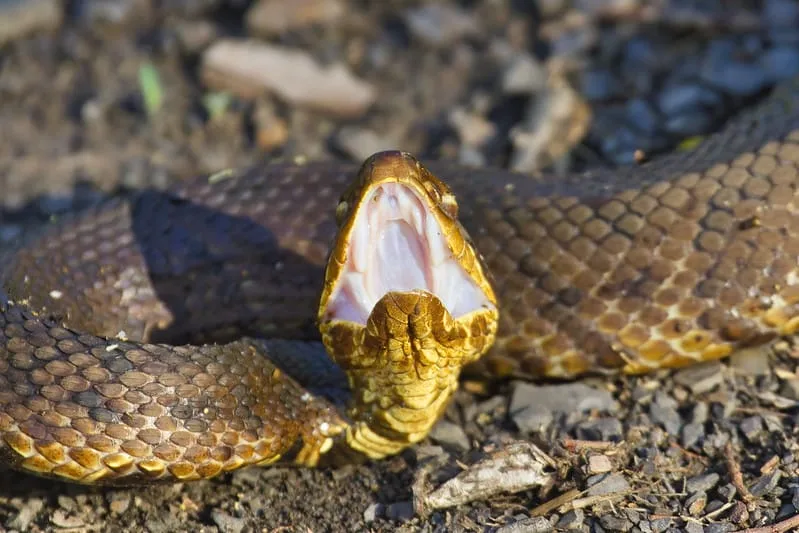
Image source: Web (Bing) / thefactbase.com (Web image (fair-use with source credit))
The Western diamondback delivers large volumes of hemotoxic venom. A bite damages tissue and blood cells. It can be fatal without treatment, though modern antivenom makes death rare.
The CDC notes that most bites happen during deliberate handling or when people try to kill the snake.
The water moccasin has a reputation for aggression. It's overstated, but it's not a snake you test either. When cornered, it opens its mouth wide and shows the white lining, then strikes.
Give it a wide berth and move slowly.
The Wagler's pit viper lives in trees across Southeast Asia. It's green, well-camouflaged, and extremely painful to encounter. Its venom causes severe swelling and tissue damage.
The universal rule is simple. If you can't positively identify a reptile as harmless, treat it as venomous. Keep at least the length of the snake between you and it.
A good rule is five feet minimum. And never, ever attempt to pick up a snake you haven't identified with certainty.
For safe distances and proper field behavior, the venomous snake safety guidelines from the American Society of Ichthyologists and Herpetologists are a solid reference.
Frequently Asked Questions
What is the most common reptile that starts with W?
The Western fence lizard is likely the most common. It lives across the western United States, from Washington down to Mexico. It's a backyard regular in California, Oregon, and Arizona.
Its blue belly patches make it easy to spot.
Are all W snakes venomous?
No. Only a handful are venomous. The Western diamondback, water moccasin, and Wagler's pit viper are the main ones.
The Western hognose, Western rat snake, and worm snake are completely harmless. The hognose even pretends to be venomous as a defense, but it's all show.
What is the difference between a worm snake and a blind snake?
Worm snakes belong to the family Colubridae and have small but functional eyes. They're found across the eastern United States. Blind snakes belong to the family Typhlopidae and have eyes reduced to dark spots.
They mainly live in tropical and subtropical regions.
Can you keep a Western hognose snake as a pet?
Yes, and many people do. Western hognose snakes are popular pets because of their small size, usually 15 to 33 inches, and their dramatic defensive displays. They eat toads in the wild, so captive ones need a specialized diet of rodents scented with toad or lizard material.
How can I tell a water moccasin from a water snake?
Check the head and behavior. Water moccasins have a blocky head wider than their neck and swim with their head held up. Water snakes are slimmer and dive when scared.
A moccasin that feels cornered opens its mouth to show the white interior.
Final Verdict: Your Next Step in Herping
You now have the tools to identify the W reptiles you'll encounter. Start with the habitat, then the head, then the pattern. Take photos and compare before you conclude anything.
The most important takeaway is respect. A handful of these species are venomous. Treat every unidentified reptile carefully.
Keep your distance, snap your photos, and let the animal go about its day.
If you find yourself enjoying alphabet-style animal learning, the letter S mammal guide is a fun follow-up. And for more reptile fun, check out the reptiles starting with A list.
Get outside. Herping is one of the most rewarding hobbies out there. The W section is just the beginning.
Key Identifiers: Lizards, Skinks, and Geckos That Start with W
The W lizards are easier to spot than snakes. The Western fence lizard has spiny scales and bright blue belly patches. Males flash them in push-up displays.
The Western skink is smooth and shiny, with a blue tail as a juvenile. Western whiptails are slim, fast runners. Common wall lizards climb fences in urban areas.
Turtles and Crocodilians That Start with W
Wood turtles have heavily sculpted shells that look like carved wood. They wander through forests and meadows near water. Western pond turtles stay close to ponds and lakes.
They have dark shells with yellow marks on the neck. The West African slender-snouted crocodile is fish-eating and critically endangered.
Common Visual Mistakes (and How to Avoid Them)
Don't identify by color alone. Many snakes change color as they age. Don't trust head shape too quickly either.
Water snakes flatten their heads when scared. That trick mimics pit vipers. Never kill a snake to identify it.
Back off, photograph, and walk away.
Quick Reference Table: W Reptiles at a Glance
| Species | Type | Venomous? | Key Feature |
|---|---|---|---|
| Western diamondback | Snake | Yes | Rattle, diamond pattern |
| Water moccasin | Snake | Yes | White mouth lining |
| Western hognose | Snake | No | Upturned snout |
| Worm snake | Snake | No | Tiny, shiny, burrowing |
| Western fence lizard | Lizard | No | Blue belly patches |
| Wood turtle | Turtle | No | Sculpted shell |
Finding "W" Reptiles in the Wild: Where and When to Look
Spring is the best season. March through May, reptiles bask in open spots while warming up. Early morning and late afternoon beat midday heat every time.
Wet years mean more reptiles. Dry years concentrate them near water sources. Check rock piles, logs, and pond edges first.
Those are the highest-activity zones.
Photographing "W" Reptiles for Identification
Back away and use zoom. Capture the full body, a head close-up, and the tail. Include the habitat in frame.
For turtles, photograph the shell top and bottom.
Safety First: Venomous "W" Species You Must Respect
Treat every unidentified snake as venomous. The Western diamondback, water moccasin, and Wagler's pit viper require serious distance. Keep at least five feet away.
Never handle a snake you can't name with certainty.
Image source: Web (Bing) / thefactbase.com (Web image (fair-use with source credit))
FAQs About Reptiles That Start with W
What is the most common reptile that starts with W?
The Western fence lizard. It lives across the western US and has bright blue belly patches.
Are all W snakes venomous?
No. Most are harmless. Only the diamondback, moccasin, and Wagler's pit viper carry venom.
Can you keep a Western hognose snake as a pet?
Yes. They're small, usually under 33 inches, and popular among reptile keepers.
Final Verdict: Your Next Step in Herping
Start with habitat, then head shape, then pattern. Take photos and compare. Respect every unidentified reptile.
Now get outside and explore.