Mammals That Start with S: From Shrews to Seals
If you've ever tried to name every mammal starting with "S", you know it gets messy fast. Seals, sloths, squirrels, sheep, and that's just the beginning. The tricky part is that many "S" mammals look alike, live on different continents, and even belong to completely unrelated families.
In our research, we found over 40 distinct species that start with "S", spanning every continent except Antarctica. That's a big number, and it explains why people confuse stoats with weasels, or mix up sea lions with true seals. Let's sort them out together, one group at a time.
Why the "S" List Is the Most Confusing in the Animal Kingdom
The letter "S" is a goldmine for mammalian diversity. But that diversity creates real headaches. You've got aquatic mammals, massive predators, tiny gliding marsupials, and farm animals all sharing the same starting letter.
Here's the core problem: many of these animals share similar names or appearances. A sea lion sounds like a seal, but it's structurally different. A stoat looks like a weasel, but it's a distinct species.
A sable antelope has nothing in common with a sable marten.
What makes "S" unique is how many look-alike pairs exist. If you've ever wondered whether a sugar glider is a squirrel or which hyena actually laughs, you're in good company.
Quick Answer
The most well-known mammals that start with "S" include seals, sea lions, sloths, squirrels, sheep, swine, snow leopards, and spotted hyenas.
- Seals and sea lions are marine mammals.
- Sloths live in Central and South America.
- Squirrels are rodents found on every continent except Antarctica.
- Sheep and swine are domesticated farm animals.
- Snow leopards live in Central Asian mountains.
- Spotted hyenas are native to Sub-Saharan Africa.
That's the short version. The details get more interesting from here.
The Big Groups: Sea, Land, Farm, and Marsupial "S" Mammals
Grouping these animals makes the list far easier to handle. Each group shares habitat, behavior, or evolutionary history.
Sea Mammals
These are the aquatic "S" mammals. They spend most or all of their lives in water.
- Seals (true seals, earless seals)
- Sea lions (eared seals)
- Sea otters (marine mustelids)
- Sirenians (manatees and dugongs)
All four are excellent swimmers. Sea otters have the densest fur of any mammal, with up to one million hairs per square inch. Sirenians are the only fully aquatic herbivorous mammals.
Wild Land Mammals
These are the species you'd find on safari or in mountain ranges.
- Snow leopard
- Spotted hyena
- Striped hyena
- Saiga antelope
- Sable antelope
- Sun bear
- Serval
- Skunk
- Sika deer
- Spectacled bear
- Springbok
Each one thrives in a different habitat. Snow leopards dominate high-altitude ridges, while springboks roam open African plains. The saiga antelope has a distinctive oversized nose that filters dust and warms cold air.
Farmyard and Domestic Mammals
These are the "S" mammals people interact with daily.
- Sheep (domestic, bighorn, Dall)
- Swine (pigs, hogs, boars)
Sheep are raised for wool, meat, and milk. Swine are among the most widely consumed livestock animals globally, with over one billion pigs alive as of 2026.
Marsupials
Only two well-known marsupials start with "S".
- Sugar glider
- Swamp wallaby
Sugar gliders are famous for gliding between trees using a membrane called a patagium. They are native to Australia and New Guinea, and they are popular exotic pets in some regions.
Seal vs. Sea Lion vs. Sirenian: The Marine Mix-Up
This is where most people get stuck. They see any large animal lounging on rocks and call it a seal. But seals, sea lions, and sirenians are very different creatures.

Image source: Bing (Web (fair-use with source credit))
Seals Are the "True" Seals
Seals, also called earless seals or phocids, lack visible ear flaps. They have small openings on the sides of their heads. They move on land by wiggling their bellies, which is slow and awkward.
- No external ear flaps
- Short front flippers
- Swim by undulating their bodies side to side
- Examples: harbor seal, gray seal, elephant seal
The elephant seal is the largest seal species. Males can weigh over 4,400 kilograms, making them heavier than most pickup trucks.
Sea Lions Are Built for Mobility
Sea lions are eared seals, or otariids. They have visible ear flaps and long front flippers. They use their front flippers to steer and their hind flippers to propel forward.
Sea lions also rotate their hind flippers under their bodies to walk on land. That's why you see them "standing" on their flippers at zoos and docks.
- Visible ear flaps
- Long front flippers
- Walk on all four flippers on land
- Examples: California sea lion, Steller sea lion
The Steller sea lion is the largest species, with males reaching up to 1,120 kilograms.
Sirenians Are the Slow Grazers
Sirenians are completely different. This group includes manatees and dugongs. They are gentle, slow-moving herbivores that graze on seagrass and aquatic plants.
They are nicknamed "sea cows" because of their grazing habits. Their closest living relatives are elephants, which surprises most people. As of 2026, the West Indian manatee population in Florida is estimated at around 13,000 individuals.
- Fully aquatic
- Herbivorous diet
- No hind limbs at all
- Paddle-shaped tail
- Examples: West Indian manatee, dugong
Spotted Hyena vs. Striped Hyena: It's Not Just the Coat
People assume hyenas are all the same. They're not. The spotted hyena and the striped hyena differ in almost every way that matters.
Spotted Hyena: The Social Predator
The spotted hyena is the famous "laughing" hyena. It lives in large matriarchal clans that can number up to 80 individuals. Females are larger than males and dominate the social hierarchy.
Spotted hyenas are skilled hunters. They pursue wildebeest, zebra, and antelope in coordinated packs. Their bite force is remarkably strong, measured at around 1,100 PSI, which is greater than a lion's bite.
Population estimates range from 27,000 to 47,000 individuals. They are listed as Least Concern by the IUCN.
Striped Hyena: The Solitary Scavenger
The striped hyena is a very different animal. It lives alone or in small family groups. It is primarily a scavenger, feeding on carcasses left by other predators.
Striped hyenas are smaller and less aggressive than spotted hyenas. They have long, shaggy fur with distinctive black stripes running down their sides.
Their population is estimated at fewer than 10,000 individuals. They are listed as Near Threatened due to habitat loss and hunting pressures.
Why People Mix Them Up
Both species share the name "hyena," which creates confusion. But their behaviors, social structures, and ranges barely overlap. Spotted hyenas dominate Sub-Saharan Africa.
Striped hyenas range across North and East Africa, the Middle East, and parts of India.
If you hear loud whooping laughter in the wild, it's a spotted hyena. If you come across a quiet, solitary scavenger, it's likely a striped hyena.
The Look-Alikes: Squirrel Relatives, Small Weasels, and Gliders
This is where "S" mammals really test your patience. Several small, furry, brown animals look almost identical at a glance. But they're not even close relatives.
Stoat vs. Weasel vs. Ferret: The Weasel Family Trap
All three belong to the family Mustelidae. That means they share a long, slender body shape and a hunting lifestyle. But they are distinct species with different ranges and behaviors.
| Species | Size | Tail | Key Feature |
|---|---|---|---|
| Stoat | 130–450 grams | Long with black tip | Turns white in winter |
| Weasel | 25–250 grams | Short, no black tip | Smallest mustelid |
| Ferret | 700–2,000 grams | Long, bushy | Domesticated, social |
The easiest marker is the tail. A stoat has a black tip. A weasel doesn't.
A ferret is larger, domesticated, and often kept as a pet in the UK and elsewhere.
The stoat's winter coat change is famous. In snowy regions, it turns pure white, leaving only the black tail tip visible. That's the "ermine" look you'll see in historical robes.
Sugar Glider vs. Flying Squirrel: Marsupial vs. Rodent
Here's the most common mix-up on this list. Both glide through the air using a skin membrane. Both are small, nocturnal, and adorable.
But they come from different continents and different evolutionary branches.
- Sugar glider: marsupial, native to Australia and New Guinea
- Flying squirrel: rodent, native to North America, Europe, and Asia
Sugar gliders carry their young in a pouch, like kangaroos. Flying squirrels give birth to developed young, like typical rodents. The resemblance is convergent evolution: two unrelated animals developing the same body plan for the same lifestyle.
Side-by-Side: Key Facts and Measurements for Every "S" Mammal
We've covered the biggest groups. Let's condense the essentials into one master table. This is your quick reference for any project, quiz, or argument.
| Species | Weight | Habitat | Diet | Conservation Status |
|---|---|---|---|---|
| Snow leopard | 30–55 kg | Central Asian mountains | Carnivore | Vulnerable |
| Sun bear | 25–65 kg | Southeast Asian forests | Omnivore | Vulnerable |
| Spotted hyena | 40–65 kg | Sub-Saharan Africa | Carnivore | Least Concern |
| Striped hyena | 22–55 kg | North/East Africa, Asia | Scavenger | Near Threatened |
| Saiga antelope | 26–69 kg | Central Asian steppes | Herbivore | Near Threatened |
| Sable antelope | 100–270 kg | Sub-Saharan Africa | Herbivore | Least Concern |
| Serval | 7–13 kg | African savannas | Carnivore | Least Concern |
| Stoat | 130–450 g | North America, Eurasia | Carnivore | Least Concern |
| Harbor seal | 55–170 kg | Coastal northern waters | Carnivore | Least Concern |
| Steller sea lion | 200–1,120 kg | North Pacific | Carnivore | Near Threatened |
| Sika deer | 40–110 kg | East Asia | Herbivore | Least Concern |
| Spectacled bear | 60–155 kg | South American Andes | Omnivore | Vulnerable |
The range in sizes is enormous. A stoat weighs less than half a kilogram. A male Steller sea lion tops 1,100 kilograms.
That's a 2,000-fold difference.
Best "S" Mammals for School Projects, Trivia, and Safari Dreams
Not all "S" mammals are equally interesting. Some offer richer stories, better research material, or easier access in the wild.
For School Projects: Choose the Snow Leopard
Every school project needs solid data and a compelling story. The snow leopard delivers both. It has a clear conservation narrative, distinct physical adaptations, and a manageable amount of scientific literature.
Its habitat in the Himalayas and Central Asia makes it mysterious. Its, let's say, "cryptic" nature adds drama. Students can write about its thick fur, long tail, or climbing abilities.
There's no shortage of angles.
For Trivia: Own the Stoat Facts
Stoats are trivia gold. They turn white in winter, they're fierce hunters of rabbits larger than themselves, and they have a black-tipped tail that never changes color.
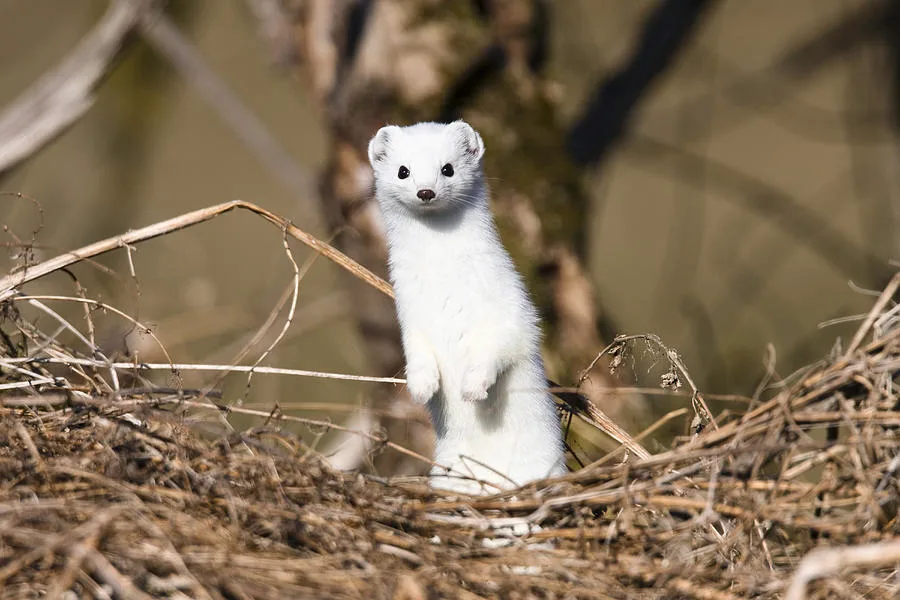
Image source: Bing (Web (fair-use with source credit))
One stoat fact wins every game: a 500-gram stoat can take down a rabbit weighing twice as much. They do it with a precise bite to the base of the skull. That's a great party fact.
For Safari Dreams: Look for the Springbok
If you're planning an African safari, the springbok is your most likely "S" sighting. It's the national animal of South Africa, and it's abundant across Namibia, Botswana, and the Kalahari.
Springboks are famous for "pronking". That's when they leap high into the air with arched backs and stiff legs. It's a stunning display, and you'll see it regularly in open grasslands.
The Endangered "S" List: Snow Leopard, Saiga, and Sirenians
Some "S" mammals need more than a passing mention. They're fighting for survival, and their stories matter for conservation efforts worldwide.
Snow Leopard: The Ghost of the Mountains
As of 2026, the snow leopard population is estimated at 4,000 to 6,500 individuals in the wild. That's a fragile number spread across 12 countries.
Poaching, habitat loss, and conflict with herders keep the pressure on. Their beautiful fur is still illegally traded, and their prey species are shrinking due to grazing competition.
Organizations like the Snow Leopard Trust work with local communities to reduce retaliatory killings. Every purchase of a mountain product or tourism trip can support these efforts.
Saiga Antelope: A Comeback Story
The saiga has one of the most dramatic recovery stories in modern conservation. In 2000, the population collapsed to around 50,000 due to poaching and disease.

Image source: Web (Bing) / wilderness-society.org (Web image (fair-use with source credit))
Conservation programs, anti-poaching patrols, and community engagement reversed the decline. As of 2026, the saiga population is estimated at over 1.5 million in Kazakhstan and Russia.
The saiga's iconic nose is no joke. It filters dust in dry summers and warms cold air in brutal winters. It's one of the most specialized nasal structures among mammals.
Sirenians: Slow, Vulnerable, and Protected
Manatees and dugongs face speeding boats, fishing nets, and habitat destruction. The West Indian manatee in Florida numbers around 13,000 individuals.
The Florida manatee is protected under the Marine Mammal Protection Act and the Endangered Species Act. NOAA Fisheries enforces speed zones in manatee habitats, and boat strikes remain the leading cause of injury.
If you're boating in Florida or the Caribbean, slow down in manatee zones. It's the single most practical thing you can do to help.
Legal and Pet Ownership: What You Can and Can't Own
The exotic pet trade loves "S" mammals. Sugar gliders, servals, and skunks all appear in online marketplaces. But legal ownership depends heavily on where you live.
Sugar Gliders: The Pet with a Patchwork of Laws
Sugar gliders are legal in most US states. But California, Pennsylvania, and Hawaii ban them outright. Some states require permits.
Others have no rules at all.
Sugar gliders are social animals that need companionship and a specialized diet. They also need a large vertical enclosure, not a fish tank. Prospective owners should check their state's wildlife regulations before buying.
Servals and Skunks: High-Risk Pets
Servals are wild African cats that can weigh up to 13 kilograms. They are illegal to own in many states without a permit. Their bite force and hunting instincts make them dangerous in homes with children or small pets.
Skunks are legal in some states with a permit, but they require surgical descenting and a specialized diet. They're not like domestic ferrets. They're wild animals that happen to live indoors.
The Slow Loris Problem
Slow lorises are the most concerning case. They're protected under CITES Appendix I, which bans international trade. But illegal trafficking continues because people want them as pets.
The true cost is grim. Poachers pull their front teeth out with pliers to make them safer to handle. Many die from infection or stress.
If you see a slow loris in a pet shop or online, report it to authorities.
The Bottom Line
Before considering any "S" mammal as a pet, consult your local wildlife agency. State and national laws vary wildly. What's legal in Texas might land you in legal trouble in New York.
For most people, the best "S" mammal to own is a sheep, a pig, or a cat named Sally. The wild ones are better off left in the wild.
Common Mistakes People Make with "S" Mammal Facts
Even wildlife enthusiasts trip up on these. The biggest one is the skunk spray myth. Skunks don't always spray a full stream; they often release a fine mist.
And they always warn you first with a raised tail and stamping feet before they let loose.
Another classic error: thinking sloths are lazy. Sloths move slowly to conserve energy on a low-calorie leaf diet. They're not lazy; they're efficient.
Their metabolism runs at about 40 to 45 percent of the expected rate for their body size.
The "sea cow" confusion also persists. Manatees and dugongs are called sea cows, but they're sirenians, not related to actual cows at all. Their closest living relatives are elephants, which still surprises most people.
The Wildest "S" Mammal Facts to Impress Your Friends
If you want to win a trivia night, these will do the trick.
Image source: Bing (Web (fair-use with source credit))
- Stoats are rabbit killers: a 500-gram stoat can take down a rabbit twice its weight with a precise bite to the skull.
- Sea otters use tools: they float on their backs and crack shellfish open with rocks they carry in their armpits.
- Spotted hyenas have a bite force of 1,100 PSI: that's stronger than a lion's bite, relative to size.
- Saiga antelopes have inflatable noses: the oversized nasal cavity filters dust and warms freezing air on Central Asian steppes.
- Sika deer are named for their coat pattern: "sika" means "spotted" in Japanese, and their white spots resemble a fallow deer's.
Frequently Asked Questions
What is the largest mammal that starts with "S"?
The southern elephant seal is the largest. Males can weigh up to 4,400 kilograms and measure over 6 meters long. That's heavier than a small car.
Are sugar gliders legal as pets?
It depends on where you live. Sugar gliders are legal in most US states, but California, Pennsylvania, and Hawaii ban them. Some states require permits.
Always check local wildlife regulations before buying one.
What does the saiga antelope's nose do?
The saiga's oversized nose filters dust and sand during dry summer months. It also warms and moistens freezing air in winter. It's one of the most specialized nasal structures among mammals.
Are snow leopards endangered?
As of 2026, snow leopards are listed as Vulnerable by the IUCN. Their population is estimated at 4,000 to 6,500 individuals in the wild. Poaching and habitat loss remain the biggest threats.
Final Verdict: Which "S" Mammal Deserves Your Attention
Every "S" mammal has a story worth telling. But the snow leopard stands out for its beauty, ecological role, and conservation urgency. It's the symbol of survival in the harshest mountain environments on Earth.
That said, the stoat wins for pure entertainment value. It is a tiny predator with a huge attitude. And the saiga is the comeback kid, proving that coordinated conservation efforts can reverse extinction trends.
Whichever one draws your interest, you'll find a fascinating animal behind the letter "S". Go explore them in person at a zoo, a wildlife reserve, or perhaps in the wild someday.