Mammals That Start with P: Platypus to Puma
If you've ever tried to name all the mammals that start with p, you probably got stuck after panda and platypus. That's normal. Most people can rattle off two or three before drawing a blank, then they end up down a Wikipedia rabbit hole for an hour.
We've done the digging for you.
The truth is, the "P" list is surprisingly deep. It includes the fastest land mammal in North America, a venomous egg-layer, and a cat that isn't actually a panther at all. As of 2026, conservation groups track over a dozen distinct species in this group, several of them endangered.
Let's break down the full list, clear up the confusion, and give you the facts that actually matter.

Image source: Bing (Web (fair-use with source credit))
Quick Answer
The mammals that start with p include the panda, polar bear, panther, puma, pig, porcupine, platypus, possum, opossum, pronghorn, pika, pony, paca, patas monkey, proboscis monkey, Pallas's cat, and pygmy hippopotamus. Some are well-known. Others will surprise you.
Keep reading for the details on each one.
How to Use This Guide (Why Visuals Matter for Identification)
Here's the thing about mammal identification: names lie. The "panther" isn't a species. The "puma" has over 40 common names.
And the "possum" you see in your backyard might not be a possum at all. That's why this guide leans heavily on visual cues rather than just names.
When you're trying to identify an animal, the first thing to look at is body shape. Is it round and low to the ground like a paca? Long and sleek like a patas monkey?
Big and bulky like a polar bear? Shape alone can eliminate half the list. Next, check the fur pattern and color.
A giant panda's black-and-white markings are unmistakable. A Pallas's cat has that flat-faced, grumpy expression you can't confuse with anything else. Finally, look at the habitat.
Where you spot the animal matters as much as what it looks like.
We've also covered similar ground with our other alphabet lists if you want to compare animals across letters. Our animals starting with C guide covers cheetahs and crabs, and the A-list starting with A begins with the aardvark and axolotl. They're handy references when you're building a full alphabet of animal knowledge.
The Big Names: Panthers, Pandas, and Polar Bears
These are the heavy hitters. Most people can name at least one of these three, but the details often get muddled. Let's sort out the facts.
Giant Panda: More Than Just Black and White
The giant panda is technically a bear, and it's one of the most recognizable animals on the planet. Those black patches around the eyes aren't just for looks. Researchers believe they help pandas recognize each other and possibly signal aggression.
Their diet is almost entirely bamboo, which is odd for a bear. They eat anywhere from 26 to 84 pounds of it daily.
Pandas are native to central China, specifically the mountain ranges in Sichuan, Shaanxi, and Gansu provinces. As of 2026, the International Union for Conservation of Nature (IUCN) classifies them as vulnerable rather than endangered, which is genuinely good news. Wild populations have rebounded to around 1,800 individuals, thanks to decades of habitat protection and breeding programs.
When you see a panda in a zoo, you're looking at an ambassador for one of the more successful conservation stories of the last fifty years.
Polar Bear: The Arctic Apex Predator
Polar bears are the largest land carnivores on Earth. Adult males can weigh anywhere from 900 to 1,600 pounds, and they stand up to 10 feet tall on their hind legs. Here's a fun fact that surprises most people: their fur isn't actually white.
Each hair is translucent and hollow, which scatters and reflects visible light, making the bear appear white. Their skin underneath is black to absorb heat.
These bears live exclusively in the Arctic, spending most of their time on sea ice where they hunt seals. Climate change has made sea ice less reliable, which directly threatens their hunting grounds. The IUCN lists them as vulnerable.
According to the US Fish and Wildlife Service, polar bears are protected under the Endangered Species Act, and their long-term survival depends on addressing habitat loss.
Panther vs. Puma vs. Cougar: Clearing Up the Confusion
This is where things get messy. The word "panther" technically refers to any big cat in the Panthera genus, which includes lions, tigers, leopards, and jaguars. But colloquially, people use it to mean a black leopard or a black jaguar.
That dark coloring comes from a genetic mutation called melanism, and it's rare. Here's the kicker: a "black panther" isn't a separate species.
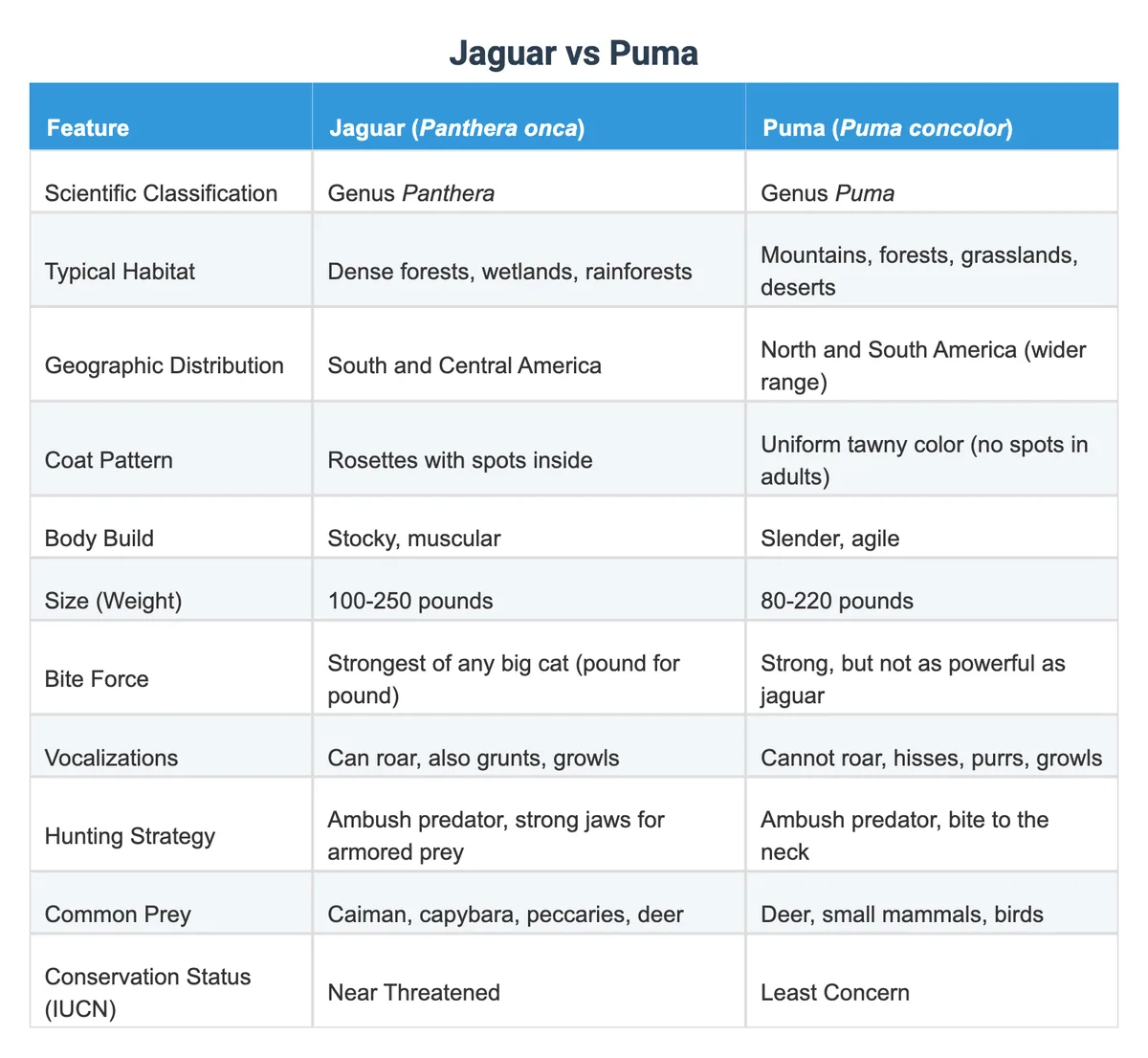
Image source: Web (Bing) / difbetween.com (Web image (fair-use with source credit))
Now for the puma. The puma, also called cougar, mountain lion, or catamount, is a completely different animal. It's in the genus Puma, not Panthera, so it's not technically a panther at all.
Pumas are native to the Americas, ranging from Canada down to Patagonia. They're large cats, but they can't roar like lions or tigers. Instead, they make a screeching scream that has to be heard to be believed.
To compare them directly with jaguars, your best bet is a side-by-side visual. The jaguar is stockier with rosette spots, while the puma is leaner with a uniformly tawny coat.
| Feature | Puma (Cougar) | Jaguar |
|---|---|---|
| Genus | Puma | Panthera |
| Coat pattern | Solid tan/brown | Rosettes with spots |
| Build | Lean, long body | Stocky, muscular |
| Roaring ability | No (screams) | Yes (roars) |
| Range | Americas | South & Central America, historically US Southwest |
The Oddballs: Monotremes and Marsupials
If you want to impress people at trivia night, this is your section. The mammals that start with p include some of the strangest creatures in the animal kingdom.
Platypus: The Egg-Laying Venomous Wonder
The platypus looks like a prank. It has a duck's bill, a beaver's tail, and webbed feet, and it lays eggs. That combination makes it a monotreme, one of only five mammal species that reproduce by laying eggs instead of giving birth.
The echidna is its closest relative.

Image source: Web (Bing) / naturepl.com (Web image (fair-use with source credit))
Here's the part that really gets people. Male platypuses have a spur on their hind feet that delivers venom. It's not lethal to humans, but it causes intense pain that can last for weeks.
The venom contains defensin-like proteins that aren't found in any other mammal. If you ever see a platypus in the wild, which only happens in eastern Australia, give it space. Those spurs are no joke.
The platypus also has a sixth sense. Its bill is covered in electroreceptors that detect the electrical signals given off by prey. When it dives underwater, it closes its eyes and ears and navigates entirely by detecting these tiny electric fields.
It's essentially a mammal with a built-in metal detector.
Possum vs. Opossum: Two Different Animals, One Confusing Name
This mix-up is one of the most common in animal identification. The short version: if you're in North America, you're looking at an opossum. If you're in Australia or New Zealand, you're looking at a possum.
They're different animals with different appearances and different behaviors.
The Virginia opossum is the only marsupial native to North America. It has a white face, a pointed snout, and a bare, rat-like tail. When threatened, it famously plays dead, which is where the phrase "playing possum" comes from.
That involuntary reaction is actually an involuntary comatose state that can last from a few minutes to a few hours.

Image source: Bing (Web (fair-use with source credit))
Australian possums are a different family entirely. The common brushtail possum is furry, with a bushy tail and pointier ears. It's more closely related to kangaroos than to the Virginia opossum.
If you see photos of the two side by side, the differences are obvious. The opossum looks like a large rat with a white face. The possum looks like a fluffy cat with a long tail.
They diverged evolutionarily millions of years ago, and they ended up on opposite sides of the planet.
Spikes, Hooves, and Speedy Herbivores
Not every "P" mammal is a predator or a weird egg-layer. This group includes some of the most specialized herbivores on Earth.
Porcupine: The Rodent With 30,000 Quills
Porcupines are the third-largest rodents in the world, behind capybaras and beavers. They're covered in about 30,000 quills, which are actually modified hairs made of keratin. The quills lie flat until the porcupine feels threatened, then they raise.
Contrary to popular belief, porcupines can't shoot their quills. That's a myth. Instead, the quills detach easily upon contact, and the barbs on the tips make them painful to remove.
You'll find porcupines in the Americas, from Canada down to Argentina. The North American porcupine tends to live in forests and spend time in trees. The African crested porcupine is terrestrial and lives in burrows.
Both are herbivores, and they have one thing in common: an appetite for salt. They'll chew on anything that has trace minerals, including tool handles, plywood, and even car tires. That salty habit causes no end of property damage, but it also means porcupines play a role in nutrient cycling in their ecosystems.
Pronghorn: The Fastest Land Mammal in North America
The pronghorn is a living fossil. It's the only surviving member of the Antilocapridae family, and it's been racing across North American grasslands for about a million years. It's also seriously fast.
Pronghorns can sprint up to 55 miles per hour, making them the second-fastest land animal in the world, right behind the cheetah. But here's the twist: they can hold that speed for much longer than a cheetah can. They're endurance sprinters, and they can run at 30 to 40 miles per hour for miles.
Their name comes from their horns, which are unique among hoofed mammals. Each horn has a bony core with a sheath that branches into a forward prong. Pronghorns shed the sheath annually and grow a new one.
Unlike deer antlers, which are solid bone and shed entirely, pronghorn horns are permanent structures with a replaceable outer layer.
Pika: The Small Mountain Relative of Rabbits
Pikas are the smallest mammals on this list, and they're absolutely worth knowing. They're in the same order as rabbits and hares, but they look more like a tiny hamster with round ears. They live in rocky slopes and talus fields in the mountains of western North America and Asia.
If you've ever hiked above the treeline and heard a short, high-pitched squeak, you were probably hearing a pika warning its neighbors about your presence.
What makes pikas fascinating is their relationship with temperature. They have thick fur and a high metabolism, which means they can't tolerate heat. In fact, pikas can die if exposed to temperatures above 78°F for more than a couple of hours.
That makes them sensitive indicators of climate change. As alpine temperatures rise, pika habitats shrink, and populations at lower elevations have already disappeared. It's one of those subtle, quiet extinctions happening a few yards at a time.