Rare & Wonderful Mammals That Start With R
If you've ever found yourself stuck on an alphabetical animal list, you know the letters get tricky fast. Once you pass the easy ones like "A" for aardvark and "B" for bear, "R" suddenly feels like a wall. But here's the thing: mammals that start with r are actually plentiful, surprising, and some of the most fascinating creatures on the planet.
Our research pulled together 76 recognized species that fit this category, ranging from the massive white rhinoceros at over 2,300 kilograms to the tiny royal antelope that weighs barely two. Some you'll know instantly. Others will genuinely surprise you.
Let's walk through the full list, clear up some common mix-ups, and give you the facts that actually matter for identification, trivia, and conservation awareness.
Quick Answer
The most well-known mammals that start with r include the raccoon, rat, reindeer, rhinoceros, red fox, red panda, red kangaroo, ring-tailed lemur, ruffed lemur, and rhesus macaque. Less common ones include the ribbon seal, rock hyrax, Risso's dolphin, Reeves's muntjac, and red river hog. Several species use "red" as a descriptor, which creates naming overlap across different families.
Total confirmed species count reaches roughly 76 when including subspecies and regional variants.
Raccoons and Their Relatives: More Than Just Trash Pandas
Raccoons belong to the family Procyonidae, which includes coatis, ringtails, and kinkajous. The common raccoon (Procyon lotor) is native to North America but has spread across Europe and Asia as an invasive species. Its close cousin, the crab-eating raccoon (Procyon cancrivorus), lives throughout Central and South America and prefers wetland habitats.
The raccoon dog deserves special mention here because it creates endless confusion. Despite looking like a raccoon with its facial mask and thick fur, the raccoon dog is actually a canid, meaning it's more closely related to foxes and wolves. Native to East Asia, it has established wild populations in Scandinavia and Eastern Europe.
If you spot one in the wild, the tail is your giveaway: raccoon dogs have shorter, bushier tails without the distinctive black rings.
Key Raccoon Family Members
- Common Raccoon: North America, highly adaptable to urban environments
- Crab-Eating Raccoon: South America, prefers swamps and mangrove forests
- White-Nosed Coati: Central and South America, long snout and ringed tail
- Ringtail: Southwestern US and Mexico, sometimes called the "miner's cat"
- Kinkajou: Tropical Americas, arboreal with a prehensile tail
Raccoons are famously intelligent. Studies using puzzle boxes show they can remember solutions for up to three years. That behavioral flexibility explains why they thrive in cities across North America, often denning in attics and chimney flues.
If you're dealing with one on your property, the humane approach is exclusion rather than trapping.

Image source: Web (Bing) / animalia-life.club (Web image (fair-use with source credit))
The red panda also belongs here historically, though taxonomists have moved it into its own family, Ailuridae. It shares the raccoon's tree-climbing ability and masked face but diverged genetically millions of years ago. We'll cover the red panda in detail later in this guide.
Rhinoceroses: Five Species, One Critical Story
Rhinoceroses are among the largest land mammals alive today, but they're also among the most endangered. Five species remain: white, black, Indian, Sumatran, and Javan. The name comes from Greek roots "rhino" meaning nose and "ceros" meaning horn, a fitting description for their most distinctive feature.
The white rhinoceros and black rhinoceros aren't actually different colors. Both are gray. The "white" name likely comes from the Afrikaans word "wyd" meaning wide, describing the animal's broad, square lips adapted for grazing.
Black rhinos have pointed, prehensile lips for browsing leaves and twigs from bushes. That feeding difference is the easiest way to distinguish them in the wild.
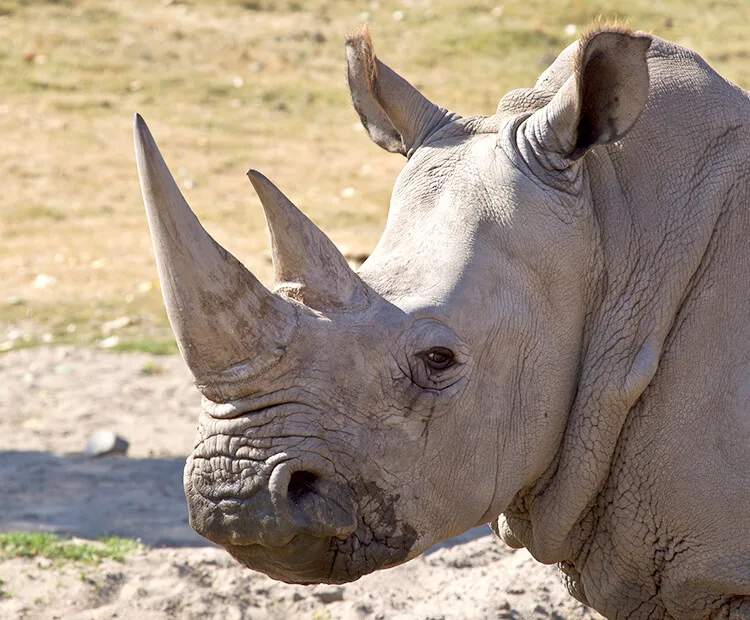
Image source: Web (Bing) / sdzwildlifeexplorers.org (Web image (fair-use with source credit))
Quick Species Comparison
| Species | Location | Weight Range | Population Status |
|---|---|---|---|
| White Rhino | Southern Africa | 1,600–2,300 kg | Near Threatened |
| Black Rhino | Eastern & Southern Africa | 800–1,400 kg | Critically Endangered |
| Indian Rhino | Nepal, Assam | 1,600–2,200 kg | Vulnerable |
| Sumatran Rhino | Sumatra, Borneo | 500–800 kg | Critically Endangered |
| Javan Rhino | Ujung Kulon, Java | 900–2,300 kg | Critically Endangered |
The Javan rhino is the rarest large mammal on Earth. As of 2026, fewer than 70 individuals survive, all confined to a single national park in Indonesia. The Sumatran rhino faces similar pressure with roughly 80 animals left in fragmented populations.
Poaching for keratin horns drives much of the decline, despite international trade bans under CITES.
Rhino horns grow continuously throughout the animal's life, about 6 to 7 centimeters per year. They're made of keratin, the same protein found in human hair and fingernails. The largest recorded horn reached 158 centimeters long on a white rhino.
That's taller than most adult humans.
Reindeer and Caribou: Same Animal, Two Names
Here's a fun fact that trips people up constantly: reindeer and caribou are the same species, Rangifer tarandus. The distinction is purely geographic and linguistic. In North America, wild populations are called caribou.
In Europe and Asia, and for domesticated herds, they're called reindeer. Same animal, different regional terminology.
Reindeer hold the unique distinction of being the only deer species where both males and females grow antlers. Male antlers can reach 135 centimeters in length and weigh up to 12 kilograms. Females keep their antlers through winter, which helps them compete for food in the snow.
Males shed theirs after the autumn mating season.
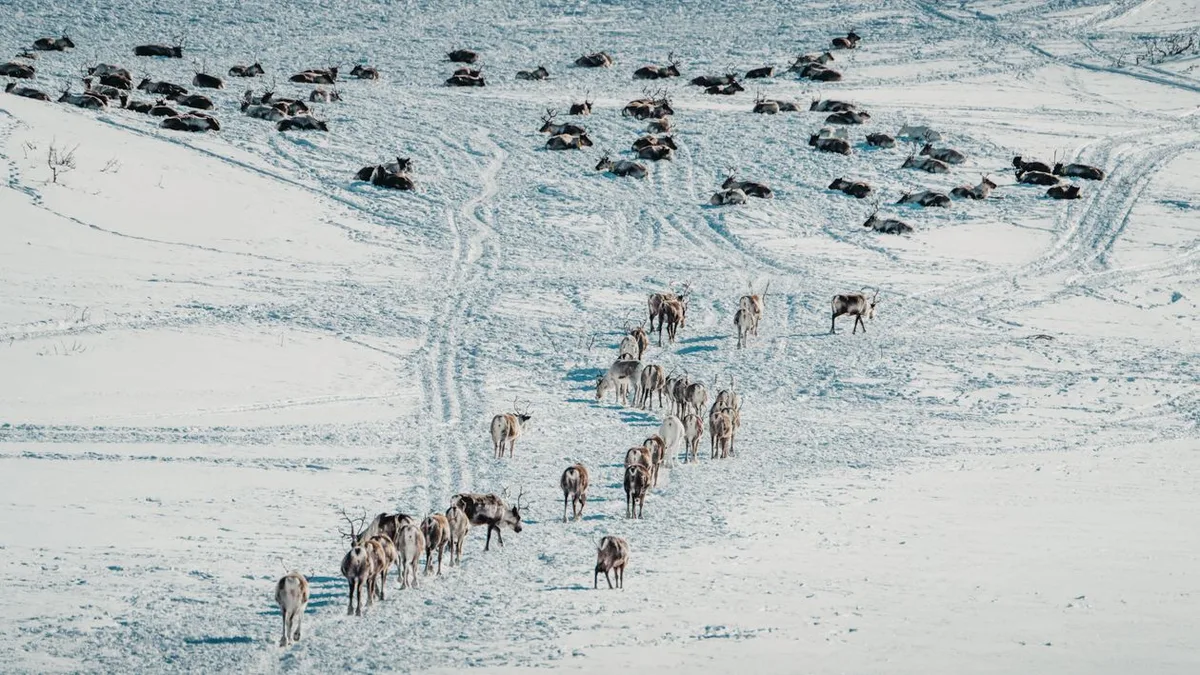
Image source: Web (Bing) / pexels.com (Web image (fair-use with source credit))
What really sets reindeer apart is their migration. The Porcupine caribou herd in Alaska and Canada travels over 800 kilometers each year, one of the longest terrestrial migrations on Earth. They cover this ground at speeds up to 80 kilometers per hour when fleeing predators.
Their hooves adapt seasonally, developing soft pads in summer for traction on tundra and hard rim edges in winter for cutting through ice and snow.
Arctic and sub-Arctic regions host about 7 million wild reindeer and caribou combined. Another 3 million are domesticated, primarily in Scandinavia and Russia. The Sámi people have herded reindeer for centuries, and their traditional knowledge drives modern management practices in the region.
According to the USGS Alaska Science Center, caribou populations face increasing pressure from climate change, with earlier springs throwing off the timing of calving and plant growth.
The Rodent Section: Rats, Kangaroo Rats, and Relatives
Rats top the list of R-mammals for sheer population and global distribution. The brown rat (Rattus norvegicus) and black rat (Rattus rattus) have followed human civilization across every continent except Antarctica. Brown rats prefer ground burrows and basements while black rats excel at climbing into attics and ship rigging, which is how they spread worldwide.
The term "kangaroo rat" causes immediate confusion because these animals aren't rats at all. They belong to the family Heteromyidae and are more closely related to pocket mice. Native to arid regions of North America, kangaroo rats get their name from their powerful hind legs and hopping locomotion.
They rarely drink water, deriving moisture entirely from their seed-based diet through metabolic processes.
Notable Rodent Species
- Brown Rat: weighs 300, 500 grams, grayish-brown, blunt nose
- Black Rat: smaller at 150, 250 grams, dark fur, pointed nose
- Kangaroo Rat: 35, 180 grams, long tail, enormous hind feet
- Red Squirrel: 250, 350 grams, rusty-red coat, ear tufts in winter
- Rock Cavy: 800, 1,200 grams, guinea pig relative from Brazil
Red squirrels deserve a mention here too, though they're technically in the Sciuridae family alongside chipmunks and marmots. They're distinct from gray squirrels by their smaller size, red fur, and habit of building leaf nests called dreys. In the UK, red squirrel populations have declined dramatically due to competition from invasive gray squirrels carrying squirrelpox virus.
The rock cavy rounds out this group as a lesser-known South American rodent. It lives in rocky outcrops and caves across eastern Brazil, resembling a large guinea pig with a coarse brown coat. It's classified as Least Concern by the IUCN but faces habitat fragmentation from deforestation.
Not All R-Mammals Are Rodents
- Rock Hyrax: more closely related to elephants and manatees
- Royal Antelope: the smallest antelope species, standing just 25 centimeters tall
- Red Brocket: a small deer species from Central and South America
Red Pandas, Red Foxes, and Red Kangaroos: The "Red" Crew
Three iconic "red" mammals start with the letter R, and each belongs to a completely different family tree. The red panda, red fox, and red kangaroo share nothing genetically except their common name. That overlap makes them perfect for trivia questions but confusing for casual learners.
The red panda (Ailurus fulgens) lives in the eastern Himalayas and southwestern China. It's the only living species in its family, Ailuridae, though genetic studies place it near raccoons, weasels, and skunks. Despite the name, red pandas aren't closely related to giant pandas, which belong to the bear family.
Their "false thumb" is actually an enlarged wrist bone that helps them grip bamboo stems.
Red pandas consume up to two kilograms of bamboo leaves daily, but their digestive system processes it poorly. They digest only about 24 percent of what they eat, so they need constant feeding. Their red-brown coat provides excellent camouflage among the moss-covered trees of their cloud forest habitat.
As of 2026, wild populations are estimated below 10,000 mature individuals and declining.
The red fox (Vulpes vulpes) holds the title of the most widespread carnivore on Earth. Native to the Northern Hemisphere, it now lives on every continent except Antarctica. Its adaptive success comes from opportunistic feeding habits: red foxes eat rodents, birds, insects, fruit, and human garbage with equal enthusiasm.
Red foxes are smaller than most people expect, weighing 4 to 8 kilograms with a body length under a meter. Their bushy tail, called a brush, makes up a third of their total length. The classic fire-orange coat with white chest and black legs is most common, but color morphs include silver, cross, and pure black.
The red kangaroo (Osphranter rufus) is the largest marsupial and the largest kangaroo species. Males can reach 1.8 meters tall and weigh 85 kilograms. They're built for endurance rather than speed, capable of sustaining 40 kilometers per hour over long distances while covering up to 8 meters per leap.
Red kangaroos dominate the arid and semi-arid regions of central Australia, congregating near water sources during drought.