Reptiles That Start with R: Rattlesnakes, Racers & More
When someone asks about reptiles that start with r, most people name the rattlesnake and stop there. That's understandable, because rattlesnakes are hard to forget. But the full list runs much deeper.
You get giant pythons, iridescent boas, island iguanas, and even a turtle that reshaped pet ownership in America.
Here's a concrete anchor: the reticulated python holds the record as the world's longest snake species, with verified individuals topping 23 feet. The rubber boa, by contrast, rarely reaches two feet. That size gap is exactly why "starts with R" says almost nothing about an animal's care, temperament, or danger level.
So let's sort the whole group out.

Quick Answer
Reptiles that start with r include rattlesnakes, rat snakes, racers, and reticulated pythons. Rainbow boas, rosy boas, rubber boas, and rhinoceros iguanas also qualify. Red-eared sliders round out the list.
Most are snakes and several make excellent pets. Rattlesnakes are venomous and not pets.
The Quick List: Every R-Reptile You Actually Need to Know
Here's the full lineup, from famous to genuinely obscure. Some of these are common pet-trade animals. Others you might go years without seeing in person.
- Rattlesnake (Crotalus and Sistrurus): venomous pit vipers found throughout the Americas. That rattle is a serious warning system.
- Racer (Coluber constrictor): fast, smooth-scaled, non-venomous, and constantly on the move.
- Rat Snake (Pantherophis): a climbing constrictor that loves barns and rodent-filled fences.
- Reticulated Python (Malayopython reticulatus): the longest snake in the world, native to Southeast Asia.
- Rainbow Boa (Epicrates cenchria): a South American boa with a jaw-dropping iridescent sheen.
- Rosy Boa (Lichanura trivirgata): a small, docile desert boa and one of the best beginner snakes.
- Rubber Boa (Charina bottae): a gentle, cold-tolerant snake with loose, rubbery skin. Nearly never bites.
- Rhinoceros Iguana (Cyclura cornuta): a sturdy Caribbean lizard with horn-like tubercles on its snout.
- Red-Eared Slider (Trachemys scripta elegans): the classic pet turtle with the red stripe behind each eye.
- Rough Green Snake (Opheodrys aestivus): a slim, insect-eating snake that spends its life in bushes.
- Ringneck Snake (Diadophis punctatus): a small, secretive snake with a bright yellow neck collar.
- Red-Footed Tortoise (Chelonoidis carbonarius): a medium tortoise with reddish-orange leg scales and a friendly attitude.
That's the field. We've also built alphabetical roundups for other letters on this site, covering everything from agamas to anacondas. And if you want the mammal version of this R-list, it's sitting in our archive too.
For now, let's untangle the three snakes that cause the most confusion.
Rattlesnake, Racer, and Rat Snake: The Three Most Confusing "R" Snakes
These three create the most misidentifications in herpetology circles. On paper, they're easy to separate. In the field, people mix them up constantly.
Here's how to tell them apart at a glance.

Rattlesnake
Rattlesnakes belong to the genera Crotalus and Sistrurus. As of 2026, over 30 species are recognized across the Americas. All of them are venomous pit vipers, meaning they locate warm prey using heat-sensing pits between the eye and nostril.
The rattle itself is made of interlocking keratin segments, and each shed adds a new one.
One critical detail: a rattlesnake can strike without rattling first. Basking animals stay silent. Give them space, especially in warm months when they're most active.
The western diamondback (Crotalus atrox) is the most widespread and the species most people picture when they hear the name.
Racer
The racer (Coluber constrictor) is a non-venomous speed demon. It has smooth scales, a slender body, and oversized eyes. It hunts lizards, insects, and small rodents by chasing them down rather than crushing.
It can climb, but it usually prefers open ground where it can sprint.
Racers share territory with rat snakes across much of the eastern United States. The fastest field clue is scale texture. Racers feel smooth and look shiny.
Rat snakes have weakly keeled scales, which gives a slightly rough appearance under the fingers.
Rat Snake
The rat snake (Pantherophis species) is the barn favorite. It climbs, constricts, and does a genuinely good job of reducing rodent populations around farms. The eastern ratsnake can reach six feet, making it one of the larger non-venomous snakes in North America.
Black rat snakes, yellow rat snakes, and gray rat snakes are all regional color variations of the same species.
The easiest way to separate a rat snake from a racer is the pattern. Young rat snakes carry bold blotches that fade with age. Adult black-phase animals keep a faint checkered pattern on the belly.
Racers are uniformly solid-colored top to bottom. The other trick is behavior. Rat snakes freeze and bluff when cornered.
Racers bolt. If it disappears in a blur, it was a racer.
Reticulated Python vs. Rainbow Boa vs. Rosy Boa: The Constrictor Showdown
Three big-name constrictors share the "R" slot, and they have almost nothing else in common. One is a giant with real safety implications. One is a humidity-sensitive beauty.
One is a desert dweller that almost anyone can keep. Comparing them side by side makes the differences obvious.
Reticulated Python
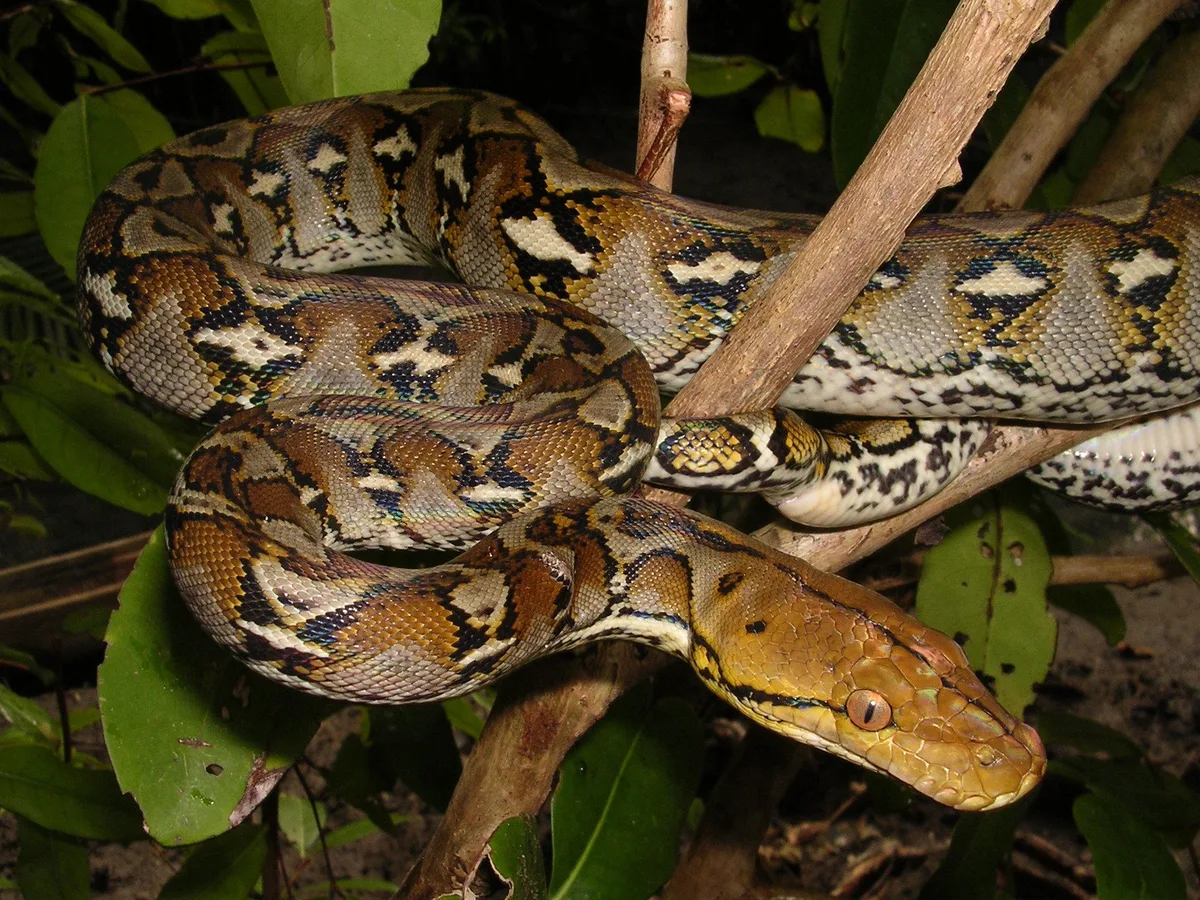
The reticulated python (Malayopython reticulatus) is the longest snake on the planet. Verified specimens exceed 23 feet, and unverified reports push past 30. That alone disqualifies it for most private keepers.
A snake that size needs a room, not a cage, and an adult can overpower a human. Several deaths and serious injuries in the pet trade tie directly to large constrictors like this one.
The pattern is unforgettable: diamond-shaped blotches with light centers arranged in a net-like geometry. That's where "reticulated" comes from, meaning net-like. As of 2026, this species also comes in a staggering range of designer morphs, which pushes prices from a few hundred dollars into the tens of thousands.
The morphs don't change the size problem. They make the snake more expensive to reach the same dangerous endpoint.
Rainbow Boa
The Brazilian rainbow boa (Epicrates cenchria) is the showstopper. Its scales are microscopically textured and refract light, producing a slick rainbow sheen after a fresh shed. In photos, it looks edited.
In person, it looks like it's glowing.
The trade-off is care complexity. Rainbow boas need 70 to 80 percent humidity and warm, consistent temperatures. Slip on that and you'll deal with stuck sheds, respiratory infections, and scale rot.
They're not beginner snakes. They're for someone with experience managing tropical enclosures and a willingness to monitor humidity daily.
Rosy Boa
The rosy boa (Lichanura trivirgata) is the opposite in every way. It maxes out around four feet. It lives in the deserts of the southwestern United States and Mexico.
It tolerates room temperature and doesn't need fancy humidifiers. It eats once every couple of weeks as an adult. And it's famously gentle, with a calm disposition that makes it a legitimately great first snake.
The one quirk: rosy boas can go on hunger strikes, especially males during breeding season. Skip their meals for a month and they lose weight fast. But most keepers find that once the season passes, appetite returns normally.
For a beginner, the rosy boa is the safest bet in this trio. You can also order them through most reputable breeders and even find them at local reptile expos.
Beyond Snakes: Rhinoceros Iguana, Red-Eared Slider, and the Small-Scale Options
Snakes dominate the "R" list, but the category goes deeper. The rhinoceros iguana is a true lizard heavyweight. The red-eared slider is arguably the most recognizable turtle on the planet.
And a few small snakes offer something different for reptile fans who want low-key, niche species.

Rhinoceros Iguana
The rhinoceros iguana (Cyclura cornuta) lives on the Caribbean island of Hispaniola. It gets its name from three horn-like tubercles on the snout, which look like rhino horns and are more pronounced in males. Adult males push 20 pounds and can live 30 to 50 years.
They're also protected under CITES, and many captive animals come from sanctioned breeding programs.
One warning: these iguanas have a strong bite and a sharp tail. They can also be territorial at maturity. They need a large outdoor enclave with deep substrate for burrowing and real UVB exposure.
This is not a living-room lizard. It's a commitment for a serious keeper with space.
Red-Eared Slider
The red-eared slider (Trachemys scripta elegans) is the classic pet turtle with the red stripe behind each eye. It was imported by the millions in the 20th century, and their release into waterways created a major invasive-species problem in places like Florida. The Lacey Act now restricts some interstate movement of them in the United States, so you must check local laws before buying.
Their care gets underestimated constantly. An adult slider needs a tank of 75 gallons or more, strong filtration, and a basking setup with UVB light. Without proper lighting, they develop metabolic bone disease and deformed shells.
If you live in a region with mild winters, a backyard pond setup can work well. Otherwise, prepare for a serious indoor commitment.
The Small-Scale Options
For those who want something rare, the rough green snake (Opheodrys aestivus) and ringneck snake (Diadophis punctatus) are fascinating. Both are small, insectivores, and not commonly bred in captivity. Wild-caught individuals are prone to stress and parasites.
If you find captive-bred stock, they're rewarding but delicate. These are observation pets, not handling pets.
You can read more about similar reptile species starting with C or the D-list reptiles we've profiled. They cover some of the same ground from a different alphabetical angle.
Side-by-Side: R-Reptile Specs at a Glance
Let's compress everything into one comparison table. It's the fastest way to compare size, care level, and real-world risk.
| Species | Average Adult Size | Care Level | Bite Risk | Best Fit |
|---|---|---|---|---|
| Rattlesnake | 3–6 ft depending on species | Advanced/expert | Venomous | Not a pet |
| Racer | 4–6 ft | Intermediate | Low | Observation in the wild |
| Rat Snake | 4–6 ft | Beginner | Low, harmless | Beginner pet |
| Reticulated Python | 10–20+ ft | Expert only | High, dangerous | Not for most keepers |
| Rainbow Boa | 5–7 ft | Intermediate/advanced | Moderate | Enthusiasts |
| Rosy Boa | 2–4 ft | Beginner | Very low | First-time snake owners |
| Rubber Boa | 1–2 ft | Beginner | None | Kids and apartment dwellers |
| Rhinoceros Iguana | 3–4 ft, 20 lbs | Advanced | Moderate, tail whip | Experienced keepers |
| Red-Eared Slider | 8–12 in shell | Beginner/medium | Low, but salmonella risk | Pond or large tank owners |
| Rough Green Snake | 2–3 ft | Advanced | None | Observation only |
| Ringneck Snake | 10–15 in | Advanced | None | Observation only |
| Red-Footed Tortoise | 12–16 in | Intermediate | Low | Outdoor enclosures in warm climates |
The pattern is easy to see. The easiest R-reptiles to keep are the rosy boa, rubber boa, and rat snake. The hardest are the reticulated python and rhinoceros iguana, for opposite reasons.
The reticulated python gets too large for safety. The iguana gets large, old, and territorial all at once. For a full list of mammals starting with R, we've got you covered separately.
Choosing the Right R-Reptile for Your Situation
This is where the "R" label stops mattering and your actual situation takes over. The single biggest variable is experience. The second is space.
The third is lifetime commitment.
If you're a first-time keeper, limit yourself to the rosy boa, rubber boa, or rat snake. All three tolerate moderate mistakes. None of them have dangerous bites.
And their enclosures fit in a normal bedroom. If you've kept a few medium-difficulty reptiles before, try the rainbow boa. It's not impossibly hard, but it won't forgive a lazy water schedule.
If you have outdoor space and a dry climate, the red-footed tortoise is the most interactive option. They have personality, forage around the yard, and live for decades. If you live in a cold climate, skip it and stick with indoor species, because indoor tortoise care is substantially harder than outdoor care.
The biggest red flag in our research is the reticulated python. Manufacturer specs and historical data are clear: they require expert-level protocols, secure locking enclosures, and a backup plan for reaching size. Unless you have years of large-constrictor experience, a dedicated snake room, and a support system of handlers, don't start there.
Common Mistakes and Safety Warnings with R-Reptiles
Let's talk about what goes wrong, because every rehomed R-reptile started with a mistake.
Mistake 1: Confusing look-alike species
Racers and rat snakes are the classic example. They share territory, color patterns, and a defensive posture. The difference is subtle but important.
Racers are smoother and shinier. Rat snakes have keeled scales. Learning the difference prevents unnecessary panic, since racers are completely harmless.
Mistake 2: Underestimating the salmonella risk
Any turtle or tortoise carries salmonella. Red-eared sliders specifically caused thousands of pediatric infections in the 1970s, which is why the US banned their sale as tiny turtles. If you have a red-eared slider or red-footed tortoise, wash your hands after any contact.
Never clean their enclosures in the kitchen sink. Vulnerable people, including young children and older adults, should not handle them at all.
Mistake 3: Ignoring humidity requirements for rainbow boas
Rainbow boas need 70 to 80 percent humidity. Without it, they get stuck sheds, which can constrict their toes and tail tips, leading to necrosis. A reliable hygrometer and a misting system are not optional extras.
They're as important as the enclosure itself.
Mistake 4: Keeping venomous snakes without proper safety gear
Rattlesnakes are not pets. They're wildlife with a serious bite. If you do keep venomous species, you should have snake hooks, tubes, a secure locked room, an antivenom access plan, and a trained response partner.
Local regulations in most states also require specific permits. Many experienced keepers still refuse to keep hot snakes at all.
Mistake 5: Buying wild-caught small snakes
Rough green snakes and ringneck snakes are almost never bred commercially. Most are wild-caught, carrying heavy internal parasite loads and severe stress. They often die within months.
If you find a captive-bred source, verify it. Otherwise, skip them. There are better pet options that don't suffer for your curiosity.
For more alphabetical wildlife content, our animal lists starting with A and B-lists cover a wider variety of species beyond reptiles. We also went deep on mammals starting with M if you want to branch out.
The Final Verdict: Which R-Reptile Deserves Your Interest?
If you're looking for a pet, the rosy boa is our top pick for beginners. It's small, gentle, affordable, and genuinely easy to keep. The rubber boa is a close second, especially for people who want a snake that never bites.
The rat snake makes sense if you have a farm or outbuilding, and you want free rodent control.
If you're looking for a conversation piece, the rainbow boa wins, hands down. Its iridescence is not exaggeratable in photos. It's a beautiful species with higher maintenance demands.
If you're looking for a display animal in a warm climate, the red-footed tortoise is the right call. It's interactive, long-lived, and hardy when given the right space.
If you're just curious about the natural world, the reticulated python and rhinoceros iguana are the species to research, not to own. They're impressive because they are extreme versions of what reptiles can do. But extremes come with trade-offs.
The largest snakes demand respect. The largest iguanas demand space and patience.
The "R" list, it turns out, is not a quick list. It's a small encyclopedia of evolutionary experiments. And that's exactly why we keep building these alphabetical guides, including the C-list reptiles and the A-list reptiles elsewhere on the site.
Frequently Asked Questions
Is a rattlesnake the same as a racer?
No. Rattlesnakes are venomous pit vipers with a keratin rattle on the tail. Racers are completely non-venomous, smooth-scaled constrictors.
They share the letter R, but they are not related in any practical sense.
What is the easiest R-reptile to keep as a pet?
The rosy boa is widely considered the easiest. It stays under four feet, tolerates room temperature, eats frozen-thawed rodents, and has an exceptionally calm temperament. The rubber boa is a close second but is scarcer in the pet trade.
Are rainbow boas good for beginners?
No. Rainbow boas require 70 to 80 percent humidity and strict temperature control. Without it, they develop respiratory infections, scale rot, and stuck sheds.
They're best suited to keepers with some experience managing tropical enclosures.
Do red-eared sliders make good pets?
They can, but they need far more space than people expect. Adults require a 75-gallon tank or a backyard pond, along with strong filtration and UVB lighting. They also carry salmonella on their skin, so hand hygiene is mandatory.
What is the largest R-reptile?
The reticulated python holds the record as the longest snake species in the world. Verified specimens reach over 23 feet, with unverified reports pushing past 30 feet. It's not a pet for most people.
R-Reptile Enclosure Setup: Minimums That Work
Enclosure size drives everything else. A rosy boa stays fine in a 20-gallon tank. A reticulated python needs a custom-built room.
For adult red-eared sliders, plan on 75 gallons minimum, plus a dry basking platform.
Substrate also differs by species. Rosy boas need dry aspen or sand and clay mix. Rainbow boas need coconut husk that holds humidity.
Rat snakes do well on paper-based bedding or cypress mulch. Research the species first, then buy the enclosure.
| Species | Minimum Enclosure | Substrate | Humidity |
|---|---|---|---|
| Rosy Boa | 20 gal | Aspen/sand mix | 40-50% |
| Rainbow Boa | 40 gal | Coconut husk | 70-80% |
| Rat Snake | 40-75 gal | Cypress mulch | 50-60% |
| Red-Eared Slider | 75 gal | Bare bottom/pond | N/A |
Feeding and Diet: What Each R-Reptile Eats
Most R-snakes eat frozen-thawed rodents. Rosy boas and rat snakes take mice every 1-2 weeks as adults. Rainbow boas eat larger prey less often.
Reticulated pythons eat rabbits or large rats, and that gets expensive fast.
Rough green snakes and ringneck snakes need insects. Crickets and small moths work, but wild-caught food carries parasites. Red-footed tortoises eat leafy greens, vegetables, and occasional fruit.
Red-eared sliders eat pellets, feeder fish, and leafy greens.
Handling and Temperament: What to Expect
Rosy boas and rubber boas tolerate handling well. Rat snakes are more nervous and may musk when picked up. Rainbow boas can be defensive when young, but calm down with regular handling.
Reticulated pythons are powerful and unpredictable at large sizes. They should not be handled alone. Rhinoceros iguanas may whip their tails.
Red-eared sliders are observational pets, not lap pets. Matching temperament to your lifestyle matters as much as matching the size.
Health Issues to Watch For
Stuck sheds signal humidity problems, especially in rainbow boas and rat snakes. Respiratory infections show up as wheezing or open-mouth breathing. These are common when temperatures drop below the species' required range.
Address humidity and temperature first, then see a vet if symptoms persist.
Imported rough green snakes and ringneck snakes often carry parasites. Quarantine all new reptiles for at least 30 days. Fecal exams with a reptile vet are the standard way to catch internal parasites early.
For turtles and tortoises, watch for shell softening, which points to metabolic bone disease.
Where to Find R-Reptiles and What to Avoid
Look for captive-bred animals from reputable breeders or reptile rescues. Rosy boas, rat snakes, and red-footed tortoises are widely bred in captivity. Rainbow boas also have solid captive-bred availability.
Avoid wild-caught rough green snakes and ringneck snakes, as most die within months of purchase.
Check local laws before buying any R-reptile. Red-eared sliders face restrictions in several states. Rhinoceros iguanas require CITES documentation.
Venomous species like rattlesnakes need special permits. For more alphabetical wildlife guides, explore our mammal list starting with N or the complete collection of animal lists to keep exploring.