Fish That Start With R: 15 Cool Species to Know
You're staring at a fish tank at the store, or maybe scrolling through photos online, trying to figure out what that "R" fish is called. Whether you're picking your next aquarium centerpiece or identifying a catch, the fish that start with R include some of the most popular species in the hobby. But here's the thing: the list is longer than you think, and the names can be genuinely misleading.
Our research shows over three dozen fish species commonly sold, caught, or farmed under names beginning with R. They range from the half-inch Chili Rasbora to the four-foot Redtail Catfish. That's an enormous spread of size, temperament, and care requirements.
What works for a nano tank will kill a fish that needs a pond. So let's break down the real candidates, what they look like, and which ones actually fit your setup as of 2026.
Quick Answer
The main groups of fish that start with R include Rasboras, Rainbowfish, Rams, Ropefish, and Red Tail Sharks. Freshwater species dominate the aquarium trade. Saltwater options include the Royal Gramma and Regal Angelfish.
Gamefish like Redfish and Rainbow Trout are popular for anglers. Rohu is a major food fish in Asia.
Why Visual Identification Matters (And Where Names Fail You)
Common names in the fish trade are a mess. The same fish gets called three different things in three different stores. And sometimes, two completely different fish share the same "R" name.
Take Rainbowfish and Rainbow Cichlid. Both start with R. Both are freshwater.
That's where the similarity ends. Rainbowfish are peaceful schooling fish from Australia and New Guinea. The Rainbow Cichlid is a Central American cichlid with entirely different care needs.
A beginner buying the "rainbow" without looking carefully could bring home a fish they weren't expecting.
The same problem hits the Galaxy Rasbora. Despite the name, it's not a Rasbora at all. It's a Danio, specifically Danio margaritatus.
It was reclassified years ago, but the store names never caught up. So when you search for fish that start with R, you'll find it listed under Rasbora everywhere, even though it's scientifically a different genus.
There are three other name traps worth knowing:
- Red Zebra Cichlid: it's not a zebra and it's not always red. Females can be blue.
- Red Tail Shark: not a shark. It's a carp relative with a pointy fin.
- Ropefish: often sold as "Reedfish," a different common name for the same species.

Image source: Web (Bing) / animal.photos (Web image (fair-use with source credit))
The lesson here is simple. Match the scientific name, not the marketing name. If you're researching from a photo, look at the body shape and fin structure, not just the color.
That's exactly what this guide helps you do. We'll walk through each major group with the visual cues that actually matter.
And if you enjoy alphabet-based species lists, you'll appreciate our similar breakdown of mammals that start with R. The same identification principles apply across the animal kingdom.
The Freshwater Favorites: Rasboras, Rainbowfish, and Tetras
This is where most fish keepers start their search. These three groups make up the bulk of the peaceful community fish that begin with R. They're colorful, active, and generally beginner-friendly.
But they have different needs, so let's sort them out.
Rasboras: Small, Schooling, and Perfect for Planted Tanks
Rasboras are small, slender fish from Southeast Asia. They thrive in soft, slightly acidic water. Most species stay under two inches, making them ideal for nano tanks.
The Harlequin Rasbora (Trigonostigma heteromorpha) is the classic choice. It has a distinctive black wedge-shaped patch on its rear half. It grows to about two inches and does best in schools of eight or more.
A 20-gallon tank gives them plenty of room to shoal.
The Chili Rasbora (Boraras brigittae) is the tiny option. At under an inch, it's one of the smallest aquarium fish available. It needs soft, acidic water with a pH around 5.0 to 6.5.
A 10-gallon planted tank with dark substrate makes its red coloration pop.
The Lambchop Rasbora (Trigonostigma espei) looks similar to the Harlequin but with a thinner wedge. The Scissortail Rasbora (Rasbora trilineata) is larger and more active. It shows a distinctive black-and-white pattern on its tail that opens and closes like scissors.

Image source: Web (Bing) / fishes.ae (Web image (fair-use with source credit))
Rainbowfish: Iridescent Showstoppers
Rainbowfish are the visual centerpieces of the "R" list. Their scales reflect light in shifting blues, greens, and golds. The effect is strongest under bright lighting with a dark background.
The Boeseman's Rainbowfish (Melanotaenia boesemani) is the most striking. Males develop a bright orange front half and a metallic blue rear half. They reach about four inches and need a 55-gallon tank for a proper school.
The Dwarf Neon Rainbowfish (Melanotaenia praecox) stays smaller, around 2.5 inches. Males have brilliant red fins and a blue-silver body. They're peaceful and do well in a 30-gallon planted tank.
The Threadfin Rainbowfish (Iriatherina werneri) is the delicate option. Males have extended fin rays that look almost feathery. They're peaceful but need stable water conditions.
Keep them with other small, gentle species.
Rainbowfish are active swimmers. They need horizontal tank space over vertical height. A long, low tank suits them better than a tall one.
Tetras: The Schooling Classics
Several tetras start with R, and they're all solid community fish.
The Rummynose Tetra (Hemigrammus rhodostomus) is famous for its bright red head and striped tail. It's a tight schooling fish that looks best in numbers of ten or more. It needs clean, stable water and can be sensitive to poor conditions.
The Red Eye Tetra (Moenkhausia sanctaefilomenae) has a silver body with a distinctive red patch above the eye. It's hardy and forgiving, making it a good choice for beginners. Keep it in groups of six or more.
The Ruby Tetra (Axelrodia riesei) is small, around 1.5 inches. It has a subtle reddish-orange hue that intensifies with good diet and dark substrate. It's peaceful and does well in nano tanks.
Quick tank comparison for the freshwater favorites:
| Species | Adult Size | Tank Size | School Size | pH Range |
|---|---|---|---|---|
| Harlequin Rasbora | 2 in | 20 gal | 8+ | 6.0–7.0 |
| Chili Rasbora | 0.8 in | 10 gal | 10+ | 4.0–6.5 |
| Boeseman's Rainbowfish | 4 in | 55 gal | 6+ | 6.5–7.5 |
| Dwarf Neon Rainbowfish | 2.5 in | 30 gal | 6+ | 6.5–7.5 |
| Rummynose Tetra | 2 in | 30 gal | 10+ | 6.0–7.0 |
| Red Eye Tetra | 2.5 in | 20 gal | 6+ | 6.0–7.5 |
If you're still building your species knowledge across the alphabet, our guide to animals that start with C offers a broader look at identification basics.
The Cichlid Corner: Rams, Rift Lake Species, and Red Devils
Cichlids are a different world. They're intelligent, interactive, and often aggressive. The fish that start with R in this group range from peaceful dwarfs to absolute monsters.
Choose based on your experience level and tank size.
Ram Cichlids: Small but Full of Personality
The Ram Cichlid (Mikrogeophagus ramirezi) is a dwarf cichlid from South America. It reaches only about two to three inches. Despite the small size, it has a big personality and shows complex behaviors.
The German Blue Ram is the most popular color morph. It has a bright yellow body, blue iridescent spots, and red eyes. It's gorgeous but sensitive.
It needs warm water, around 80 to 84°F, and soft, acidic conditions. It's not a beginner fish.
The Bolivian Ram (Mikrogeophagus altispinosus) is the hardier alternative. It's slightly larger, reaching about three inches. It has a subtler yellow and brown coloration with less blue.
It tolerates a wider range of water parameters and is much more forgiving of beginner mistakes.
The Gold Ram is another color morph of the same species. It's selectively bred for its bright yellow-gold body. Like the German Blue, it needs pristine water and stable temperatures.
Rift Lake Cichlids: The Alkaline Specialists
These cichlids come from Lakes Malawi and Tanganyika in East Africa. They need hard, alkaline water with a pH between 7.8 and 8.6. That's the opposite of what most freshwater fish need.
You can't keep them with Rams or Rasboras.
The Red Zebra Cichlid (Maylandia estherae) is a mouthbrooder from Lake Malawi. Despite the name, it's not always red. Females are commonly blue or orange.
Males are more territorial than females. Keep one male with several females in a 55-gallon tank.
The Rusty Cichlid (Iodotropheus sprengerae) is a smaller, more peaceful option. It has a brownish-red body with a rusty orange head. It reaches about four inches and can work in a 40-gallon tank with other mild Mbuna.
The Ruby Red Peacock (Aulonocara sp.) is a Lake Malawi species known for its vivid red-orange coloration. It's a harem keeper, best kept with one male and multiple females. A 75-gallon tank is the recommended minimum.
The Big Personalities: Red Devils and Oscars
These fish aren't community pets. They're species-only tanks with serious space requirements.
The Red Devil Cichlid (Amphilophus labiatus) is highly aggressive. It grows to about 15 inches and needs a 125-gallon tank minimum. It will bite, rearrange decorations, and attack anything that moves.
It's not for beginners. It's not for most experienced keepers either, honestly.
The Red Oscar (Astronotus ocellatus) is more manageable but still large. It reaches 12 to 14 inches and needs a 75-gallon tank at minimum. It recognizes its owner and can learn tricks.
But it will also eat smaller tankmates. Keep it alone or with other large, tough fish.
The Red Spotted Severum (Heros efasciatus) is a gentler option. It reaches about eight inches and shows a greenish body with red spots. It's semi-aggressive but can work in a community tank with similar-sized fish.
Cichlid comparison at a glance:
| Species | Size | Tank Size | Temperament | Difficulty |
|---|---|---|---|---|
| German Blue Ram | 2–3 in | 20 gal | Peaceful | Hard |
| Bolivian Ram | 3 in | 30 gal | Peaceful | Moderate |
| Red Zebra Cichlid | 5 in | 55 gal | Aggressive | Moderate |
| Rusty Cichlid | 4 in | 40 gal | Semi-aggressive | Moderate |
| Red Devil Cichlid | 15 in | 125 gal | Very aggressive | Expert |
| Red Oscar | 14 in | 75 gal | Aggressive | Moderate |
Understanding the behavioral differences between fish families helps everywhere, even beyond aquatics. Our breakdown of mammals that start with M follows similar comparison logic.
The Oddballs and Specialists: Ropefish, Sharks, Plecos, and More
Not every "R" fish fits neatly into a community tank. Some are predators. Some need special diets.
Some grow far larger than the pet store clerk will tell you. This section covers the fish that need extra research before you commit.
Ropefish: The Prehistoric Eel
The Ropefish (Erpetoichthys calabaricus) looks like an eel, but it's not. It's a member of the bichir family, related to species that swam alongside the dinosaurs. It has a long, snake-like body, a dorsal fin running down its back, and small pectoral fins it uses to walk along the substrate.
It grows to about 15 to 20 inches. That means it needs a 75-gallon tank at minimum. It's a predator that will eat small fish, so tankmates need to be too large to fit in its mouth.
It's also an escape artist. A tight-fitting lid is non-negotiable.
Ropefish are nocturnal. You'll see them more at night or during feeding. They're peaceful toward large fish but can't be trusted with anything that looks like a meal.
Red Tail Shark and Rainbow Shark: The Semi-Aggressive Duo
These two fish look similar and behave the same way. Both need a 55-gallon tank. Both are semi-aggressive.
Both should be kept alone with their own kind.
The Red Tail Shark (Epalzeorhynchos bicolor) has a black body with a bright red tail. It's critically endangered in the wild, but it's widely bred in captivity. It's territorial, especially at the bottom of the tank.
It will chase other bottom-dwellers relentlessly.
The Rainbow Shark (Epalzeorhynchos frenatum) looks almost identical, but it has red fins on all sides, not just the tail. Its body is a gray-brown rather than jet black. It's slightly less aggressive than the Red Tail Shark, but not by much.

Image source: Bing (Web (fair-use with source credit))
Both species do best with plenty of hiding spots and fast-moving tankmates that stay near the surface. They're not community fish in the traditional sense. They're more like "aggressive community" fish, kept with similarly tough species.
Royal Pleco: The Wood Eater
The Royal Pleco (Panaque nigrolineatus) is a large, striking catfish. It has a dark body with pale stripes and bright red or orange eyes. It grows to about 15 inches and needs a 125-gallon tank.
What makes it unusual is its diet. It's one of the few fish that actually eats wood. It grazes on driftwood as a major part of its nutrition.
You must provide driftwood in its tank, or it won't thrive.
The Rhino Pleco (Panaque sp.) is similar but rarer in the trade. It has a prominent bump on its snout that looks like a small horn. Same wood-eating habit, same large adult size.
Ricefish: The Overlooked Coldwater Option
The Japanese Ricefish (Oryzias latipes) is small, hardy, and often missed on lists of fish that start with R. It's a cool-water species that does fine without a heater in most homes. That makes it a great option for rooms that get too warm for goldfish.
It reaches about 1.5 inches. It's peaceful and does well in a 10-gallon tank with other small, cool-water fish. It comes in several ornamental color morphs, including orange-red, white, and platinum.
Reticulated Hillstream Loach: The Algae Grazer
The Reticulated Hillstream Loach (Sewellia lineolata) looks like a tiny stingray. It has a flattened body and wide pectoral fins. It lives in fast-moving streams in Vietnam, so it needs strong water flow and high oxygen levels.
It grows to about 2.5 inches. It feeds on algae and biofilms, making it a useful clean-up crew in coldwater or hillstream setups. It needs smooth rocks and a current to feel at home.
Standard tropical tanks with gentle filters won't work.
If you enjoy discovering unusual species profiles, our collection of reptiles that start with D follows a similar "oddball" theme.
Saltwater Species: Royal Gramma, Regal Angelfish, and Reef-Safe Options
Saltwater tanks open up a different set of "R" fish. These species come from coral reefs and rocky shorelines. They need stable marine conditions, which means more equipment and more maintenance.
But the visual payoff is worth it.
Royal Gramma: The Beginner's Saltwater Favorite
The Royal Gramma (Gramma loreto) is one of the best first saltwater fish. It's hardy, peaceful, and reef-safe. It has a striking two-tone coloration: a purple front half and a yellow rear half.
A black spot sits on the dorsal fin, which can look like an eye to predators.
It grows to about three inches. A 30-gallon tank is plenty. It's not a strong swimmer, so gentle water flow is better than high current.
It will claim a cave or crevice as its territory and dart out to feed.
It accepts most prepared foods, including flakes, pellets, and frozen options. This hardiness makes it a reliable choice for beginners who want to learn marine fish keeping without constant worry.
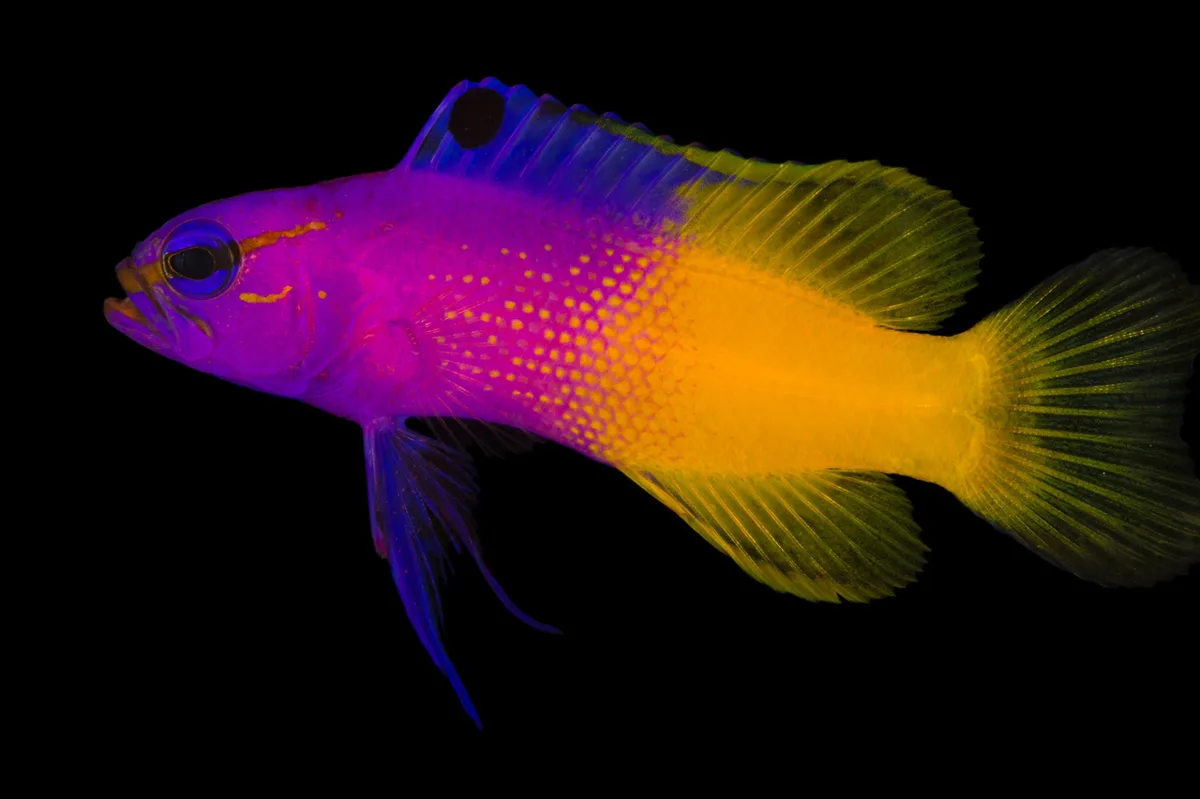
Image source: Bing (Web (fair-use with source credit))
Regal Angelfish: Beautiful but Demanding
The Regal Angelfish (Pygoplites diacanthus) is one of the most striking fish in the ocean. It has vertical orange and white stripes with a yellow rear end. It looks like something out of a painting.
It's not for beginners. It grows to about 10 inches and needs a 125-gallon tank. It's a picky eater that often refuses prepared foods at first.
Many specimens starve during quarantine. Even established fish can be difficult to keep.
A healthy Regal Angelfish needs a mature tank with plenty of live rock for grazing. It will pick at sponges and tunicates. It's not reliably reef-safe, as it may nip at coral polyps.
This is a fish for experienced marine keepers with established systems.
Other Saltwater Options
The Raccoon Butterflyfish (Chaetodon lunula) has a distinctive black mask across its eyes. It grows to about eight inches. It's not reef-safe and will eat coral polyps and anemones.
The Red Coris Wrasse (Coris gaimard) is a large, active fish with a yellowish body and blue spots as a juvenile. Adults turn green with red fins. It reaches about 15 inches and needs a 125-gallon tank.
It will bury itself in the sand at night.
The Ruby Red Dragonet (Synchiropus sycorax) is tiny, reaching about 2.5 inches. It's related to the popular Mandarin Goby. It only eats small crustaceans, so it needs a mature tank with a thriving copepod population.
It's not a beginner fish.
Saltwater species comparison:
| Species | Size | Tank Size | Reef-Safe | Difficulty |
|---|---|---|---|---|
| Royal Gramma | 3 in | 30 gal | Yes | Easy |
| Regal Angelfish | 10 in | 125 gal | No | Expert |
| Raccoon Butterflyfish | 8 in | 100 gal | No | Hard |
| Red Coris Wrasse | 15 in | 125 gal | Yes (with caution) | Moderate |
| Ruby Red Dragonet | 2.5 in | 30 gal | Yes | Hard |
For those who enjoy systematic species lists, our overview of animals that start with B offers a similar structured approach to learning.