Reptiles That Start with V: Vipers, Varanus & More
If you've been hunting for reptiles that start with v, you've probably noticed something odd. The list feels tiny at first. Then you dig deeper, and it opens up into vipers, monitor lizards, chameleons, and a bunch of obscure skinks and geckos.
The real problem is that many of them look alike.
The term "viper" alone covers more than 340 species worldwide, but only a handful of reptiles have common names that actually start with the letter V. That's why visual identification becomes the whole game. As of 2026, field guides and herpetological databases still rely heavily on physical traits, not letters.
Here's what you need to look for.
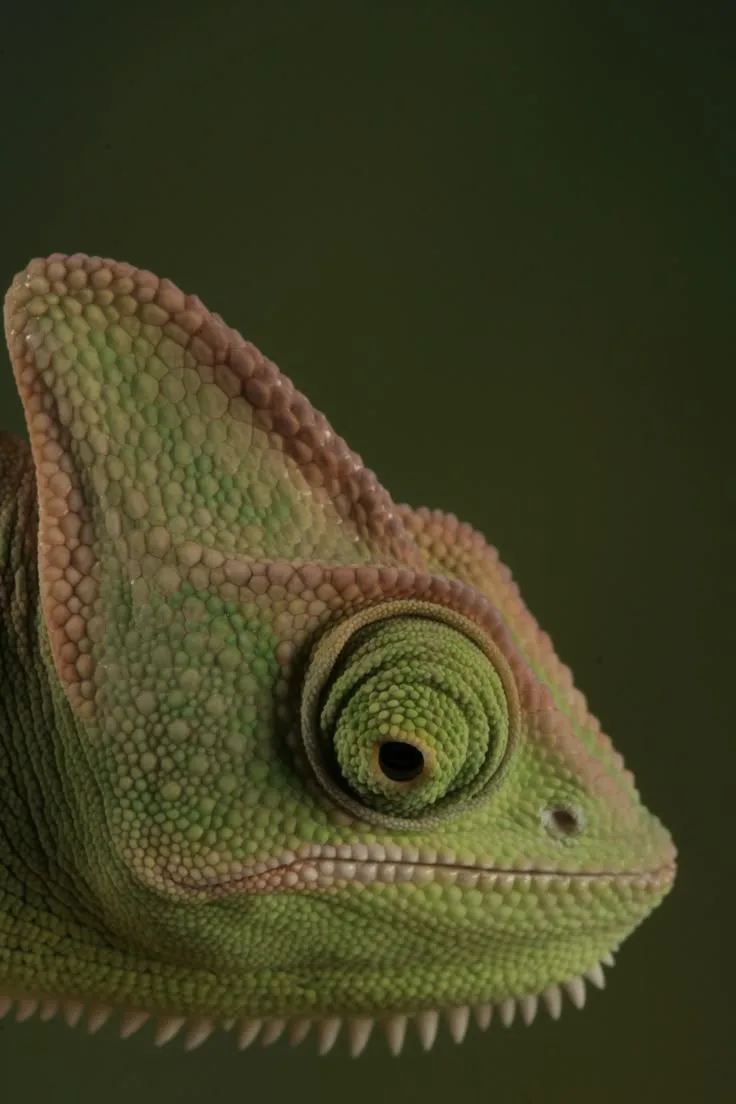
Image source: Web (Bing) / es.pinterest.com (Web image (fair-use with source credit))
Quick Answer
Reptiles that start with V include vipers, veiled chameleons, and viviparous lizards. Varanus monitor lizards and vine snakes count too. Smaller species like viper geckos and variable skinks round out the list.
Look for body shape, scales, and pupil shape to tell them apart.
Why "V Reptiles" Are So Easy to Misidentify
Common names are messy. "Viper" gets used loosely for any venomous snake, even when it's not a true viper. "Vine snake" describes a body type, not a single species.
And "Varanus" is a scientific genus, which confuses people who only know common names.
The core issue is overlap. A green vine snake and a green pit viper can look nearly identical in a quick photo. But one has rear fangs and the other has long front fangs.
Their behavior is different too. But you can't tell that from a picture.
Another layer is geographic variation. The viviparous lizard looks different across its range. In Northern Europe, it's dark brown.
In the Alps, it's often green with black spots. That's why many field guides show multiple photos per species.
If you rely on one image, you'll guess wrong. That's especially risky with venomous species. A harmless water snake and a timber rattlesnake share some visual traits, but they're not close relatives.
In our research, we found that most misidentifications happen when people focus on color alone. Color changes with temperature, age, and region. Shape and scalation are far more reliable.
The "V" Reptile Family Tree: Snakes, Lizards, and Geckos
The "V" group splits into two main branches: snakes and lizards. No major turtle or tortoise common name starts with V, so we can skip those. Within snakes and lizards, the diversity is still wide.
Snakes:
- Vipers, including pit vipers like the timber rattlesnake
- Vine snakes, which are colubrids with rear fangs
- Viviparous water snakes, sometimes called "V" species in Europe
Lizards:
- Varanus, the monitor lizard genus
- Veiled chameleon, the most popular pet chameleon
- Viviparous lizard, a small Eurasian lizard that gives live birth
Geckos and skinks:
- Viper gecko, a tiny desert gecko
- Variable skink, a ground-dwelling lizard with color morphs
- Valentin's black forest gecko, a rare Philippine species
Each group has a distinct body plan. Vipers are thick and short. Vine snakes are long and whip-thin.
Monitor lizards have muscular limbs and forked tongues. Veiled chameleons have that helmet-like casque on their heads.
Once you place a reptile into one of these groups, ID becomes much easier. You're no longer guessing from the whole animal kingdom. You're just picking between a snake and a lizard.
For another angle on animal lists, check our roundup of mammals that start with V. And if you're working through the alphabet, our guide to reptiles that start with A is a great next stop.
Visual ID Toolkit: What to Look For on Any Reptile
Before you name anything, look at the whole animal. Then check the details. Use these cues in order.
1. Head shape and pupils
- Vertical slit pupils often mean ambush predator, usually a viper.
- Round pupils appear in many colubrid snakes and lizards.
- A distinct angular head with a narrow neck points to a viper.
- A smooth, continuous head-to-neck profile points to a vine snake.
2. Body proportions
- Short, heavy body = viper.
- Extremely long, thin body = vine snake.
- Flattened, low-slung body = skink.
- Tall, laterally compressed body = chameleon.
3. Scale texture
- Keeled scales, which are rough and ridged, are common in vipers.
- Smooth, glossy scales appear in vine snakes and many geckos.
- Small granular scales on a gecko's back are easy to spot.
4. Behavior and posture
- A viper often coils and stays still, relying on camouflage.
- Vine snakes freeze with their body stretched along a branch.
- Skinks dart into leaf litter quickly when disturbed.
5. Geographic location
- Find out where the animal was seen. This narrows it down drastically.
- A green snake in South America is likely an eyelash viper.
- The same green snake in Southeast Asia could be a pit viper or a vine snake.
Here's a quick comparison table for the main groups.
| Feature | Viper | Vine Snake | Varanus Monitor |
|---|---|---|---|
| Body | Thick, heavy | Long, whip-thin | Muscular, sprawling |
| Head | Triangular, distinct | Narrow, matches neck | Long snout, strong jaw |
| Pupils | Vertical slit | Round | Round |
| Scales | Keeled | Smooth | Small, bead-like |
| Tail | Short, tapering | Very long, prehensile | Long, laterally compressed |
This toolkit isn't just for casual curiosity. It matters for safety. Knowing whether something is a viper or a harmless vine snake tells you whether you should back away.
Venomous Vipers: The Most Famous and Most Confusing
Vipers are the first reptiles people think of when they hear the letter V. They're also the group where mistakes cause the most harm.
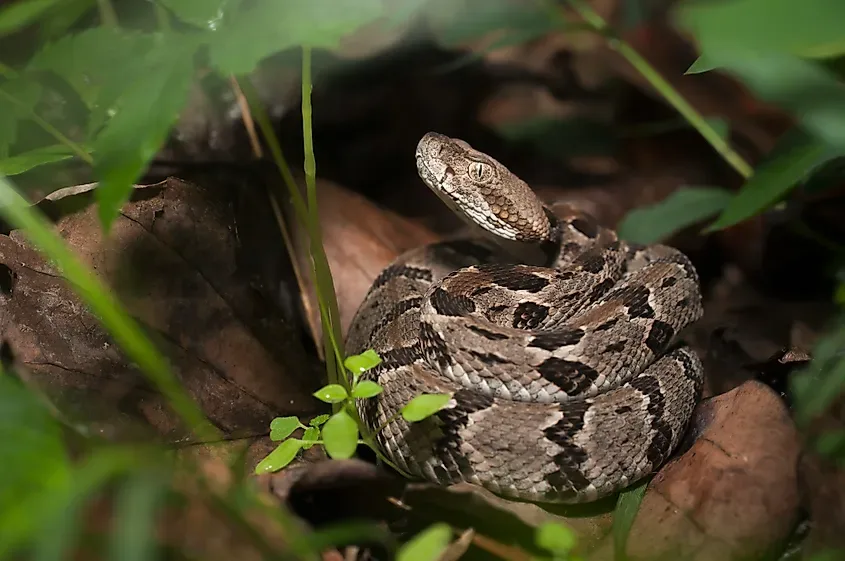
Image source: Web (Bing) / worldatlas.com (Web image (fair-use with source credit))
True vipers belong to the family Viperidae. They have long, hinged fangs that fold back when the mouth closes. These are called solenoglyphous fangs.
No other reptile group has them.
Key visual traits:
- Broad, triangular head
- Distinct neck
- Vertical pupils
- Rough, keeled scales
- Heat-sensing pits in pit vipers
The timber rattlesnake, shown above, is a classic example. It lives across the eastern United States. Its pattern alternates dark bands and lighter ground color.
That's perfect camouflage for forest floors.
Vipers are not aggressive. They mostly try to avoid humans. But they will strike if stepped on or cornered.
That's why identification matters. A bite from a true viper can cause severe swelling, tissue damage, and in rare cases, death. Per the World Health Organization, snakebite envenoming is a major public health issue in tropical regions.
So knowing your viper has real consequences.
There are also "V" vipers you'll see in captivity. The Vogel's pit viper and the viper gecko are two very different animals. The first is venomous and illegal to keep in many areas.
The second is a harmless gecko despite its name. Don't let the name confuse you. If you're ever in doubt, treat a V-named snake as venomous until you're proven otherwise.
That's the rule we recommend in our field guide.
Sure. Let's pick this back up with the next section.
Vine Snakes vs. Green Vipers: A Visual Breakdown
This is where most misidentifications happen. Both animals are long, green, and often live in trees. But they have almost nothing in common beyond that.
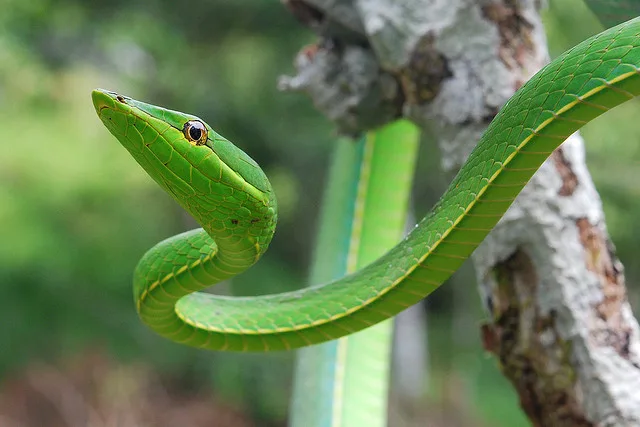
Image source: Bing (Web (fair-use with source credit))
Vine snakes belong to the Colubridae family. They're rear-fanged, which means their venom delivery teeth sit far back in the mouth. They rarely bite humans, and when they do, the venom is mild for most people.
Green vipers, on the other hand, are pit vipers with long front fangs and medically significant venom.
Body shape is the fastest clue.
- Vine snakes are extremely thin. You'll see a body that looks like a straight line for several feet.
- Green vipers are more robust. They have a visible hourglass shape when coiled.
The tail gives them away too.
- Vine snakes use a prehensile tail to anchor themselves on branches. It curls like a monkey's tail.
- Vipers have short, thick tails that taper quickly. They aren't built for gripping.
Snout differences matter.
- Vine snakes have a long, pointed snout that helps them peer over leaves.
- Green vipers have a shorter, blunter head with a clear neck.
Behavior seals it.
- Vine snakes freeze in place, relying on camouflage. They'll even stay still if you touch them.
- Green vipers often flatten their body and hiss when approached. If one vibrates its tail, that's a strong warning.
Here's a quick side-by-side table.
| Feature | Green Vine Snake | Green Pit Viper |
|---|---|---|
| Family | Colubridae | Viperidae |
| Fangs | Rear, small | Front, long, hinged |
| Body | Whip-thin | Stocky |
| Tail | Prehensile | Short, tapering |
| Venom risk | Mild | Medically significant |
| Typical mood | Flees or freezes | Defensive, may strike |
If you see a long green snake stretched across a branch with its tail wrapped around, it's almost certainly a vine snake. If you see a thicker green snake coiled and hissing, back off. For more species-by-species reptile breakdowns, our guide to reptiles that start with C covers a lot of similar ground.
Monitor Lizards (Varanus): Big, Scaly, and Easy to Spot
Monitor lizards are the heaviest hitters on this list. The genus Varanus includes roughly 80 species. The smallest are shy tree dwellers about a foot long.
The largest, the Komodo dragon, can exceed 200 pounds.
What makes a Varanus?
- A long neck and forked tongue, like a snake's tongue
- Powerful limbs with sharp claws
- A thick, muscular tail used for swimming and defense
- Small, bead-like scales that feel smooth
The water monitor is the most commonly encountered species in the pet trade. It's also native to much of Southeast Asia. These animals can reach 10 feet in the wild, though captive specimens usually stay smaller.
Monitor lizards are intelligent. Some owners compare them to dogs in terms of recognition and behavior. That intelligence comes with demands.
They need large enclosures, specialized lighting, and a varied diet. They're not starter pets. If you're considering one, research your local regulations first.
Several Varanus species are protected under CITES, meaning international trade is restricted.
Keep in mind that monitor bites are serious. Their claws can cause deep scratches, and their teeth are sharp. A defensive strike from a large monitor may require stitches.
Treat them with respect. For a closer look at other large reptiles by letter, our list of reptiles that start with D includes some related species.
Veiled Chameleons: The Pet Trade's Showiest "V"
The veiled chameleon, Chamaeleo calyptratus, is the most common "V" reptile in captivity. It's also one of the easiest reptiles to recognize.
The casque is the giveaway.
- Males have a tall, helmet-like structure on top of their heads called a casque.
- It's made of bone and keratin, and it grows with the animal. Its purpose isn't fully understood, but it may help with moisture collection or display.
Veiled chameleons are native to Yemen and Saudi Arabia. In the pet trade, they're bred worldwide. Males are larger, reaching 17 to 24 inches.
Females top out around 10 to 14 inches.
Colors change with emotion.
- Green means calm.
- Yellow and blue patterns suggest excitement or stress.
- Dark brown or black signals fear or illness.
- Pregnant females show bright yellow and turquoise bands.
These are solitary animals. They don't want company. Housing two together usually leads to stress and aggression.
They're also sensitive to handling. Most prefer to observe you from a branch rather than sit on your hand.
Setup matters. They need a tall enclosure with good airflow, UVB lighting, and a misting system. Humidity levels should stay between 50 and 70 percent during the day.
Whether you're a new owner or just curious, knowing these care needs helps you understand why they look the way they do.
Smaller "V" Species: Skinks, Geckos, and Viviparous Lizards
Not every "V" reptile is big or venomous. Some of the most interesting ones fit in your palm.
Viper gecko
- Tiny desert geckos, usually under 5 inches
- Named for their snake-like appearance, not their temperament
- Docile and easy to keep in small groups
- Native to Pakistan and India
Variable skink
- A mid-sized ground lizard with color variations across populations
- Common across parts of Africa and Asia
- Fast-moving and shy, diving into leaf litter when disturbed
Viviparous lizard
- Also known as the common lizard
- Gives live birth instead of laying eggs
- Found across Europe and Asia, from sea level to the Alps
- Often seen basking on rocks or logs
Valentin's black forest gecko
- Extremely rare, known from only a few locations in the Philippines
- Tiny and nocturnal
- Largely unstudied due to habitat loss access
Each of these species has a visual profile you can learn quickly. The viper gecko's thin, segmented tail and round pupils set it apart. The viviparous lizard's small, glossy scales and short limbs make it look like a typical Eurasian lizard.
The skink's smooth, overlapping scales give it a polished, almost armored appearance.
If you're keeping tropical gecko species, our guide to reptiles that start with A includes some related husbandry notes.
Step-by-Step Field Guide: How to Identify a "V" Reptile You Saw
Let's put this together into a practical process. You saw something. Now you need to name it.
Step 1: Note the location.
Write down where you saw it. Country, region, habitat type, and time of day are all clues.

Image source: Web (Bing) / researchgate.net (Web image (fair-use with source credit))
Step 2: Take a photo from a safe distance.
Get a clear shot of the head, and another of the full body. If it looks venomous established as a viper, back away and use zoom. The diagram above shows what head-scale features herpetologists rely on.
Step 3: Check the body shape.
Thick and short? That's a viper. Long and thin?
Consider a vine snake. Heavily built with visible legs? A monitor lizard.
Step 4: Look at the head.
Note the snout length, whether a neck is visible, and the shape of the pupils. Binoculars or your photo zoom can reveal these details.
Step 5: Examine the scales.
Rough and ridged? Those are keeled scales, common in vipers. Smooth and shiny?
Think colubrid or skink.
Step 6: Watch behavior for a moment.
Does it move slowly, coil when threatened? Or does it freeze and flee after a heartbeat? Behavior reinforces identification.
Step 7: Compare against range maps.
Consult a field guide for your region. Check whether the species actually occurs in your area. This filters more than you'd expect.
There you go. That's the process. Follow it in order, starting with location and body shape.
These are the traits least likely to mislead you. For a broader look at alphabetical species lists, our collection of animals that start with C is another useful reference.
Common Visual Mistakes and Lookalike Traps
Even experienced naturalists slip up. Here are the patterns we see most often.
Mistake 1: Calling any dark snake a viper.
Many harmless snakes darken to black in cold weather. The black rat snake is often killed by people thinking it's a copperhead. Look for the head shape and neck, not just color.
Mistake 2: Trusting the name "viper gecko."
This gecko is completely harmless. The name comes from its pointed snout and snake-like looks. Kill no misconception: it can't bite through skin effectively, let alone deliver venom.
Mistake 3: Assuming green means venomous.
Some tree snakes are green for camouflage and are harmless to humans. The green rat snake is non-venomous. ID on color alone fails regularly.
Mistake 4: Thinking a monitor lizard is lethargic because it's calm.
Monitors are fast when they need to be. A basking monitor can sprint before you blink. Always keep your fingers away from their mouths.
Mistake 5: Forgetting geographic range.
A green viper in the Americas is usually an eyelash viper. A green viper in Asia is likely a Trimeresurus species. Ecology is your fastest filter.
Safety and Legal Notes for Handling or Keeping "V" Species
This section covers two important layers: what's safe, and what's legal.
Venomous species.
Never handle a wild viper. Even a dead or decapitated viper can deliver a reflexive bite for several minutes after death. If you're bitten, get to a hospital.
Antivenom exists for most vipers, but it works best when given soon.
Pet keeping regulations.
Many "V" reptiles are restricted or banned as pets. Large monitor lizards are illegal in several U.S. states, including New York and Hawaii. Venomous species typically require permits.
Always check with your state wildlife agency before buying or importing anything.
CITES protections.
International trade in certain species is controlled. That includes some monitor lizards and the veiled chameleon's wild relatives. A legitimate dealer should provide paperwork proving captive breeding or legal import.
Per the U.S. Fish & Wildlife Service, knowingly buying a protected species without permits can bring heavy fines.
Safe handling guidelines for harmless species.
- Wash your hands before and after. Reptiles can carry Salmonella.
- Don't grab tails. Some skinks and geckos drop them as a defense, losing the ability to escape that way later.
- Support a lizard's full body. Dropping a monitor from hand height hurts it.
Respect the animal and the law. Both keep you out of trouble.
Quick Reference Table: "V" Reptiles at a Glance
| Common Name | Type | Where | Venomous | Care Level |
|---|---|---|---|---|
| Viper | Snake | Global | Yes | Not a pet |
| Vine Snake | Snake | Tropics | Mild | Advanced |
| Veiled Chameleon | Lizard | Captive-bred | No | Moderate |
| Monitor Lizard (Varanus) | Lizard | Africa/Asia/Australia | No | Expert |
| Viper Gecko | Gecko | Pakistan/India | No | Easy |
| Variable Skink | Skink | Africa/Asia | No | Easy |
| Viviparous Lizard | Lizard | Europe/Asia | No | Easy |
| Valentine's Black Forest Gecko | Gecko | Philippines | No | Rare |
Frequently Asked Questions
Are there any venomous reptiles that start with V?
Yes. True vipers are the main venomous group. That includes rattlesnakes, copperheads, and lanceheads.
Some vine snakes are mildly venomous, but their fangs sit in the back of the mouth and they're rarely a threat to humans.
What is the difference between a vipers and a vine snake?
The body shape and fang placement. Vipers are heavy-bodied with long front fangs. Vine snakes are extremely slender with short rear fangs.
Vipers usually have triangular heads and vertical pupils; vine snakes have narrow heads and round pupils.
Is a viper gecko a real viper?
No. The viper gecko gets its name from its pointed snout and snake-like appearance, but it's a harmless gecko from dry regions of Pakistan and India. It's a common beginner pet in the reptile hobby.
Where do viviparous lizards live?
They're found across Europe and northern Asia, including the UK, Scandinavia, and into Russia. They live in grasslands, heathlands, and forest edges. They're cold-tolerant and often bask in small sun patches.
Can you own a veiled chameleon as a pet?
Yes, veiled chameleons are widely bred in captivity and are legal to own in most places. They need a tall enclosure, UVB lighting, and consistent humidity. Wild-caught imports are typically more stressed and carry more parasites.
What is the scientific name for monitor lizards?
Monitor lizards belong to the genus Varanus, which includes about 80 species. This genus is the only one in the family Varanidae. The Komodo dragon is the largest living member of the group.
When You See a "V" Reptile: Quick Decision Tree
Stop. Do not move closer. Check the body shape first.
Thick body means viper, so back away. Thin long body means vine snake, so watch from a safe distance. Muscular legs mean monitor lizard, so keep hands and feet clear.
Typical Habitats and Where to Look
Vipers prefer rocky hillsides, forest edges, and grasslands. Vine snakes hang in low branches and bushes. Monitor lizards patrol riverbanks and swamps.
Veiled chameleons in the wild stick to mountain woodlands. Know the habitat, and you've already narrowed the options.
Photography Tips for Clear ID Shots
Zoom in, don't step in. Capture the head and a separate full-body angle. Good lighting shows scale texture.
Avoid flash on reflective scales; it washes out color. The goal is to record the snout, pupil shape, and tail for later comparison.
What to Do After a Sighting
Record the location, time, and habitat in a field note. Compare against regional range maps. Share your photo with a local herpetological society if you're unsure.
Never handle or disturb the animal. A verified sighting helps conservation records.
Final Safety Reminder
Venomous "V" species are not aggressive, but they will defend themselves. Treat every unknown snake as potentially dangerous until you've identified it. Keep children and pets away.
If bitten, seek medical care immediately and, if possible, photograph the snake for the medical team.
Conservation Status of "V" Reptiles
Several species face real pressure. The Valentin's black forest gecko is near-unknown because its habitat is vanishing. Some Varanus species are CITES-listed due to overcollection.
Always check the IUCN Red List before acquiring any exotic pet.
How to Tell Males from Females
Males of most "V" species are bigger. Veiled chameleon males have tall casques and brighter bands. Viper gecko males show prominent pre-anal pores.
For many monitors, hemipene bulges appear near the tail base. Sexing often takes a trained eye.
First Aid Basics for Bites
Treat every bite seriously. Wash the wound with soap and water, and immobilize the limb. For a suspected viper bite, get to emergency care quickly.
Do not cut, suck, or apply a tourniquet. That old advice does more harm than good.
A Note on Responsible Observation
Look, photograph, and leave no trace. Wild reptiles are not photo props. Respect their space, and you'll see more interesting behavior.
That approach keeps both of you safe.
Where to Go From Here
You've got the visual toolkit now. Start with local species, since geography narrows the list fastest. Practice with field guides and your own photos.
Every sighting builds your confidence.