Meet the M-Insects: Moths, Mantises & More
You've spotted something with six legs and wings, and it starts with M. Maybe it's fluttering around your porch light, hovering near a puddle, or crawling across your kitchen floor. You're not sure if it's a pest, a pollinator, or something in between.
Insects that start with m cover a lot of ground, from the beloved monarch butterfly to the universally dreaded mosquito. The trick is figuring out which one you're actually looking at before you swat, spray, or simply admire it.
That's where this guide comes in. We've dug through entomology resources, extension service databases, and field identification guides to help you tell your mantises from your mayflies. As of 2026, there are over 900,000 described insect species worldwide, and a surprising number of the ones you'll encounter in your daily life fall under the letter M.
Some are garden heroes. Others are genuine health concerns. Most are just fascinating once you know what to look for.
Let's start with the ones you're most likely to meet.
Quick Answer
Common insects that start with M include the monarch butterfly, mosquito, moth, praying mantis, mayfly, and mealworm beetle. Each varies wildly in behavior, habitat, and risk to humans. Mosquitoes bite and spread disease.
Mantises and minute pirate bugs are garden predators. Mayflies signal healthy water. Moths mostly pollinate at night.
Millipedes decompose leaf litter. Correct identification matters for safety and yard care.
Why Visual ID Matters More Than Memorizing Names
Here's the thing about common names: they're unreliable. The "mosquito hawk" you've heard about isn't a mosquito at all, it's a crane fly. The "moth" eating holes in your wool sweater is a specific carpet beetle larva, not a true moth.
And the "mantis" you found on your rose bush might actually be a mantidfly, a completely different order of insect with very different habits.
When you memorize names without understanding visual cues, you end up in trouble. You might douse your garden in pesticide to kill a harmless crane fly that's actually helping pollinate your plants. Or you might ignore a real mosquito breeding site because you thought all hovering insects were midges.
We've seen this confusion in countless extension office queries and online ID forums. It's more common than you'd think.
Visual identification isn't just about being accurate. It's about making smart decisions. Once you know what you're looking at, you can figure out if it's a threat, a benefit, or just passing through.
The five cues below will get you 90% of the way there, and they work for nearly any insect you encounter.
How to Identify an "M" Insect Like a Pro: 5 Visual Cues That Matter
Before you reach for a field guide or an app, train your eyes on these five features. They're the same ones professional entomologists use to sort insects into groups. Once you start noticing them, you'll never look at a bug the same way again.
1. Wing Position at Rest
This is your fastest filter. Butterflies hold their wings vertically above their backs when resting. Moths typically hold theirs flat and spread out.
If you see an insect resting with wings closed like a sailboat, it's almost certainly a butterfly. Wings open flat like a tent? That's a moth trait.
This single cue eliminates half your guesses instantly.
2. Antennae Shape
Get close enough to see the antennae, and you'll unlock a world of information. Butterflies have thin antennae with a little club or ball at the tip. Moths have feathery, comb-like, or threadlike antennae without clubs.
Mosquitoes have feathery antennae in males and plain ones in females. Antennae shape is often the definitive giveaway between lookalike species.
3. Body Shape and Leg Structure
Praying mantises have those iconic folded raptorial forelegs designed for grasping prey. Millipedes have long, segmented bodies with two pairs of legs per segment. Mole crickets have oversized shovel-like front legs built for digging.
Body proportion tells you an enormous amount about what an insect eats and how it lives.
4. Color Patterns and Wing Veining
This is where identification gets precise. Monarch butterflies have black veins running through orange wings. Viceroys mimic that pattern but add a distinctive black line across the hindwing.
Minute pirate bugs are tiny but have distinctive white markings on black bodies. Wing veining is often the only reliable way to separate two lookalike species.
5. Size Reference
Size matters more than people realize. A crane fly can measure 2.5 centimeters long, while a mosquito is usually under 1 centimeter. That's a massive difference when you see them side by side.
Keep a mental reference point, like a penny or your thumbnail, and compare. Size alone can eliminate half the possibilities on any ID chart.

Image source: Bing (Web (fair-use with source credit))
Moths vs. Butterflies: The 3 Reliable Ways to Tell Them Apart
People lump moths and butterflies together, but they're different in several fundamental ways. If you're trying to identify an "M" insect, knowing which group it belongs to cuts your search in half. Here are the three most reliable differences.
| Feature | Butterflies | Moths |
|---|---|---|
| Antennae | Thin with a club at the tip | Feathery, comb-like, or threadlike |
| Wing position at rest | Vertical, held above the body | Flat, spread out to the sides |
| Activity time | Daytime (diurnal) | Nighttime (nocturnal) or twilight |
There are exceptions to every rule, of course. Some moths fly during the day, and a few butterflies are active at dusk. But for the insects you're likely to encounter around your home and garden, these three cues hold up remarkably well.
The antennae test is the most reliable of the three. If you can get a clear look at the head, you'll know immediately. Butterflies have that distinctive club at the tip, like a tiny golf club.
Moths don't. Their antennae might be feathery, like a tiny comb, or plain and threadlike. This single difference is how entomologists separate the two groups in taxonomic classifications.
Wing position matters too, but it can be tricky. A resting butterfly looks like a closed book standing on edge. A resting moth looks like a flat roof over its body.
The next time you see a butterfly sunning itself on a leaf, freeze and study it. Then compare that pose to a moth you find near your porch light. The difference is obvious once you see it.
There's also a behavioral difference worth noting. Butterflies tend to be showy, fluttering through gardens in broad daylight. Moths are more secretive, darting away from light fixtures when you turn them on.
You'll rarely see a moth during the day unless it's been disturbed from its resting spot.
Moths That Start With M: The Ones Worth Knowing
Not all moths are created equal. Some are stunningly beautiful. Others are genuine pests.
A few are both, depending on their life stage. Here are the "M" moths you're most likely to encounter and what you should know about each.
Mourning Cloak Butterfly
Technically a butterfly, but it starts with M, so it deserves a spot here. The mourning cloak is one of the first butterflies you'll see in spring because it overwinters as an adult. Its wings are a rich brownish-maroon with pale yellow edges and a row of blue spots.
They're common across North America and Europe. Adults feed on tree sap rather than flower nectar, which makes them unique among butterflies.
Meal Moth
If you've ever opened a bag of flour or birdseed and found tiny caterpillars webbing it together, you've met the Indian meal moth. Adults are small, about 8 to 10 millimeters long, with a distinctive reddish-brown band across their gray wings. They're pantry pests, pure and simple.
The larvae feed on grains, nuts, dried fruit, and pet food. Infestations happen fast because females lay up to 400 eggs.
Miller Moth
The miller moth isn't a specific species but a common name for several army cutworm moths in their adult stage. They get their name from the powdery scales on their wings that look like miller's flour dust. In late spring, huge migrations of these moths move from the plains into the mountains in the western United States.
They're harmless to humans but notoriously annoying because they sneak into homes through any crack they can find.
If you want to identify a moth you've found, start with size and color. A giant moth with a wingspan of 10 centimeters is likely a silk moth or sphinx moth. A tiny moth less than 1 centimeter near your pantry is almost certainly a stored-product pest.
Context matters as much as appearance.
Mosquitoes vs. Their Lookalikes: Don't Swat the Wrong Bug
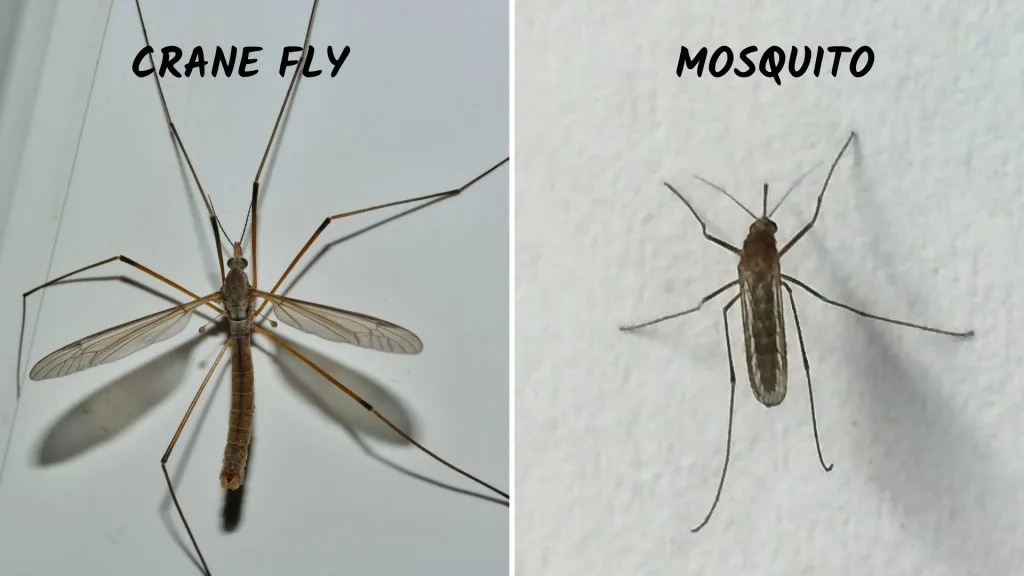
Image source: Web (Bing) / pestsamurai.com (Web image (fair-use with source credit))
Here's a scenario we've all lived through. You're sitting on your porch at dusk, and a long-legged insect lands on your arm. You slap it without thinking, then wonder if you just killed something harmless.
Chances are, you probably did.
The "mosquito hawk" is a myth that won't die. People insist that crane flies eat mosquitoes, so they're beneficial. That's false.
Adult crane flies don't eat anything at all. They live just long enough to mate and lay eggs. They're completely harmless, but they look enough like giant mosquitoes that people panic.
Here's how to tell them apart.
| Feature | Mosquito | Crane Fly |
|---|---|---|
| Size | 3 to 9 mm | 10 to 25 mm |
| Legs | Short, delicate | Extremely long, fragile |
| Wings | Scaly, narrow | Clear, broad |
| Mouthparts | Long proboscis for biting | None (don't feed as adults) |
| Behavior | Bites, seeks blood | Hovers, doesn't bite |
Midges cause similar confusion. They look like small mosquitoes, and they swarm near water in massive numbers. The key difference?
Midges don't bite. They lack the mouthparts for it. They're annoying because they form clouds that get in your eyes and up your nose, but they're entirely harmless.
Mosquitoes, on the other hand, are a genuine health concern. They transmit West Nile virus, Zika, and malaria in various parts of the world.
The CDC and EPA both emphasize mosquito control as a public health priority. Standing water is their breeding ground. Even a bottle cap full of water can support mosquito larvae.
Check your yard for anything that collects water, and you'll go a long way toward reducing the mosquito population around your home.
When you see a flying insect near water, pause before you swat. Look at the size, the legs, and the mouthparts. If it has a visible proboscis, it might be a mosquito.
If it has long, dangling legs and no visible mouthparts, it's almost certainly a crane fly. One is a legitimate health concern. The other is a harmless creature living its brief adult life.