
Insects That Start with L: Names and Fascinating Facts
Look around almost any backyard, and you'll spot at least a few insects that start with l. The tricky part is figuring out which ones are garden heroes and which ones are pantry invaders. That's exactly what this guide breaks down, using simple identification steps that work for beginners and seasoned gardeners alike.
In our research across entomology resources and university extension guides, we found 12 common species in the "L" group worth knowing. As of 2026, seven of them are either beneficial or harmless, while the rest can cause real problems. Let's walk through each one so you can tell your lacewings from your larder beetles with confidence.
Quick Answer
The most common insects that start with l are lacewings, ladybugs, leafhoppers, leafcutter bees, luna moths, larder beetles, locusts, lice, longhorn beetles, and lygus bugs. Most are beneficial or harmless. Lacewings and ladybugs are garden predators.
Leafhoppers and lygus bugs are crop pests. Lice are human parasites. The rest are mostly harmless.
Friend or Foe? How to Tell What You're Looking At
The fastest way to identify any "L" insect is to ask where you found it. That single question eliminates half the possibilities before you even look at physical features. If you spotted it crawling across your kitchen counter, it's not a luna moth.
If it's fluttering around your porch light at night, it's not a larder beetle.
The Three Decision Branches
Branch 1: Found outdoors in a garden or yard. You're likely looking at a lacewing, ladybug, leafhopper, leafcutter bee, or longhorn beetle. Most of these are either helpful or completely harmless.
Branch 2: Found indoors in a kitchen or pantry. Larder beetles are your prime suspect. They invade homes looking for dried meats, pet food, and stored grains. If you're seeing small brown beetles with a pale band across the back, that's your answer.
Branch 3: Found on your body or in your hair. This narrows it down to lice. Head lice are tiny wingless insects that live exclusively on human scalps. They don't jump or fly, and they require direct head-to-head contact to spread.
If you're still unsure after identifying the location, look at the mouthparts. Chewing mouthparts suggest beetles or caterpillars. Piercing-sucking mouthparts point to true bugs like leafhoppers and lygus bugs.
The shape of the antennae also helps. Beetles have segmented, often long antennae, while true bugs have shorter, thread-like ones.
The animals that start with c guide follows a similar identification logic, grouping creatures by habitat and behavior rather than just listing names.
The Garden Helpers: Lacewings, Ladybugs, and Leafcutter Bees
These three insects are the unsung heroes of the garden. They pollinate, they hunt pests, and they keep your plants healthy without any chemical intervention. If you spot any of them, you should be thrilled.
Green Lacewings: The Aphid Annihilators
Green lacewings are delicate, pale green insects with transparent, veined wings that look like fine lace. Adults feed on nectar and pollen, but their larvae are ferocious predators. Lacewing larvae, sometimes called aphid lions, have large, curved mandibles that they use to pierce aphids and other soft-bodied insects.
What makes them special is their appetite. A single lacewing larva can consume 100 to 200 aphids per week. They'll also eat mealybugs, thrips, spider mites, and insect eggs.
Gardeners often purchase lacewing eggs from supply catalogs to release them as biological pest control.
The adults lay their eggs on thin stalks to protect them from predators. These stalks look like tiny mushrooms growing on leaves, and many gardeners mistakenly scrape them off, thinking they're fungus. Don't make that mistake.
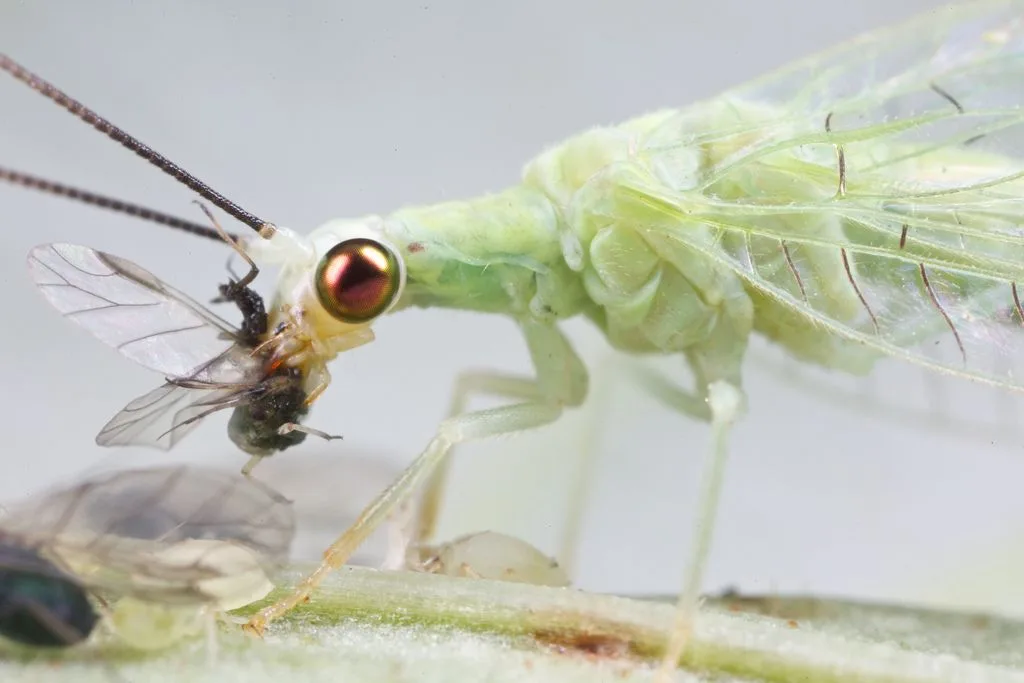
Image source: Bing (Web (fair-use with source credit))
Ladybugs: The Classic Garden Predator
Ladybugs, also known as lady beetles or ladybirds, are arguably the most recognized beneficial insect. Both the adults and larvae feed on aphids, scale insects, and mites. A single ladybug can eat up to 5,000 aphids in its lifetime, which makes them invaluable in organic gardening.
However, not all ladybugs are created equal. The native species you see in gardens are wonderful, but the Asian lady beetle (Harmonia axyridis) can become a nuisance. These invasive beetles congregate on the sunny sides of homes in autumn and find their way indoors through cracks and gaps.
Here's how to tell them apart:
| Feature | Native Ladybug | Asian Lady Beetle |
|---|---|---|
| Head color | Black with white spots | Yellowish with black markings |
| White marking | Two white spots on head | "W" shape on the pronotum |
| Behavior | Stays outdoors | Aggregates on buildings |
| Bites | Rarely bites | Can bite if handled |
Leafcutter Bees: The Solo Pollinators
Leafcutter bees are solitary natives that cut neat semicircular holes in leaves. They use those leaf pieces to line their nests, which they build inside hollow plant stems or rotting wood. The cut circles look alarming, but the damage is cosmetic at worst.
These bees are exceptional pollinators. In fact, they're more efficient at pollinating alfalfa, blueberries, and various garden crops than honeybees. They carry pollen on their hairy undersides, which makes contact with flower reproductive parts far more likely.
If you see those distinctive cut leaves, thank your local leafcutter bees rather than reaching for pesticides.
For a broader look at helpful backyard creatures, the marvelous mammals that start with m guide offers similar insight into beneficial wildlife.
The Crop Pests: Locusts, Leafhoppers, and Lygus Bugs
Not every "L" insect earns its keep. Leafhoppers, lygus bugs, and locusts can cause significant damage to crops, ornamentals, and even entire agricultural economies. Knowing what they look like and how they damage plants helps you catch infestations early.
Leafhoppers: Small Jumpers, Big Damage
Leafhoppers are slender, wedge-shaped insects that jump sideways when disturbed. They're typically green, yellow, or brown, and they feed by piercing plant tissue and sucking out sap. This feeding method creates stippling, yellowing, and curling of leaves.
Some leafhoppers transmit plant pathogens. The glassy-winged sharpshooter, for instance, spreads Pierce's disease in grapevines, which has devastated vineyards across California. If you notice leaf discoloration and fine, pale speckling on your plants, check the undersides of leaves for these quick-moving insects.
The tricky part is that leafhopper damage often looks like a plant disease or nutrient deficiency. The key difference is the presence of the insects themselves. If you shake the plant and see small, hopping insects, you have leafhoppers.
Lygus Bugs: The Fruit Blemishers
Lygus bugs, sometimes called tarnished plant bugs, are small oval insects that range from pale green to dark brown. They attack a wide range of crops, including strawberries, cotton, alfalfa, and various vegetables. Their feeding injects toxins that deform plant tissue and cause "cat-facing" on fruit.
These bugs overwinter as adults in plant debris, so the first line of defense is good sanitation. Remove weeds and crop residue in the fall to reduce overwintering sites. If you find nymphs in spring, you're in for a season-long battle unless you intervene early.
Chemical controls exist, but they often kill beneficial insects too. A more balanced approach involves monitoring lygus populations with sweep nets and treating only when thresholds are exceeded. Many university extension programs publish specific treatment thresholds based on crop and region.
Locusts: The Swarming Threat
Locusts are a special type of grasshopper that exhibits swarming behavior under specific conditions. When population densities rise and resources become scarce, locusts undergo physical and behavioral changes. They shift from solitary green forms to gregarious yellow-and-black forms that mass in devastating swarms.
A single desert locust swarm can contain up to 80 million individuals per square kilometer. These swarms consume their body weight in food daily, which threatens food security across affected regions. The U.S. experienced devastating locust outbreaks in the 1870s, though modern control methods have largely contained this threat in North America.
If you see unusually high numbers of grasshoppers with darker coloring and longer wings, that's worth reporting to your local agricultural authority.
For similar pest identification guidance, check out the wild w mammals article, which covers a different group of creatures with their own unique traits.
The Wood Lovers: Longhorn Beetles and Larder Beetles
These two beetles share a common letter but have completely different lifestyles. Longhorn beetles are mostly beneficial decomposers that break down dead wood in forests, while larder beetles are pantry pests that signal hygiene issues in your home.
Longhorn Beetles: The Forest Recyclers
Longhorn beetles get their name from their extraordinarily long antennae, which often exceed the length of their bodies. They're typically brown or black with distinctive patterns, though some species display metallic colors or bold yellow stripes.
These beetles play a vital role in forest ecosystems. The larvae bore into dead and decaying wood, accelerating decomposition and recycling nutrients back into the soil. Without them, forests would choke on fallen timber.
Most longhorn beetles only attack dead or dying trees, so they're not a threat to healthy living wood.
The exception is certain invasive species like the Asian longhorned beetle. This pest attacks living hardwood trees, boring through bark and potentially killing them. If you see smooth, round exit holes about 3/8 inch in diameter on the trunks of maple, birch, or willow trees, report them to your local USDA office.
The rare and wonderful mammals that start with r page similarly highlights species that play unexpected roles in their environments.
Larder Beetles: The Pantry Alarm
Larder beetles are small, oval beetles with a distinctive pale band across their dark brown or black bodies. Adults are about 1/3 inch long, and they thrive on high-protein foods. In nature, they feed on dead animals, dried meat, and insect carcasses.
Indoors, they're drawn to pet food, dried meats, cheese, and even wool.
Finding larder beetles in your kitchen is a clear signal that you have a food storage problem. The adults lay eggs in accessible food sources, and the larvae feed for about 40 to 50 days before pupating. If you're seeing adults regularly, there's likely an infestation in your pantry.
Here's what to check:
- Pet food storage. Keep kibble in sealed, airtight containers.
- Dried meats and jerky. Throw away any unsealed packages.
- Spices and grains. Inspect them for tiny holes or webbing.
- Cracks and crevices. Vacuum the pantry thoroughly, especially along baseboards and shelf corners.
Larder beetles don't bite humans or spread disease, but their presence is a hygiene red flag. Throwing out infested food and sealing everything else usually resolves the problem permanently.