Reptiles That Start with M: Monitors, Mambas & More
Ever spotted a snake with bright red, yellow, and black bands and wondered if you were looking at something deadly? That moment of uncertainty hits harder when the reptile in front of you starts with the letter M. There are dozens of reptiles that start with M, and some of them look almost identical to creatures that could send you to the hospital.
Others, like the mud turtle and musk turtle, are so similar that even experienced herpers double-check.
The good news? Once you know what to look for, identification gets surprisingly simple. As of 2026, there are over 10,000 described reptile species worldwide, and roughly 200 common names begin with M.
That's a lot of mud, musk, map, milk, and monitor. Let's break down the ones you actually need to know, starting with why visual clues matter more with this letter than any other.
Quick Answer
The most common reptiles that start with M include milk snakes, mud turtles, musk turtles, map turtles, monitor lizards, and the matamata. Most are harmless. Two exceptions are the massasauga rattlesnake and the Mexican beaded lizard.
Both are venomous. Visual identification is essential because many M reptiles mimic dangerous species.
Why Visual ID Matters More with M Reptiles Than Any Other Letter
Here's the thing about the letter M in herpetology: it's packed with lookalikes. No other letter groups so many similar species together. Mud turtles and musk turtles share nearly identical shells.
Milk snakes and coral snakes wear the same three colors. Monitor lizards and beaded lizards both have thick, heavy bodies and forked tongues.
That's not a coincidence. Evolution pushed many of these animals toward similar shapes because those shapes work. A brown, dome-shelled turtle survives better in murky water than a brightly colored one.
A snake with bold bands confuses predators. The problem is that humans also get confused.
This is why a visual-first approach matters. You can't identify most M reptiles by size alone. You can't rely on habitat either, since mud snakes and water snakes share the same swamps.
What separates them are the details: scale texture, shell shape, banding order, and snout structure.
Take the milk snake and coral snake as the prime example. Both have red, yellow, and black bands. Both live in the southeastern United States.
One is completely harmless. The other carries neurotoxic venom. The difference comes down to band order, specifically whether the red bands touch the yellow bands.
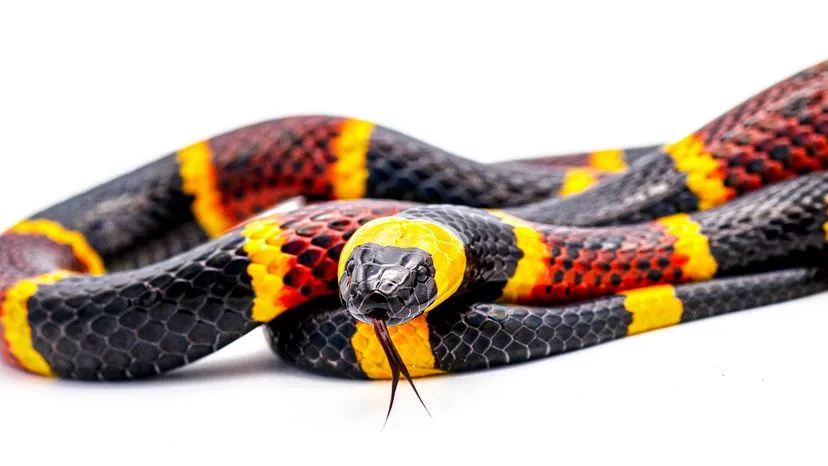
Image source: Web (Bing) / storage.googleapis.com (Web image (fair-use with source credit))
In our research, we found that most bites from venomous snakes happen when people misidentify them. That's not a statistic to shrug at. When you're out hiking or working in your yard, knowing exactly what you're looking at can be the difference between a memorable encounter and a hospital visit.
The M-Lizards: Monitors, Beaded Lizards, and Chameleons
When people think of lizards that start with M, monitors come to mind first. These are the heavyweights of the lizard world, and they range from modest swimmers to the largest lizard on Earth. But the M group also includes venomous beaded lizards and some genuinely bizarre chameleons.
Monitor Lizards: The Varanus Family, From Komodo to Mertens'
Monitor lizards belong to the genus Varanus, which contains around 80 species. They share a few key traits: long necks, muscular bodies, forked tongues, and sharp claws. The most famous M monitor is the Komodo dragon, which can reach 10 feet and weigh over 150 pounds.
That's a real animal, not a movie prop.
But most monitors you'll encounter are much smaller. The Mertens' water monitor, for example, tops out around 3 feet and spends most of its time in rivers across northern Australia. It's semi-aquatic, with a laterally flattened tail that helps it swim.
The Asian water monitor, another common M species, grows up to 6 feet and lives near waterways throughout Southeast Asia.
Monitor lizards are intelligent. They can recognize individual humans, solve basic puzzles, and even follow scent trails. That intelligence comes with a downside.
They're not beginner pets. Large monitors can deliver serious bites and have claws like small knives. If you're considering one, understand the commitment.
These animals can live 15 to 20 years and need enormous enclosures.
Mexican Beaded Lizard: The Beaded Venomous Icon
The Mexican beaded lizard is one of only two venomous lizards in the world. Its closest relative is the Gila monster, which lives further north. The beaded lizard gets its name from the bumpy, bead-like scales that cover its body.
Here's what most people don't realize: its venom isn't delivered through fangs. Instead, the lizard chews venom into the wound through grooved teeth in its lower jaw. A bite is painful and can cause swelling, but fatalities are extremely rare.
That doesn't mean you should handle one casually. It's a protected species in Mexico, and keeping one typically requires special permits.
In our research, we found something genuinely fascinating. Scientists are studying the beaded lizard's venom for pharmaceutical applications. Certain compounds in it show promise for treating diabetes.
That's a wild example of a dangerous animal quietly contributing to medicine.
Meller's Chameleon and Mountain Horned Dragon: The Oddballs
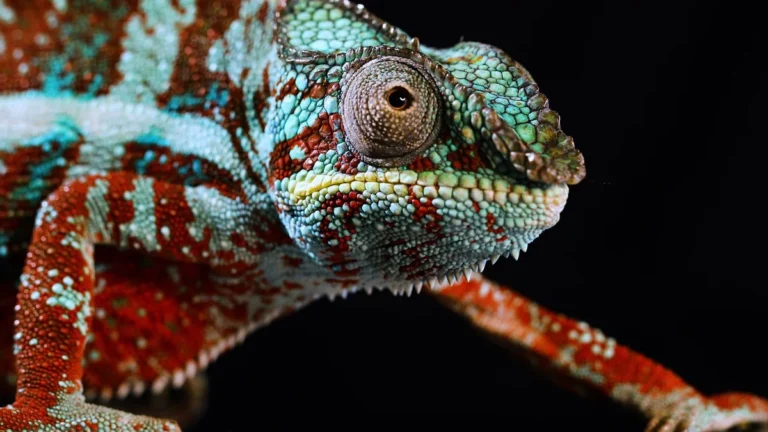
If you want unusual, M delivers. The Meller's chameleon is the largest chameleon in mainland Africa, reaching up to 24 inches in total length. It has a tall casque on its head and can change color based on mood, temperature, and light.
Unlike milksnakes, these chameleons are not beginner animals. Most are wild-caught, arrive stressed, and carry heavy parasite loads.
The mountain horned dragon, by contrast, is a smaller arboreal lizard found across Southeast Asia. It has a spiky dorsal crest and a large gular pouch that inflates during displays. It looks like a miniature dinosaur, which explains its popularity in the pet trade.
Just know that it's delicate and needs cool, humid enclosures to thrive.
If you want something you can actually observe in nature, both species are best seen in the wild. Watch from a distance, and let them go about their business. That's where the real show happens.
The M-Snakes: Banded Mimics, Swamp Gliders, and a Rattler
Snakes are where the letter M gets seriously confusing. You've got harmless mimics, glossy swamp dwellers, and one venomous rattlesnake that shares a name with a Great Lake. Let's sort them out one by one.
Milk Snake vs. Coral Snake: How to Read the Bands
This is the most important identification lesson in this entire article. The milk snake and the eastern coral snake share the same red, yellow, and black banding. One is a gentle constrictor that eats rodents.
The other packs a neurotoxic bite that requires antivenom.
The difference comes down to the rhyme: red touch yellow, kills a fellow. Red touch black, venom lack.
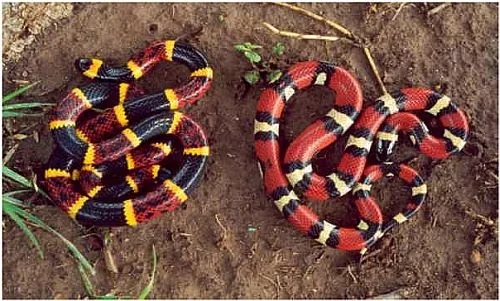
Image source: Bing (Web (fair-use with source credit))
Look closely at the image above. On a coral snake, the red bands touch the yellow bands. On a milk snake, the red bands touch the black bands, with yellow rings separating them.
That's the whole trick.
But here's the caveat: this rhyme only works reliably in North America, and only for the eastern coral snake. Other coral snake species in Central and South America don't always follow the pattern. Also, there are individual milk snakes with unusual patterns.
When in doubt, don't get close enough to check. A photo zoomed in from a safe distance works fine.
Milk snakes are harmless. They're constrictors that eat mice, birds, and other small prey, which is how they got their name. Legend says they snuck into barns and drank milk from cows, but that's just folklore.
Their size varies by subspecies, from 20 inches to nearly 5 feet.
Mud Snakes and Mangrove Snakes: Wetland Specialists
The mud snake is a glossy, iridescent creature that lives in swamps and ditches across the southeastern United States. Its back is a solid, shiny black, and its belly has bold red or pink checkering. If you've seen one, you remember it.
They spend most of their lives buried in mud, hunting for giant salamanders called amphiumas.
Mud snakes are completely harmless. They rarely bite, and they're not venomous. If you flip one over, the red belly pattern is unmistakable.
Some people mistake them for venomous water snakes, but the glossy, unkeeled scales give them away.
The mangrove snake, on the other hand, lives in Southeast Asia. It's a slender, rear-fanged species that hunts birds and lizards in the treetops. Its venom is mild, but a bite can cause quite a bit of swelling.
It's also highly agile and can strike quickly, so it's definitely not a beginner snake. If you see one in the wild, admire it from a respectful distance.
Massasauga Rattlesnake: The Only Venomous M Snake
The massasauga is a small rattlesnake, typically 18 to 30 inches long, found in the Great Lakes region and across the US Midwest. It's also the only venomous snake whose common name starts with M. That alone makes it worth knowing.
Massasaugas are shy and reclusive. They prefer wetlands, prairies, and marshy areas where they hunt small rodents. Their venom is potent, and bites can be serious, but they rarely strike unless stepped on or cornered.
Most bites happen when people try to handle them.
Here's the key visual clue: a massasauga has a segmented rattle at the end of its tail, hence the name. It also has a distinctive pattern of dark brown blotches on a gray or light brown background. If you're in their range and hear a buzzing sound, freeze, look around, and back away slowly.
That rattle is a warning you should never ignore.
The M-Turtles: Mud, Musk, Map, and the Matamata
Turtles starting with M are a study in contrasts. You've got tiny, semi-aquatic turtles that fit in your hand, and you've got a bizarre Amazonian creature that looks like a pile of dead leaves with a nose. Let's meet them.
Mud Turtles vs. Musk Turtles: The Ultimate Lookalike Matchup
If you've ever tried to tell a mud turtle from a musk turtle, you know the struggle. They look almost identical. Both are small, brown, and live in the muddy bottoms of ponds and slow rivers.
But there are reliable ways to tell them apart.

Image source: Bing (Web (fair-use with source credit))
The easiest check is the shell. Mud turtles have a hinged plastron, the bottom part of the shell, that can close almost completely. This lets them hide entirely inside their shell like a box turtle.
Musk turtles lack this hinge. Their plastron is smaller and doesn't close up.
There's also a size difference. Musk turtles are the smallest turtles in North America, topping out around 5 inches. Mud turtles get slightly bigger, generally reaching 4 to 6 inches.
And the musk turtle has a pair of glands that release a strong, musky odor when threatened, which is exactly where its name comes from.
For a quick field identification, remember this: if you can close it like a box, it's a mud turtle. If it smells like garlic and musk, that's a musk turtle. Both make okay pets for experienced keepers, but they need proper filtration and clean water.
They're messier than people expect.
Map Turtles: The Keeled River Baskers
Map turtles are named for the intricate, map-like lines on their shells. These lines are most visible in juveniles and fade as the turtle matures. They also have a prominent vertebral keel, a raised ridge running down the center of the shell, which helps distinguish them from sliders and cooters.
There are around 15 species of map turtles, and they're found throughout the Mississippi and Missouri river systems in North America. They love basking. On sunny days, you'll see them piled onto logs and rocks, often several at a time.
If you approach too quickly, they'll slide into the water before you can get a good look.
The biggest is the common map turtle, reaching about 10 inches. The smallest is the Ouachita map turtle. Their shells vary from olive to brown, with yellow markings on their heads and legs.
If you're trying to identify one, focus on the keel and the head patterns rather than overall color.
Matamata and Mary River Turtle: Nature's Weirdest M Turtles
Now we get to the outliers. The matamata is a freshwater turtle from South America that looks like a piece of bark with a long, snorkel-like snout. Its shell is flattened and covered in ridges and knobs, giving it perfect camouflage in murky water.
It waits motionless for fish to swim close, then opens its mouth and sucks them in.
The matamata isn't aggressive, but it's not a pet. It needs warm, acidic water and eats only live fish. It also grows up to 18 inches long, which is much bigger than most people expect.
The Mary River turtle comes from Queensland, Australia, and it has an even wilder feature: algae growing on its head. The algae gives older turtles a bright green, almost punk-rock mohawk. This species can also breathe through its cloaca, which is a fancy way of saying it can absorb oxygen from water through its backside.
Both turtles are fantastic examples of evolutionary creativity. They look nothing like the mud turtles and map turtles above, which just proves how diverse the M group really is. If you want to see them, the matamata is found in the Amazon basin, and the Mary River turtle lives only in the Mary River catchment in Australia.
The M-Crocodilians: Mugger and Morelet's
When people think of crocodilians, they usually picture the big Nile crocodile or the American alligator. But two crocodile species start with M, and both deserve attention.
Mugger Crocodile: The Marsh Dweller
The mugger crocodile, also called the marsh crocodile, lives in freshwater lakes, rivers, and swamps across India, Sri Lanka, Pakistan, and Iran. It's a medium-sized crocodilian, with males reaching up to 16 feet, though most stay closer to 10 feet.
Its name comes from the Hindi word "magar," which means water monster. That's fitting for an ambush predator that spends most of its time lurking near the surface, waiting for deer, fish, or small livestock to come too close.
Muggers are opportunistic hunters. They're also highly adaptable, surviving in everything from large reservoirs to village ponds. In some parts of India, they coexist with dense human populations, which requires careful management.
They're protected under CITES Appendix I in most of their range, meaning international trade is tightly restricted.
Morelet's Crocodile: The Snout Specialist
The Morelet's crocodile, also known as the Mexican crocodile, lives in freshwater wetlands along the Atlantic coast of Mexico, Belize, and Guatemala. It's smaller than the mugger, generally reaching 10 to 14 feet. Its snout is notably broader than other crocodiles, which sets it apart at a glance.
Morelet's crocodiles are secretive and tend to avoid humans. They build nest mounds out of vegetation, and females guard their nests aggressively. Like the mugger, their conservation status has improved in recent decades thanks to protection and farming programs.
If you're in their habitat, you're unlikely to see one. They stay hidden in dense wetland vegetation during the day and hunt at night. But knowing they're there is part of understanding the ecosystem.
Both M crocodilians are keystone predators that keep fish populations in check and maintain healthy wetland environments.
Common Visual Mistakes People Make with M Reptiles
Even experienced herpers make errors. The key is knowing where the traps are. Here are the most common ones:
- Red touches yellow vs. red touches black. This is the biggie. Forgetting the rhyme, or applying it to species outside North America, gets people bitten.
- Mud turtles vs. musk turtles. Look at the plastron. If it closes like a box, it's a mud turtle. If not, it's a musk turtle.
- Assuming every brown basking turtle is a slider. Map turtles have a raised keel and distinct head markings that set them apart.
- Calling any large monitor a Komodo dragon. Most monitors stay well under 5 feet. The Komodo dragon is confined to a handful of Indonesian islands.
Another common error involves names. People hear "mud snake" and assume it's a venomous moccasin. But the mud snake's glossy, smooth scales and bright red belly make it unmistakable once you know what to look for.
The same lookalike problems show up in our reptile alphabet guides for other letters. Each one has its own pair of confusing species. M just has more than most.
Which M Reptiles Are Safe vs. Which Need Respect (or a Permit)
Most M reptiles are completely harmless. A milk snake can't hurt you. A mud turtle will just pull into its shell.
A map turtle will slide off its basking log before you get within 10 feet.
A few demand serious respect:
| Species | Risk Level | Why |
|---|---|---|
| Massasauga rattlesnake | High | Venomous, potent neurotoxin |
| Mexican beaded lizard | High | Venomous, bites by chewing |
| Mugger crocodile | High | Large ambush predator |
| Morelet's crocodile | High | Defensive around nests |
| Komodo dragon | Extreme | Lethal bite, massive size |
Permits and regulations vary by location. Crocodilians and the beaded lizard are protected under CITES. In the US, keeping any of these requires state permits, and some states ban them outright.
For current conservation status, the IUCN Red List is the most reliable reference. The US Fish & Wildlife Service also publishes guidelines on protected reptile species.
If you're hiking in massasauga country, wear closed-toe boots and stay on marked trails. If you're near crocodile habitat, keep away from the water's edge. That's not fear.
It's smart behavior.
The Best M Reptiles for Beginners, Enthusiasts, and Wildlife Watchers
| Audience | Best M Choices | Why |
|---|---|---|
| Beginners | Milk snakes, musk turtles | Docile, hardy, manageable |
| Enthusiasts | Map turtles, mud turtles | Active, fascinating behavior |
| Wildlife watchers | Mud snakes, massasauga | Rare, exciting encounters |
Milk snakes win for new snake keepers. They stay calm, eat frozen-thawed mice, and come in dozens of color morphs. Musk turtles work well for turtle beginners because they stay small and don't need massive tanks.
More experienced keepers gravitate toward map turtles and mud turtles. Both are more cautious and require careful water quality management. If you want a challenge, the mangrove snake and Meller's chameleon are advanced projects, not starter pets.
And if you're more of a mammal person, we've got the warm-blooded M lineup too.
Quick Visual Reference Chart: Spotting M Reptiles in the Wild
| Reptile | Key Visual Cue | Where to Look |
|---|---|---|
| Milk snake | Red bands touch black, not yellow | Fields, barns, under logs |
| Coral snake | Red bands touch yellow | Sandy forests, SE US |
| Massasauga | Segmented rattle, brown blotches | Wetlands, prairies |
| Mud turtle | Hinged plastron, closes like a box | Pond bottoms |
| Musk turtle | No shell hinge, musky odor | Muddy shallows |
| Map turtle | Keeled shell, head markings | River basking logs |
| Matamata | Snorkel snout, leaf-like shell | Amazon rivers |
| Mangrove snake | Slender, rear-fanged, arboreal | SE Asian trees |
| Mugger crocodile | Broad snout, marsh habitat | South Asian lakes |
| Morelet's crocodile | Very broad snout | Central American wetlands |
| Mexican beaded lizard | Bead-like scales, dark body | Western Mexico |
Keep this chart handy on your next hike. It won't make you a herpetologist overnight, but it'll stop you from confusing a harmless milk snake with a coral snake.
Final Take: The Most Unforgettable Reptile That Starts with M
If we had to crown one M reptile as the most unforgettable, the matamata wins. Nothing else looks like it. A living pile of leaves with a snorkel nose and a vacuum-suction mouth.
But the one you actually need to remember is the massasauga. It's the only venomous M snake in North America, and its range overlaps with millions of people. Knowing its rattle, its blotches, and its habitat will keep you safe.
If you've enjoyed this walk through the M reptiles, there's more where that came from. We've covered animal lists for other letters and the L mammal collection if you want to keep exploring.
Frequently Asked Questions
Are milk snakes dangerous?
No. Milk snakes are non-venomous constrictors that eat rodents. They rarely bite, and when they do, it's barely a pinch.
Their main defense is mimicry. They look like coral snakes, which scares off predators and people alike.
What is the difference between a mud turtle and a musk turtle?
Mud turtles have a hinged plastron that closes almost completely. Musk turtles lack this hinge. Musk turtles also have scent glands that release a strong, musky smell when threatened.
Both are small, brown, and live at the bottom of muddy ponds.
Is the massasauga rattlesnake aggressive?
No. Massasaugas are shy and reclusive. They usually freeze or retreat when humans approach.
Bites happen when someone steps on one or tries to handle it. If you hear its rattle, stop, locate the snake, and back away slowly.
Can you keep a matamata turtle as a pet?
Technically yes, but it's not a good idea. Matamatas grow up to 18 inches, need warm acidic water, and eat only live fish. They're also poor swimmers and stress easily.
This is a species best left to professional aquariums and the wild.
Does the red touch yellow rhyme always work?
The rhyme "red touch yellow, kills a fellow" works reliably for the eastern coral snake in North America. It doesn't apply to coral snakes in Central and South America. When in doubt, observe from a distance and take a photo for identification.
Frequently Asked Questions
Are there any other venomous M reptiles?
Yes. The Mexican beaded lizard is venomous, and the massasauga rattlesnake is the only venomous M snake. Both require respect and distance in the wild.
What is the easiest M reptile to identify?
The matamata. Nothing else looks like a pile of leaves with a snorkel nose. The mud turtle's hinged shell is also an easy giveaway.
Which M reptile is best for a beginner?
A milk snake or a musk turtle. Both are hardy, docile, and forgiving of minor care mistakes.
Do M reptiles hibernate?
Some do. Milk snakes and map turtles brumate during winter. Massasaugas overwinter in wetlands.
Tropical species like the matamata stay active year-round.
Can M reptiles be kept together?
No. Most M reptiles are solitary. Mixing species causes stress, injuries, and sometimes death.
House them separately.