Top 20 Birds You’ll See in Alabama
Alabama doesn't get the birding hype it deserves. The state sits at a crossroads where eastern forests meet Gulf salt marshes and the Appalachian foothills, and that mix produces a bird list of more than 430 species. If you're trying to identify the birds of Alabama, you've probably learned that field guides don't always match what you see.
The bird in your yard is usually half-hidden, moving fast, and lit badly.
Here's the thing. As of 2026, the official Alabama state checklist maintained by the Alabama Ornithological Society sits at 430 confirmed species. That number sounds huge, but you don't need to memorize it.
You need a system for narrowing down what you see. This guide gives you that system, one visual clue at a time.
Quick Answer
The birds of Alabama range from backyard cardinals to migrating warblers. Over 430 species are recorded statewide. Look for habitat first, then season, then field marks.
This method takes you to a confident ID quickly.
Why Visual Identification Is Everything in Alabama
Here's a sentence that surprises most beginners: you don't need to know the bird's song first. Visual field marks get you to the right answer faster, especially in a state as varied as Alabama. A quick glance at size, shape, and posture can separate a Blue Jay from a Northern Flicker before either one makes a sound.
Think about it this way. Alabama's landscapes range from Gulf salt marshes to mountain coves. The same habitat can host totally different species depending on where you stand.
That means location matters, but the bird's physical appearance is your first clue. Bald eagles soar over the Tennessee River in winter, while herons wade through the Mobile-Tensaw Delta. Your brain processes those differences instantly, even before you reach for a guide.
In our research, the most successful birders all follow the same rule: start with the visual snapshot, then narrow it down. It's a skill, not a talent. And it's exactly what we'll walk through next.
If you want to verify what you're seeing, Cornell Lab's All About Birds has free species accounts with photos and range maps. That's a great reference when you're stuck between two look-alikes.
The 5 Visual Clues That Narrow Down Any Bird
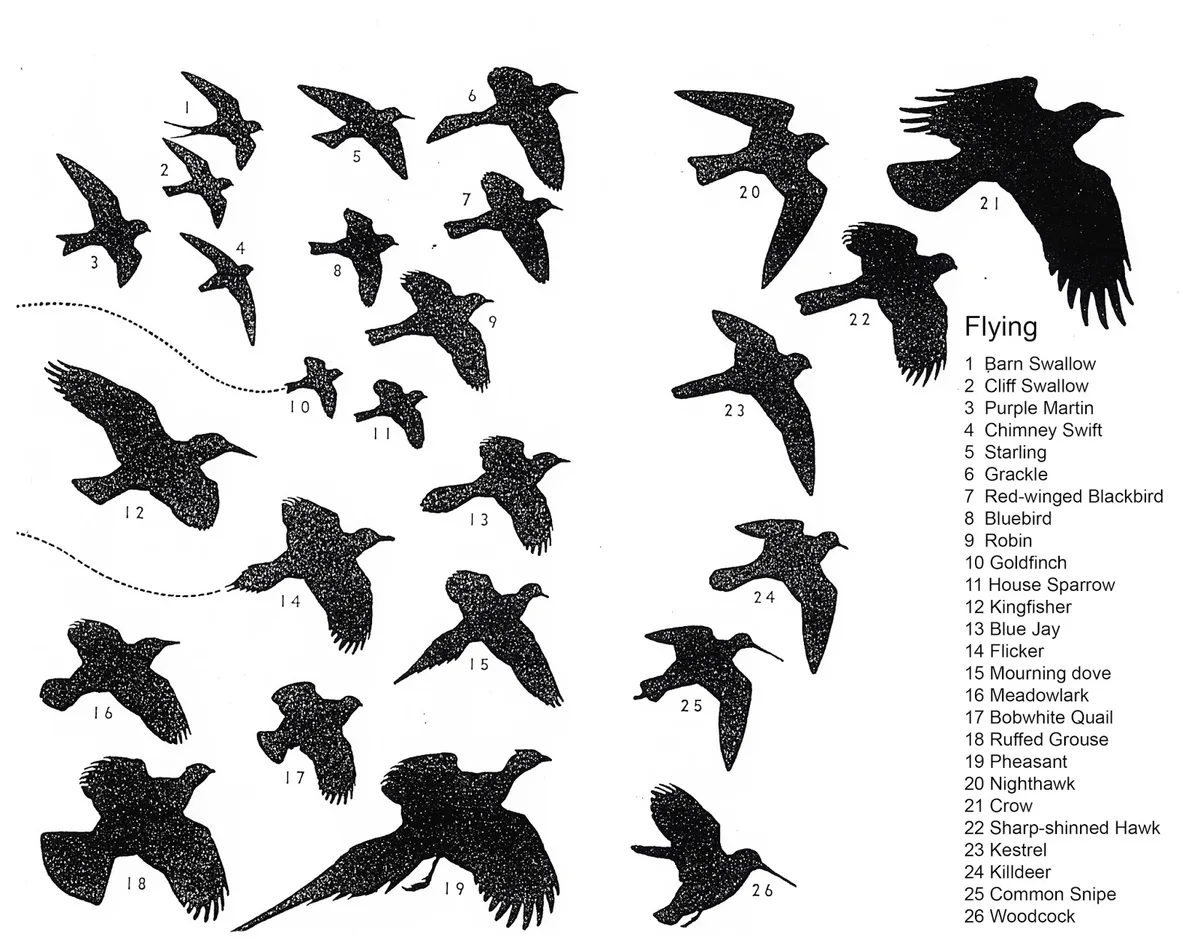
Image source: Bing (Web (fair-use with source credit))
Every bird you'll ever meet walks around with its own set of visual clues. Once you learn to spot them, identification stops feeling like guessing. These five are the ones that matter most for the birds of Alabama.
| Clue | What to check | Alabama example |
|---|---|---|
| Size & shape | Sparrow-sized? Robin-sized? Crow-sized? | Northern Cardinal (robin-sized) vs. House Finch (sparrow-sized). |
| Beak shape | Thick and conical means seed eater. Thin and pointed means insect eater. | Blue Jay's stout bill vs. Brown Thrasher's curved bill. |
| Tail & wings | Tail length, white outer tail feathers, wing bars. | Eastern Towhee flashes white edges when it flies. |
| Color pattern | Head stripes, eye rings, breast spots. | Male Indigo Bunting is all blue, while the female is plain brown. |
| Behavior | Ground feeder, canopy forager, hovering, flycatching. | Eastern Phoebe pumps its tail while perched. |
Here's how to use the table. When you spot a bird, ask yourself which clue jumps out first. A large, stout-beaked bird is probably a seed eater.
A skinny, thin-billed bird is after insects. Combine that with whether it's on the ground or high in the canopy, and you've usually got the family narrowed down. Then the finer clues, like wing bars and eye rings, snap the species into place.
Alabama's Habitat Zones: A Visual Map of Where to Look
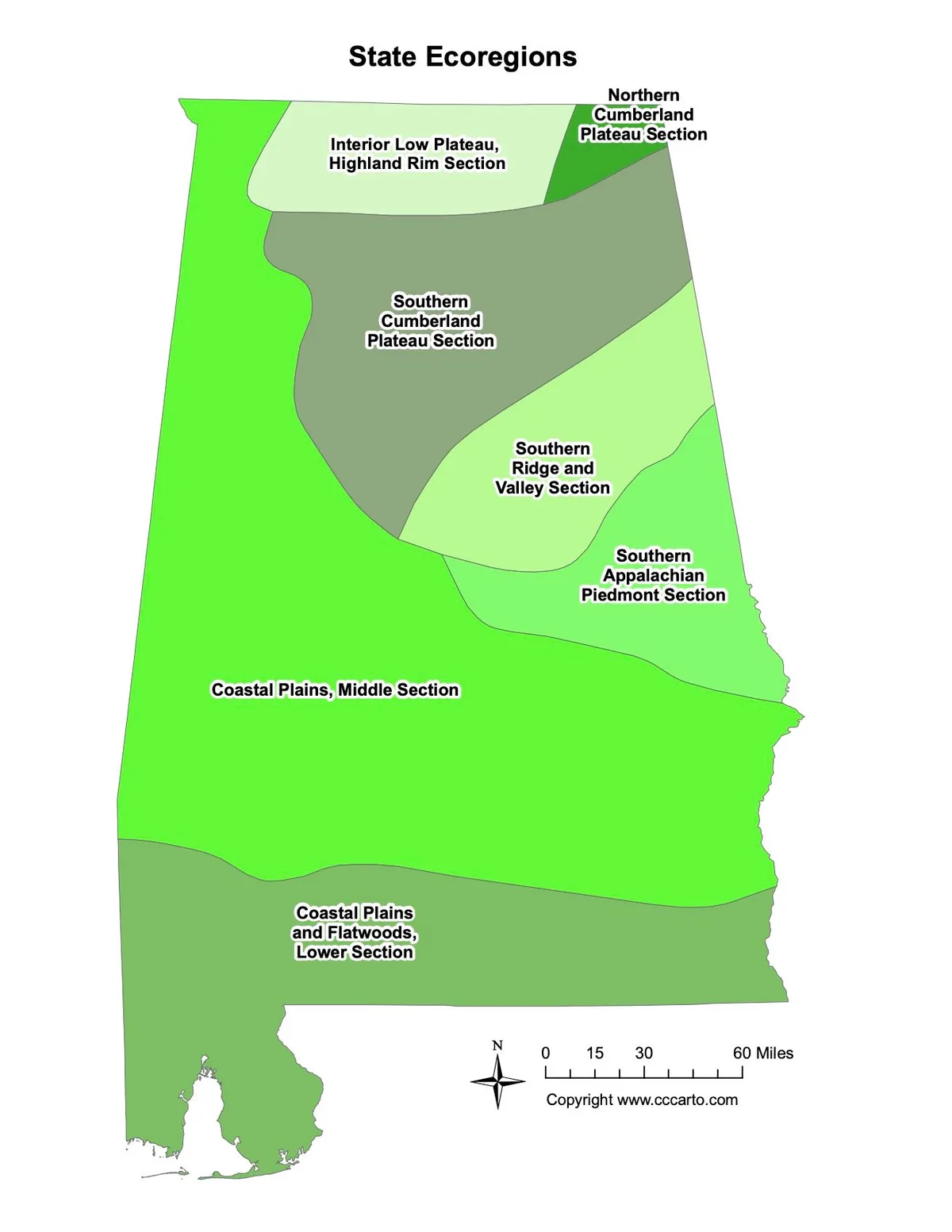
Image source: Bing (Web (fair-use with source credit))
Before you ID a bird, ask yourself where you're standing. Habitat is one of the fastest filters on the list. Alabama's ecoregions host different species, and knowing the zones saves you hours.
- Gulf Coast and salt marshes: Look for Brown Pelicans, Royal Terns, Clapper Rails, and Snowy Egrets.
- Pine Flatwoods: Brown-headed Nuthatches, Red-cockaded Woodpeckers, and Eastern Bluebirds.
- Piedmont and central Alabama: Northern Bobwhites, Prairie Warblers, and Eastern Kingbirds.
- Appalachian Highlands: Dark-eyed Juncos, Winter Wrens, and Broad-winged Hawks in summer.
These zones overlap, of course. A creek running through the Piedmont can pull in a Wood Duck or a Belted Kingfisher. But the broad habitat gives you a starting point.
In our research, herons and egrets stay close to water in every zone, so that clue is almost automatic.
Use the map above to get oriented. Then pair the habitat with the season, and you're already down to a shortlist.
Spring and Fall Migration: When the Visual Game Changes
Alabama's bird list changes dramatically between spring and fall. During spring migration, the Gulf Coast acts like a funnel. Warblers, vireos, and tanagers pile in after crossing the Gulf of Mexico.
The peak weeks run from late April through mid-May.
Fall migration is less showy but just as busy. You'll see more juveniles, and many adults trade bright breeding colors for duller ones. A male Indigo Bunting in October looks like a completely different bird from the same species in June.
That throws a lot of beginners off.
If you want to see the action, head to Dauphin Island or Fort Morgan on the coast. Inland, watch for raptors riding thermals along the mountain ridges. Even winter waterfowl numbers surge at Wheeler National Wildlife Refuge, where Sandhill Cranes show up by the thousands.
The trick is to adjust your visual expectations with the season. A yellow bird in May might be a warbler. The same yellow bird in January is almost certainly a goldfinch.
Backyard Bird ID: The 10 Residents You'll See Most
Your backyard is the best training ground. These ten species stay all year, so you'll see them again and again. Learning their shapes and behaviors makes the rest of Alabama's list easier.
- Northern Cardinal: The male's bright red is unmistakable. The female is warm brown with red accents.
- Blue Jay: Big, loud, and bold. Look for the crest and white wing bars.
- Carolina Wren: Small, round, and constantly singing. Holds its tail up.
- Tufted Titmouse: Gray, crested, with a pale belly. Often travels with chickadees.
- Mourning Dove: Sandy brown with a long pointed tail. Ground feeder.
- Northern Mockingbird: Gray with white wing patches. The state's theatrical songbird.
- Brown Thrasher: Rusty red above, streaked below, with a very long tail.
- Carolina Chickadee: Tiny, black cap, white cheeks. Acrobatic at feeders.
- Downy Woodpecker: Small black-and-white woodpecker with a short bill.
- American Goldfinch: Males are bright yellow in summer, olive-brown in winter.
These ten are your baseline. Once you can ID them in seconds, you'll have the visual vocabulary for everything else. That's when the rest of the state's bird list starts to open up.
The Look-Alike Problem: Common Birds People Confuse

Image source: Bing (Web (fair-use with source credit))
Every birder hits the same wall eventually. Two birds look nearly identical, and you start second-guessing yourself. In Alabama, the classic pair is the Downy and Hairy Woodpecker.
They share the same black-and-white pattern, the same red patch on the back of the head, and the same drumming behavior.
Here's the easiest way to tell them apart. The Downy Woodpecker has a tiny bill, about half the length of its head. The Hairy Woodpecker has a longer, chisel-shaped bill that's nearly as long as its head.
When you see them side by side, the difference is obvious.
| Identification point | Downy Woodpecker | Hairy Woodpecker |
|---|---|---|
| Bill length | Short, stubby | Long, thick |
| Overall size | Sparrow-sized | Robin-sized |
| Outer tail feathers | Black with white spots | Solid white |
| Sound | Softer, descending whinny | Sharp, loud single peck |
Another common mix-up involves Cooper's Hawks and Sharp-shinned Hawks. Both are fast, agile, and flash through backyard feeders hunting smaller birds. The Cooper's is larger with a rounded tail, while the Sharp-shinned has a squared-off tail and a smaller head.
In flight, the Cooper's flaps with a slow, steady rhythm, and the Sharp-shinned uses quick, flickering wingbeats.
Gulf Coast Specialties: Shorebirds, Pelicans, and Terns
Dauphin Island is Alabama's crown jewel for birding. It sits right in the path of spring migration, and it hosts the bird-friendly Audubon Bird Sanctuary. In one morning, you can see Brown Pelicans gliding over the surf, Black Skimmers slicing the water with their lower mandibles, and Royal Terns diving for fish beyond the breakers.
These coastal birds have visual signatures you won't find inland. The Brown Pelican is huge, gray-brown with a massive throat pouch, and it flies in tidy V-shaped lines just above the waves. The Black Skimmer has a uniquely shaped bill, with a much longer lower mandible that it drags through the water while flying.
It's one of the strangest feeding adaptations you'll see on the Gulf Coast.
Shorebirds are the hardest group on the coast. That's because most species wear the same gray and brown winter plumage. The trick is to focus on the beak shape and the legs.
Long curlews with down-curved bills stand apart from plovers with short, blunt bills and quick stop-and-run foraging patterns.
If you're new to coastal birding, start with the big showy species. Pelicans, terns, skimmers, and gulls are easy targets. After you've got those locked in, work on the small sandpipers and plovers.
Woodlands and Mountains: From Woodpeckers to Warblers
Head north and inland, and Alabama's forests open up a different set of birds. The pine flatwoods stretch across the southern half of the state, and they're home to the Brown-headed Nuthatch. This tiny bird squeaks like a rubber duck and moves along pine branches in constant motion.
It stays in family groups, so you'll usually hear several calling together.
Watch for the Red-cockaded Woodpecker in mature pine forests. It's an endangered species that excavates cavities in living pines, typically near old-growth stands. Its black-and-white barred back and large white cheek patches help separate it from other woodpeckers.
If you spot one, keep your distance. These birds rely on open, well-spaced pines that need active management.
In the Appalachian foothills, the bird community shifts again. Dark-eyed Juncos come down from higher elevations in winter, and you'll find them scratching at the forest floor for seeds. Winter Wrens hide in rhododendron thickets near cold streams, singing a remarkably long, bubbling song.
Broad-winged Hawks pass through during migration, and they're one of the easier raptors to ID because of their broad, rounded wings and compact body.
The visual takeaway here is simple. Habitat dictates the birds. Pine stands give you nuthatches and endangered woodpeckers.
Damp mountain coves give you wrens and juncos. Pay attention to the trees around you, and the bird list narrows itself.
Winter Waterfowl: Identifying Ducks on Alabama Lakes
When temperatures drop, Alabama's lakes fill with ducks. Wheeler National Wildlife Refuge near Decatur is the top spot. On a good winter day, you can see more than 30,000 ducks and geese, plus the legendary Sandhill Crane flocks that gather by the thousands along the Tennessee River.
The first thing birders should learn is the split between dabbling ducks and diving ducks. Dabblers like Mallards and Northern Pintails tip forward in shallow water, feeding with their tails in the air. Divers like Canvasbacks and Ring-necked Ducks disappear beneath the surface and pop up somewhere nearby.
The behavior alone tells you which family you're looking at.
| Clue | Dabbling ducks | Diving ducks |
|---|---|---|
| Body position | Tail up, head down | Low in the water, almost submerged |
| Feeding style | Tip-up at the surface | Fully dive underwater |
| Takeoff | Jump straight up | Run across the water first |
| Alabama examples | Mallard, Pintail, American Wigeon | Canvasback, Scaup, Ring-necked Duck |
Visual field marks matter too. A male Mallard has a glossy green head and a narrow white collar. A male Northern Pintail shows a chocolate-brown head and a long, pointed tail.
Canvasbacks have that distinctive sloping forehead and red head. Ring-necked Ducks are named for the faint brown ring around their neck, but you'll more easily spot their gray sides and peaked head shape.
Bald Eagles winter at Wheeler too. They're not ducks, but they're a huge draw every January during the refuge's eagle awareness events.
Using Your Field Guide and Binoculars Correctly
Your gear matters more than your patience. Binoculars are the single most important tool for identifying the birds of Alabama, and the best pair for beginners is an 8×42 model. The 8 means eight times magnification.
The 42 is the diameter of the objective lens in millimeters, which controls how much light reaches your eyes.
You don't need a spotting scope for most Alabama birding. A quality pair of binoculars is enough, and the same species you're trying to ID will appreciate you staying farther away.
Field guides fall into two camps. Illustrated guides like the Sibley Guide to Birds use painted plates that highlight all the important field marks. Photo guides like National Geographic show realistic lighting but can look noisy.
For beginners, illustrations usually win because they simplify the bird to its identifying features.
And don't forget the apps. Merlin Bird ID from the Cornell Lab has changed the game for beginners. It asks where you are and what you see or hear, then narrows the list to the likely candidates.
Use it in the field, but always confirm the ID with your own eyes. That's how you train the birding brain to work on its own.
The 5-Minute Visual ID Workflow
Here's a simple process that works for any bird in Alabama. It takes about five minutes, and it beats flipping through a field guide at random.
Start with size. Compare the bird to something you already know. A sparrow is small.
A robin is medium. A crow is large.
Next, check the beak. Thick and triangular means seed eater. Thin and pointy means insect eater.
Hooked means raptor.
Then look at the tail. Is it long, short, forked, or rounded? White edges and wing bars count too.
Watch the bird move for a few seconds. Does it hop on the ground? Cling to a trunk?
Hover mid-air?
Finally, use your phone or guide to match your notes against the likely species for your habitat and season. The Merlin app handles this part in seconds.
Common Visual Mistakes and How to Avoid Them
- Trusting color over pattern. Lighting changes how colors look. A bird in shadow can look gray, not blue. Pattern, like wing bars and eye rings, stays constant.
- Ignoring the tail. Tail shape and markings are decisive for hawks, flycatchers, and wrens. Always check the tail before you open your guide.
- Assuming juveniles look like adults. Young birds often wear duller, streakier plumage. A juvenile cardinal looks nothing like its parents.
- Forgetting the season. A bird you saw in May might not be the same species you're watching in January. Migration changes everything.
A Quick Visual Reference: 15 Species to Know by Heart
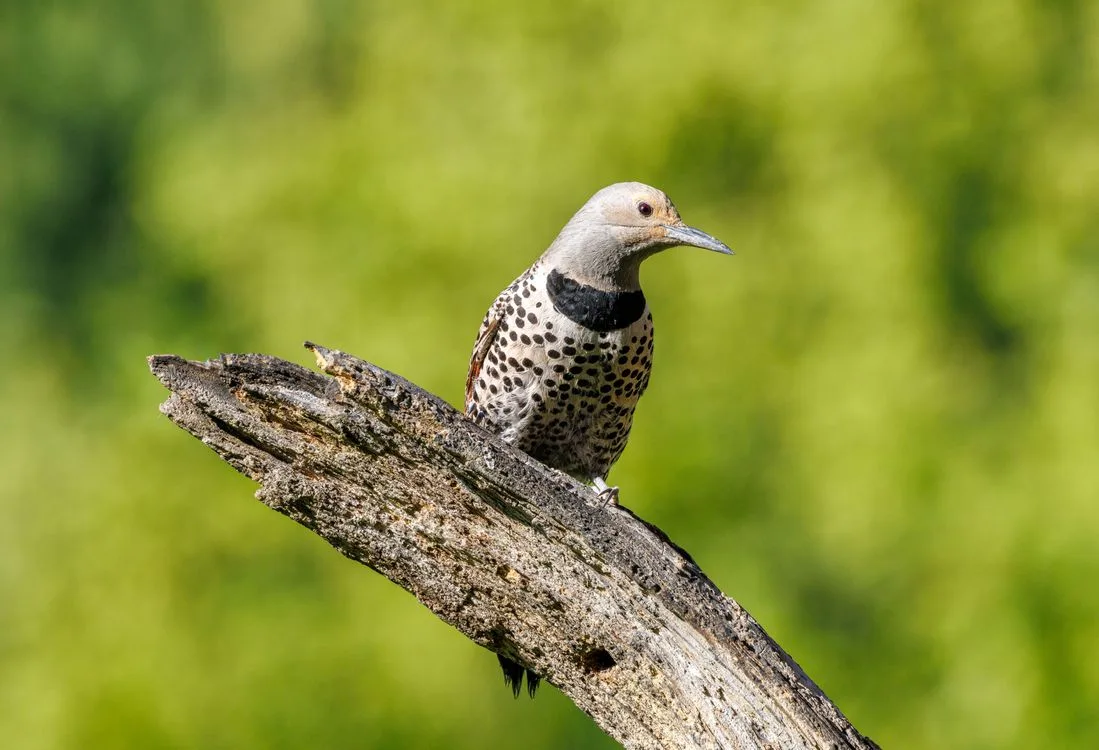
Image source: Bing (Web (fair-use with source credit))
The Northern Flicker above is Alabama's state bird, the Yellowhammer. It's a large woodpecker with a spotted belly and a black bib.
| Species | Size | Key field mark |
|---|---|---|
| Northern Flicker | Robin to crow | Black bib, spotted breast |
| Northern Cardinal | Robin | Red male, conical orange bill |
| Blue Jay | Robin | Crest, white wing bars |
| Carolina Wren | Sparrow | White eyebrow stripe, upright tail |
| Tufted Titmouse | Sparrow | Gray crest, pale belly |
| Mourning Dove | Pigeon | Long pointed tail, soft brown |
| Northern Mockingbird | Robin | White wing patches, gray body |
| Carolina Chickadee | Sparrow | Black cap, white cheeks |
| Downy Woodpecker | Sparrow | Tiny bill, black and white |
| Red-bellied Woodpecker | Robin | Red cap, zebra back |
| Eastern Bluebird | Sparrow | Blue above, rust breast |
| American Goldfinch | Sparrow | Yellow in summer, olive in winter |
| Brown Thrasher | Robin | Long tail, streaked belly |
| Eastern Towhee | Sparrow | Black hood, rufous sides |
| White-throated Sparrow | Sparrow | White throat patch, yellow lores |
Your Next Steps: Practice Where It Matters
Start in your backyard. These fifteen species show up almost everywhere, and they don't fear human presence like shyer forest birds do.
Once you've got them memorized, graduate to a local park or greenway. Work a single trail slowly. Stop, look, and listen.
Count every bird you see.
Finally, plan a trip to Dauphin Island in April. It's the single best birding weekend you can have in Alabama. Our research shows that most beginners come home with five to ten new lifers after one visit.
Frequently Asked Questions
What is the most common bird in Alabama?
The Northern Cardinal is the most common year-round bird across the state. It appears in every habitat zone, from coastal scrub to mountain woodland. Its bright red color makes it the easiest bird for beginners to confirm.
What birds are unique to Alabama?
No bird lives only in Alabama. However, the Red-cockaded Woodpecker relies heavily on Alabama's mature pine forests. The state also hosts significant wintering populations of Sandhill Cranes, especially around Wheeler National Wildlife Refuge.
When is the best time to go birding in Alabama?
April is the peak month for spring migration, especially along the Gulf Coast. Early mornings between sunrise and 10 a.m. offer the most activity. Fall migration runs from September through October, but the variety is lower than spring.
Do I need binoculars to identify birds in Alabama?
Yes. Most backyard birds are small and move quickly. An 8×42 pair is the standard recommendation for beginners.
The 8x magnification is stable, and the 42mm lens gathers enough light for early morning and late afternoon viewing.