Fish Beginning with B: From Barracuda to Betta
You look up fish that start with b and get a messy list. Bass, betta, bluegill, barracuda. But which one are you actually looking at?
That's the real question, and words alone don't answer it.
As of 2026, the International Game Fish Association lists over 40 B-named species with recognized records, and several completely unrelated fish share the word "bass" in their name. That's why identification comes down to visual cues, not vocabulary.
Quick Answer
Yes, many fish start with b. The most common are bass, bluegill, betta, and barracuda. Each belongs to a different family.
You identify them by body shape, mouth position, and fin structure. That's the whole game.
Why "Fish That Start With B" Is a Visual Game
Names fail you fast in the fish world. Common names are regional, sloppy, and often misleading. A "bream" in Alabama is a bluegill.
A "bass" in Australia might be a barramundi. And a "blackfish" can mean something completely different depending on which coast you're standing on.
This is why visual identification matters more than memorizing names. When you know what to look at, the fish basically tells you what it is. The good news is that B-named fish have some of the most recognizable body shapes in the water.
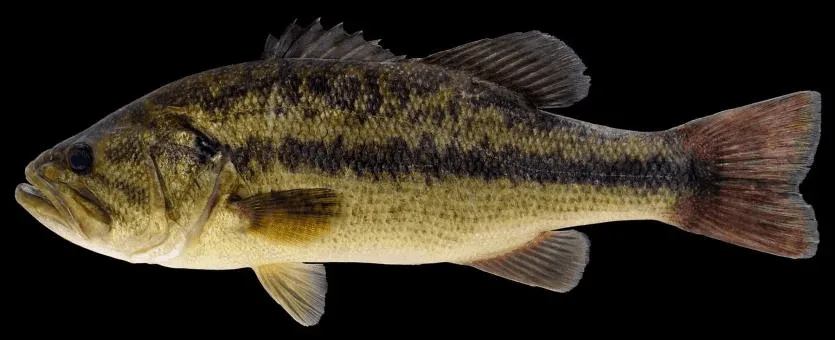
Image source: Web (Bing) / usangler.com (Web image (fair-use with source credit))
The trick is to stop guessing and start looking. Once you check a few key spots on the fish's body, the name reveals itself. That's what we're walking through here.
The 4 Visual Cues That ID Any "B" Fish
Every fish in the B club has four features worth checking. You don't need a microscope or a biology degree. You just need to look at the right places.
1. Mouth position
The mouth tells you more than almost anything else. A largemouth bass has a jaw that extends past the eye. A smallmouth's jaw stops right at the eye.
Fish that feed on the bottom, like a bonefish or catfish, have a mouth that points downward. If a fish eats from the surface, its mouth points upward.
2. Dorsal fin shape
The fin along the back is a giveaway. Bluegill and crappie have a single dorsal fin with sharp spines. Striped bass have two separate dorsal fins.
A bichir has a long, continuous fin running down most of its back that looks almost like a ridge.
3. The ear flap
Sunfish like bluegill have a dark, flexible flap extending backward from the gill cover. That little piece of tissue is often the fastest way to tell a bluegill from a redear sunfish. Redears have a longer, narrower flap with a red or orange edge.
4. Tail fin shape
Is the tail forked, rounded, or square? Bluefish and bonefish have deeply forked tails built for speed. A bluegill has a rounded tail.
A shark's tail is tall and asymmetrical, with the top lobe much longer than the bottom.

Image source: Web (Bing) / teacherspayteachers.com (Web image (fair-use with source credit))
If you're ever stuck, check these four features in order. The fish usually narrows itself down to one family by the time you hit the tail.
Freshwater "B" Fish: Bass, Bluegill, and Bullhead ID
Freshwater B-named fish are the most common ones people want to identify. They show up in ponds, lakes, and rivers across North America. Here's how to tell the big players apart.
| Species | Body Shape | Key Field Mark | What It Tells You |
|---|---|---|---|
| Largemouth Bass | Thick, elongated body | Jaw extends past the eye | A classic ambush predator |
| Smallmouth Bass | Sleeker, golden-brown body | Jaw aligns with the eye | Prefers cooler, rockier water |
| Bluegill | Deep, flattened body | Dark ear flap, dark spot on dorsal fin | A panfish, part of the sunfish family |
| Black Crappie | Thin, compressed body | 7 to 8 spines in dorsal fin, dark blotches | Slower, brushy-water fish |
| Brown Bullhead | Slender, scaleless body | Chin barbels (whiskers) | A member of the catfish family |
The easiest split is between bass and panfish. Bass have wider mouths and a more torpedo-like build. Bluegill and crappie look taller from the side, almost oval, with much smaller mouths.
If you're curious about other B-named animals beyond the fish world, we've got a broader list that covers everything from badgers to bison in our animal directory.
Saltwater "B" Fish: Barracuda, Bonefish, and Bluefish ID
Saltwater B-named fish bring different challenges. You're often trying to ID something quickly on a boat, from a dock, or in a photo. These three are the ones people confuse most.
Great barracuda: Long, snakelike body with a pointed head and a mouth full of razor-sharp teeth. The tail is deeply forked. On its side, you'll see scattered dark blotches.
There's nothing else like it in the water.
Bonefish: Sleek and silver, built for speed on shallow flats. The mouth is small and points downward, perfect for rooting in the sand. They're often called the "ghost of the flats" because their silvery color reflects the bottom.
Bluefish: Stocky and muscular with a forked tail and a mouth full of conical teeth. The most distinctive feature is the sharp, slightly curved dark patch at the base of the pectoral fin. They also have a noticeable lateral line that curves sharply toward the head.
The habitat helps too. Bonefish live in shallow tropical flats. Bluefish roam the open Atlantic coast.
Barracuda hang around reefs, wrecks, and warm shallows. If you know where you saw the fish, you're already halfway to an ID.
For anglers who want authoritative species profiles, NOAA Fisheries keeps updated stock and identification resources on their official site.
Aquarium "B" Fish: Betta, Barbs, and Bristlenose Pleco ID
Aquarium B-named fish are the ones most likely to end up on your phone, but they still get mislabeled constantly.
Betta / Siamese fighting fish: The flowing, layered fins are the giveaway. Males show long, trailing fins in blues, reds, and iridescent greens. Females have short fins and pale vertical bars when stressed.
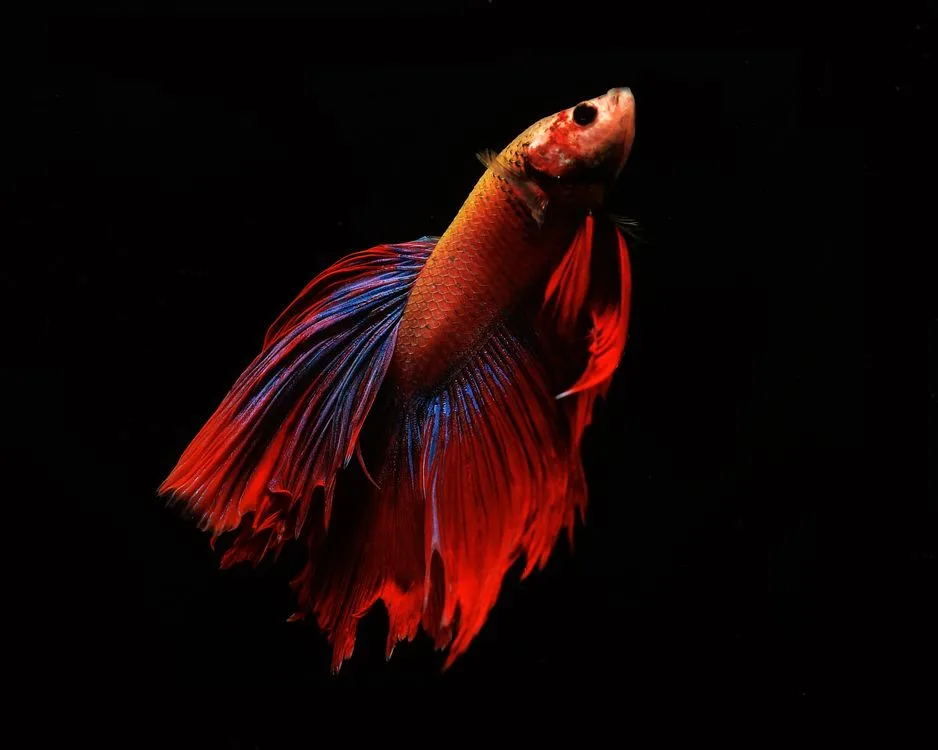
Image source: Bing (Web (fair-use with source credit))
Tiger barb: Silver to gold body with four bold black vertical stripes. The dorsal fin is black on top, and the body sits tall and compressed. They're fast, active shoalers that need a group of at least six.
Cherry barb: Much smaller and calmer than the tiger barb. A horizontal gold-to-red stripe runs down the side. Males turn deep cherry-red when breeding.
Bristlenose pleco: Flat, armored head with tentacle-like bristles on the snout of mature males. The body is brown or mottled, and the sucker mouth sits on the underside.
The betta's fins alone separate it from everything else on this list. Cherry barbs and bettas tolerate varied water conditions, which makes them solid first-tank choices. Bristlenose plecos stay under 5 inches, a manageable size for a 20-gallon tank.
If you're building a full species list for home reference, our C-animal collection is a useful companion.
Largemouth vs. Smallmouth Bass: A Visual Breakdown
These two get mixed up more than any other freshwater pair. Both belong to the sunfish family, but they look clearly different once you know what to check.
The jaw test
Largemouth bass have a jaw that extends well past the back edge of the eye. Smallmouth bass have a jaw that stops right at the eye. That's the single most reliable field mark on either fish.
Body shape and color
Largemouth bass look thicker and heavier behind the head. The dorsal fin shows a deep notch between the spiny and soft sections. Smallmouth bass have a sleeker body with a more continuous dorsal fin.
Largemouths run green with a dark horizontal stripe. Smallmouths show bronze and golden-brown with faint vertical bars.
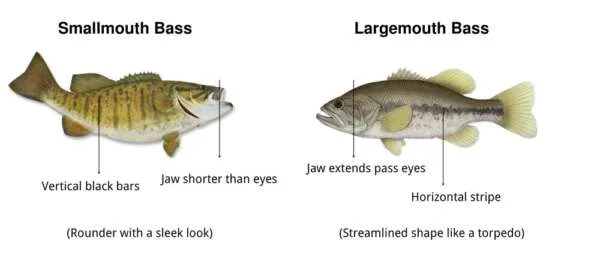
Image source: Bing (Web (fair-use with source credit))
Where they live
The habitat difference often does the identifying for you. Largemouth bass sit in warm, weedy, slow-moving water. Smallmouth bass prefer cool, clear, rocky lakes and rivers.
When both exist in one system, they split the habitat so cleanly that mixed catches are rare.
Bluegill vs. Black Crappie vs. Redear: Telling Panfish Apart
Panfish are notorious for being lumped together as "bream" or "sun perch." Once you know the three most common B-named panfish, the whole group opens up.
Bluegill
Round, deep body with a dark spot on the soft part of the dorsal fin. The gill flap is solid dark blue to black. Males develop a copper-orange chest during the spring spawn.
Black crappie
Silver-olive body covered with irregular dark blotches. The dorsal fin has 7 to 8 spines. Crappie also have deeper, more compressed bodies than bluegill, almost disc-shaped from the side.
Redear sunfish
The gill flap has a bright red or orange edge, which is the fastest marker in the group. The body is taller and more oval than a bluegill, and there's no dark spot on the dorsal fin.
| Trait | Bluegill | Black Crappie | Redear Sunfish |
|---|---|---|---|
| Ear flap | Dark blue to black | Pale with no distinct flap | Red or orange edge |
| Dorsal spines | 10 | 7 to 8 | 10 to 11 |
| Side pattern | Faint vertical bars | Dark blotchy spots | Faint gold streaks |
| Mouth size | Small | Large for a panfish | Small |
If you enjoy this visual ID approach, our alphabetical species breakdowns cover similar territory for land animals.
Common Visual Mistakes: Size, Color Phase, and Regional Nicknames
People misidentify B-named fish for three main reasons.
Size ranking
Everyone assumes a bigger fish is a different species. A 2-pound bluegill looks like a completely different animal than a 10-inch bluegill, but it's the same species. Size varies with age, genetics, and water temperature.
Color phase
Many fish change their appearance dramatically. Largemouth bass turn nearly black in dark, stained water. Bluegill develop bright breeding colors in spring and look washed out by fall.
Bettas darken and change intensity based on stress levels and water quality.
Regional nicknames
The same fish carries five different local names. Bluegill go by bream, sun perch, or copperbelly. Black crappie are called speckled perch, papermouths, or strawberry bass.
Cross a state line and you'll hear completely different words for the same fish.
The same confusion plays out in land animals too. Our mammal guides show how common-name overlap works in other groups.
The B Fish Quick-ID Reference Chart
Here's the cheat sheet. Use it when you're standing at the water's edge or staring into your aquarium.
| Fish | Habitat | Signature Visual Cue | Adult Size |
|---|---|---|---|
| Largemouth Bass | Freshwater lakes and ponds | Jaw extends past the eye | 12-24 inches |
| Smallmouth Bass | Cool, rocky freshwater | Jaw stops at the eye | 12-20 inches |
| Bluegill | Freshwater ponds and lakes | Dark ear flap and dorsal spot | 6-10 inches |
| Black Crappie | Slow freshwater, brushy areas | Dark blotches and 7-8 dorsal spines | 8-14 inches |
| Striped Bass | Atlantic coast and rivers | 7 horizontal dark stripes | 20-40 inches |
| Great Barracuda | Tropical reefs and shallows | Long toothy snout, dark blotches | 3-6 feet |
| Bonefish | Tropical sand flats | Downward-pointing mouth | 18-30 inches |
| Bluefish | Open Atlantic coast | Dark curved patch at pectoral fin | 12-30 inches |
| Betta | Aquarium / rice paddies | Flowing fins and bright colors | 2-3 inches |
| Tiger Barb | Aquarium / Southeast Asia | Four black vertical stripes | 2-3 inches |
| Bristlenose Pleco | Aquarium / rivers | Bristles on snout, flat armored body | 4-5 inches |
This chart handles the fish people actually see in the wild and in tanks. For deeper verification on native and invasive species, the U.S. Fish & Wildlife Service keeps updated identification resources by region.
Pro Moves: How to Use Range and Habitat to Confirm the ID
Four quick moves that lock in the identification before you even look at fins.
1. Match the water type
Freshwater narrows you down to bass, panfish, bullhead, and aquarium escapees. Saltwater brings barracuda, bonefish, bluefish, and sharks. That one split cuts your list in half.
2. Ask where you're standing
A fish from a rocky river is rarely a pond fish. A fish from a grassy flat is almost never a reef fish. Habitat is a filter that removes most of the remaining names instantly.
3. Check for invasive species
Peacock bass are established but non-native in Florida. Blue catfish are invasive in several Atlantic rivers. If you catch an unexpected B-named fish, report it to your state wildlife agency.
4. Take a photo before release
A side-angle photo with the mouth closed is the most useful tool you have. Blurry dorsal fins and photos from above are nearly impossible to verify. One clean photo beats ten minutes of guessing.
Frequently Asked Questions
What is the most common fish that starts with b?
The bluegill is probably the most commonly encountered B-named fish in North America. It lives in nearly every pond and lake in the eastern and central states. Largemouth bass are also common, but bluegill outnumber them in most waters.
Are betta fish good for beginners?
Yes, but not in a bowl. Bettas need at least 5 gallons of heated, filtered water. They're hardy and tolerate a range of conditions, but they need warmth to stay healthy.
What is the biggest fish that starts with b?
The basking shark, which reaches over 30 feet long. Bluefin tuna and blue marlin are the largest bony fish in the group, hitting 10 feet and more than 1,000 pounds.
Do barracuda eat humans?
No. Barracudas occasionally strike at shiny objects that resemble fish, which is why divers avoid wearing jewelry in murky water. Attacks on people are extremely rare and almost always surface-related.
What fish starts with b and ends with n?
The bluefin, as in the bluefin tuna. It's the most common answer, though "brown" appears in brown bullhead and brown trout as well.
What is the best beginner aquarium fish that starts with b?
The blackskirt tetra is a strong pick. They're hardy, peaceful, and tolerate a wide range of water conditions. Bettas also work for newcomers, provided they have a heated 5-gallon tank or larger.
Both options forgive the occasional rookie mistake.