Reptiles Starting With C: From Caiman to Chameleon
If you've ever tried to identify a reptile, you know the struggle. You spot something scaly, you're pretty sure it starts with "C," and then you're stuck wondering if it's a caiman or a crocodile, a coral snake or a corn snake. That mental block is real.
The reptiles that start with C cover everything from harmless backyard lizards to some of the most venomous snakes on the planet, and telling them apart matters more than you might think.
Getting this right isn't just about winning trivia night. It's about safety, responsible pet ownership, and knowing what you're looking at in the wild. The good news is that the C-reptile family tree splits into a few clear branches.
Once you know which branch you're on, the identification gets a whole lot easier. As of 2026, herpetologists recognize roughly 12,000 reptile species worldwide. A solid chunk of those common names begin with C.
Let's break them down the way a field guide would: step by step, branch by branch.
Quick Answer
The main reptiles that start with C are caimans, chameleons, chuckwallas, coachwhips, cobras, collared lizards, coral snakes, corn snakes, crocodiles, and crested geckos. Also included are caiman lizards and common snapping turtles. They split into three groups: lizards, snakes, and crocodilians.
Venomous species include cobras and coral snakes. Safe beginner pets include corn snakes and crested geckos.
Step 1: Does It Have Legs? (The First Branch)
The very first thing you need to do is look for limbs. That single observation splits the entire C-reptile family into two massive groups. Lizards have legs.
Snakes don't. Crocodilians have short, stubby legs that sit close to the body. It sounds obvious, but you'd be surprised how many people freeze up when they're actually face-to-face with a reptile in the wild.
If the animal has clearly visible legs and walks normally, you're looking at a lizard. That puts you in the territory of chameleons, chuckwallas, collared lizards, caiman lizards, or crested geckos. Each one has a distinct body type that narrows things down further.
Chameleons have that unmistakable compressed body and curled tail. Chuckwallas are stocky and wide-bodied, built like a small tank. Collared lizards are slender with long tails and run on their hind legs when they need speed.
If there are no legs at all, you're dealing with a snake. That brings you to coachwhips, cobras, coral snakes, and corn snakes. The legless branch splits again based on venom and behavior.
We'll get to that in a moment.
Crocodilians are the tricky ones because they have legs, but they're not lizards. Caimans and crocodiles have thick, armored bodies, powerful tails, and eyes that sit on top of their heads. If the reptile is near water and looks like a log with teeth, you're on the crocodilian branch.
Here's a quick visual breakdown:
| Legs? | Group | C-Species Examples |
|---|---|---|
| Yes, normal limbs | Lizard | Chameleon, Chuckwalla, Collared Lizard, Caiman Lizard, Crested Gecko |
| No limbs | Snake | Coachwhip, Cobra, Coral Snake, Corn Snake |
| Yes, short stubby limbs | Crocodilian | Caiman, Crocodile |
| Yes, webbed with shell | Turtle | Common Snapping Turtle |
The common snapping turtle gets overlooked in most C-lists, but it absolutely belongs. It has legs, a shell, and a beak-like mouth. If you see it near freshwater with algae on its back, you've found one.
Step 2: Snake or Danger Noodle? (Venomous vs. Non-Venomous C-Snakes)
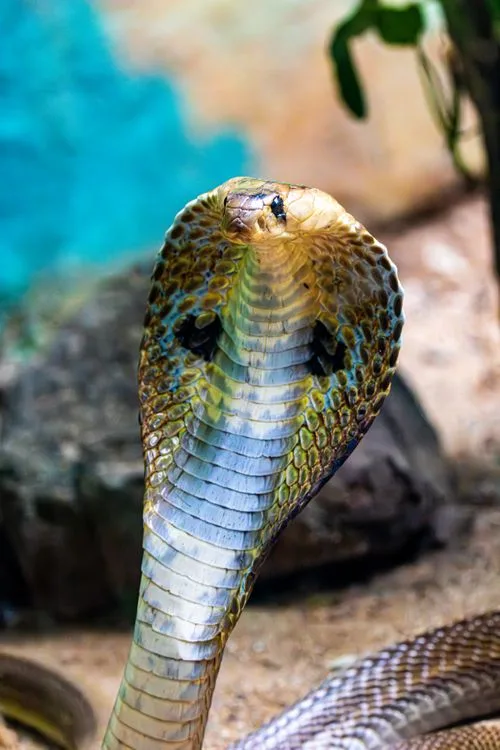
Image source: Web (Bing) / pexels.com (Web image (fair-use with source credit))
So you've confirmed it's a snake with no legs. Now comes the question that actually matters: is it venomous? Among common C-snakes, two groups demand serious respect: cobras and coral snakes.
The other two, coachwhips and corn snakes, are harmless to humans.
Cobras are the poster children for dangerous snakes. They belong to the genus Naja and related groups. When threatened, they raise the front third of their body and spread their neck into that iconic hood.
That display alone is a dead giveaway. Cobras are found across Africa, the Middle East, and Asia. They're responsible for thousands of bites each year, though antivenom exists for most species.
If you see a snake hooding up, back away slowly and give it space.
Coral snakes are a different story. They're shy, secretive, and rarely bite unless provoked. But their venom is a potent neurotoxin that can cause paralysis.
The danger with coral snakes is that they look like several non-venomous snakes with red, yellow, and black bands. The old rhyme helps: "Red touch yellow, kill a fellow. Red touch black, friend of Jack." It works in North America, though it's less reliable in other parts of the world.
On the harmless side, coachwhips are fast, slender snakes found across the southern United States. They get their name from the braided-whip appearance of their scales. They're aggressive when cornered but not venomous.
Corn snakes are the gentle giants of the C-snake world, famous in the pet trade for their docile nature and striking orange-red patterns.
Here's the safety branch:
| Snake | Venomous? | Geographic Range | Telling Feature |
|---|---|---|---|
| Cobra | Yes | Africa, Asia, Middle East | Raised hood when threatened |
| Coral Snake | Yes | Americas, Asia | Red/yellow/black band pattern |
| Coachwhip | No | Southern and central USA | Braided whip-like scales |
| Corn Snake | No | Eastern USA | Orange-red with black-bordered blotches |
If you can't positively identify a snake as harmless, treat it as venomous. That's not paranoia. That's the standard wildlife safety rule.
Step 3: If It's a Lizard, Where Did You See It?
For the legless branch, venom is the big question. For lizards, it's all about location. Where you spot a C-lizard tells you more than almost any other single clue, because each species has a tightly defined habitat.
Chuckwallas are desert specialists. They're found in the arid regions of the southwestern United States and northern Mexico. They love basking on rocky outcrops and will retreat into crevices when scared.
They're herbivores, munching on leaves, flowers, and fruit. If you see a plump, wide lizard in the desert sun, it's almost certainly a chuckwalla.
Collared lizards share some of that desert territory but behave differently. They're active hunters that chase down insects and smaller lizards. They're named for the dark bands around their necks that look like a collar.
Watch them run on their hind legs and you'll never forget it.
Chameleons flip the script entirely. They're arboreal, meaning they spend almost all their time in trees and bushes. They're native to Africa, Madagascar, southern Europe, and parts of Asia.
Their grasping feet and prehensile tails make them perfectly adapted for life off the ground. If you see a lizard with independently moving eyes and a curled tail in a tree canopy, it's a chameleon.
Crested geckos are another arboreal species, but they're nocturnal. They were thought to be extinct until rediscovered in New Caledonia in 1994. They're now one of the most popular pet reptiles in the world.
In the wild, they live in tropical rainforest canopies and come down to the ground only rarely.
Caiman lizards are the aquatic oddballs. They're found in South America, specifically in the Amazon and Orinoco basins. Their heavy, keeled scales make them look like a miniature dragon.
They spend most of their time in or near water and have a specialized diet of snails and crawfish. If you see a large, heavily armored lizard basking on a riverbank in South America, you've found a caiman lizard.
Here's the habitat flow:
- Desert rocks and crevices → Chuckwalla or Collared Lizard
- Tree canopy, day activity → Chameleon
- Tree canopy, night activity → Crested Gecko
- Rivers and swamps in South America → Caiman Lizard
Step 4: Crocodilian Check — Caiman or Crocodile?
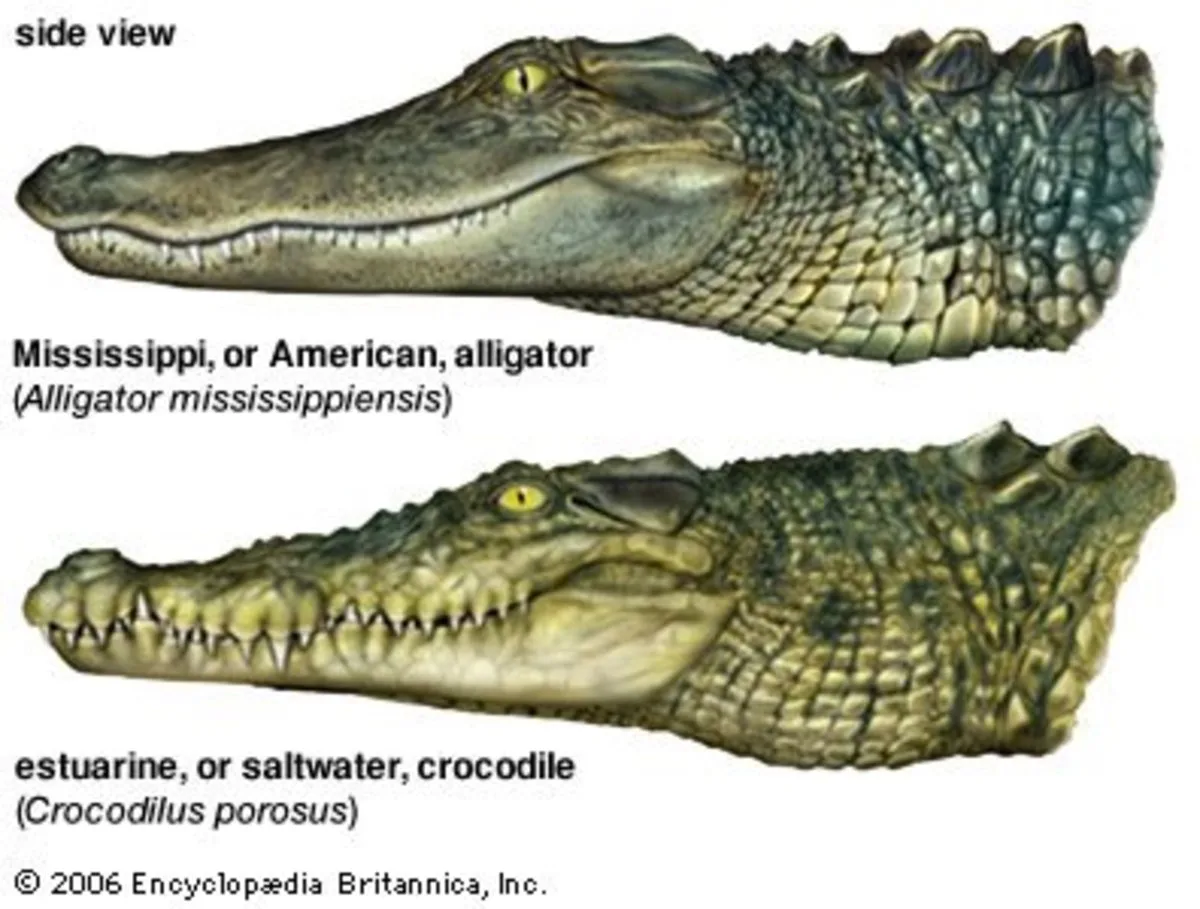
Image source: Bing (Web (fair-use with source credit))
If you've got a big, armored reptile lurking near water, you're dealing with a crocodilian. Now you need to figure out which one. The two main C-names here are caiman and crocodile.
They look similar at first glance, but a few key differences separate them.
The most reliable field mark is the snout shape. Alligators and caimans have broad, U-shaped snouts built for crushing. Crocodiles have narrower, V-shaped snouts designed for grabbing and holding.
When you look at the animal from above, the difference is obvious. A caiman's snout looks rounded and blunt. A crocodile's snout looks pointed and streamlined.
Size is another clue. Caimans are generally smaller. Most species max out between 4 and 8 feet, though the black caiman in the Amazon can reach 16 feet.
True crocodiles get much bigger. The saltwater crocodile, the largest living reptile, can exceed 20 feet and weigh over 2,000 pounds. The Nile crocodile and American crocodile also dwarf most caimans.
Geographic range settles the argument in many cases. Caimans are native only to Central and South America. Crocodiles have a much wider distribution across Africa, Asia, Australia, and the Americas.
There's only one caiman species in the United States, and it's an introduced population in southern Florida. American crocodiles, by contrast, are native to the southern tip of Florida.
Here's the quick comparison:
| Feature | Caiman | Crocodile |
|---|---|---|
| Snout shape | Broad, U-shaped | Narrow, V-shaped |
| Typical adult size | 4-8 feet | 8-20+ feet |
| Geographic range | Central and South America | Africa, Asia, Australia, Americas |
| Tooth visibility | Teeth hidden when mouth closed | Fourth lower tooth visible |
One more tip: look at the teeth when the mouth is closed. Crocodiles have a distinctive lower fourth tooth that juts up over the upper jaw. Caimans and alligators don't show that tooth.
It's a small detail, but it's the kind of thing field biologists use to make a positive ID.
Step 5: The "C" Reptile Finder: A Simple Decision Flow
Here's the entire process distilled into a practical flowchart you can carry in your head. If you go through these steps in order, you'll land on the right answer almost every time.
Step 1: Check for legs.
- No legs → it's a snake. Go to Step 2.
- Legs present → go to Step 3.
Step 2: Snake branch.
- Is it hooding its neck? → Cobra. Back away.
- Red, yellow, and black bands? → Coral snake. Back away.
- Slender, fast, braided scales? → Coachwhip. Harmless.
- Orange-red with blotches? → Corn snake. Harmless.
Step 3: Lizard or crocodilian?
- Shell on its back? → Common snapping turtle.
- Short stubby legs, armored body, near water? → Go to Step 4.
- Normal lizard legs? → Go to Step 5.
Step 4: Crocodilian branch.
- Broad U-shaped snout, Central or South America? → Caiman.
- Narrow V-shaped snout, Africa/Asia/Australia? → Crocodile.
Step 5: Lizard habitat branch.
- Desert rocks, plump body? → Chuckwalla.
- Desert, slender, running on hind legs? → Collared Lizard.
- Tree canopy, curled tail, day active? → Chameleon.
- Tree canopy, night active, sticky toe pads? → Crested Gecko.
- Riverbank in South America, heavily armored? → Caiman Lizard.
That's the whole system. Four questions, five branches, and you've narrowed it down to the correct family. The more species you encounter, the faster this process becomes.
Eventually, you'll recognize most of these animals at a glance without even thinking about the steps.
For a deeper dive into the broader animal kingdom, you might enjoy our guide to all animals starting with C. It covers the mammals, birds, and fish that share these names too. Or check out our lists for animals starting with B and animals starting with A to round out your knowledge.
The key takeaway here is simple: start with the big picture, then narrow down. Legs or no legs. Venomous or harmless.
Desert or rainforest. Caiman or crocodile. Each decision cuts the possibilities in half until you're left with the right answer.