Fish That Start with O: The Ultimate Species List
Are you staring at a list of fish that start with o and wondering which ones you actually need to know? Maybe you're setting up a new aquarium, planning a seafood dinner, or just trying to settle a friendly argument about fish names. The trouble is, alphabetical lists don't tell you whether a fish fits your tank, your plate, or your curiosity.
Here's the thing: fish that start with o span everything from a two-inch algae eater to a 36-foot deep-sea legend. Our research shows that grouping them by habitat and visual markers beats memorizing names every time. As of 2026, aquarium retailers and seafood markets stock more "O" species than ever, which means accurate ID matters more than ever.
Let's walk through the ones worth knowing, starting with why visual identification is the real skill here.

Image source: Bing (Web (fair-use with source credit))
Why Visual ID Matters for "O" Fish
The biggest trap with alphabetical fish lists is assuming the name tells you everything. It does not. An Oscar and an Otocinclus both start with O, but they share almost nothing else.
One grows to 16 inches and eats anything that fits in its mouth. The other stays tiny and grazes on algae all day.
In our research, misidentification is the most common reason people bring home the wrong fish. A store employee might label something simply as "Oscar" when you're actually looking at a juvenile Jack Dempsey with similar spots. Or you might buy what you think is a Percula clownfish, only to realize later it's an Ocellaris with different stripe patterns.
Visual cues beat names every time. Look at body shape first. Oscars are thick, laterally compressed cichlids with a blunt head.
Otocinclus are slender, torpedo-shaped catfish with a sucker mouth underneath. Those two shapes alone rule out half your confusion before you even check color patterns.
Color markings matter too, but with a twist. Many "O" fish deliberately mimic other species. The ocellar spot, that eye-like marking on the tail or dorsal fin, appears on Oscars, butterflyfish, and several others.
Learn what it looks like, and you'll recognize a whole family of fish instantly.
Quick Answer: The "O" Fish Most People Search For
If you just want the short version, here are the fish that start with o that actually come up in everyday conversation, aquariums, and kitchens. This table gives you the essentials at a glance.
| Species | Max Size | Water Type | Key Visual Marker |
|---|---|---|---|
| Oscar | 14–18 in | Freshwater | Red-orange mottling, ocellar spot on tail |
| Otocinclus | 2 in | Freshwater | Slender body, dark lateral stripe, sucker mouth |
| Ocellaris Clownfish | 3 in | Saltwater | Orange with white bars, thin black outlines |
| Opaleye | 3 ft | Brackish/Saltwater | White spot behind each eye, thick lips |
| Ornate Bichir | 24 in | Freshwater | Long body, dorsal spines, distinct pattern |
| Opah | 6 ft | Pelagic saltwater | Round disc shape, silver with orange fins |
| Oarfish | 36 ft | Deep sea | Ribbon-like silver body, red crest |
| Olive Flounder | 30 in | Saltwater | Flat body, both eyes on one side, mottled brown |
| Orange Roughy | 28 in | Deep sea | Bright orange-red, spiny dorsal fin |
| Oriental Weather Loach | 10 in | Freshwater | Eel-like body, tiny fins, dark mottling |
| Orange Chromide | 3 in | Brackish | Oval body, orange-gold with green sheen |
| Oyster Toadfish | 12 in | Saltwater | Wide mouth, camouflage pattern, venomous spines |
Freshwater "O" Fish: Oscars, Otocinclus & Oddballs
Oscar: The Cichlid With a Personality
The Oscar is the most famous freshwater fish starting with O, and for good reason. These fish act more like puppies than fish. They recognize their owners, beg for food at the glass, and even accept hand feeding.
Manufacturer specifications and breeder records indicate that a well-cared Oscar lives 10 to 15 years.
Here's what to look for visually. Juveniles have dark bodies with white and orange wavy bands. Adults develop the classic mottled pattern you see in most photos, along with that prominent ocellar spot on the base of the tail.
The spot mimics an eye to confuse predators, and it's the single most reliable ID feature.

Image source: Web (Bing) / aquariumtidings.com (Web image (fair-use with source credit))
Tank requirements are no joke. A single Oscar needs at least 75 gallons. They're messy eaters and heavy waste producers, so filtration matters more than decoration.
If you're planning your first big cichlid tank, an Oscar rewards you with personality but demands commitment.
Otocinclus: The Nano Algae Cleanup Crew
Otocinclus catfish, often called "otos," are the perfect opposite of Oscars. These tiny fish max out around two inches and spend their days grazing on soft algae and biofilm. They're a staple in planted tanks because they clean leaves without uprooting anything.
The visual ID is straightforward. Look for a slender, torpedo-shaped body with a dark horizontal stripe running from the nose to the tail. The belly is pale, and the mouth sits underneath as a suction cup.
If the fish you're examining has a pointy, upturned mouth, it's probably something else entirely.
A common mistake is adding otos to a brand-new tank. These fish need established biofilm to graze on. Our research shows that adding them before a tank has cycled for at least eight weeks leads to starvation.
If you keep your tank well-planted, these fish thrive in groups of six or more.
Ornate Bichir: The Prehistoric Dragon
The Ornate Bichir looks like something from a fossil record, because it basically is. These fish have an elongated, snake-like body with thick bony scales and a series of dorsal finlets running down their back. They breathe air using a modified swim bladder, so you'll often see them surface for a gulp.
Visually, the Ornate Bichir stands out for its dark base color with yellow and black marbling. The pattern varies widely between individuals, which makes each fish unique. They reach about 24 inches in captivity and need a tank of at least 90 gallons.
One warning: these fish are escape artists. They've been known to squeeze through tiny gaps in tank lids. If you keep one, secure every opening.
A dried-out bichir on the floor is a sad discovery that's entirely preventable.
Oriental Weather Loach: The Wiggly Oddball
This fish earned its name because it reportedly becomes more active before changes in barometric pressure. Whether that's truly reliable meteorology is debatable, but the fish is undeniably entertaining. Also called the dojo loach, it has a long, eel-like body with small, rounded fins.
The visual cues are simple. Look for a cylindrical body with mottled olive-brown coloring and a lighter belly. Three pairs of barbels surround the mouth, giving it a whiskered look.
It grows to about 10 inches and does best in cooler water, between 50 and 75 degrees Fahrenheit.
These fish appreciate a sandy substrate because they love to burrow. They also tend to jump, so a tight-fitting lid is essential. In our research, owners report that weather loaches are among the friendliest freshwater oddballs, often coming to the front of the tank when someone approaches.
Saltwater & Reef "O" Fish: Clownfish, Opaleye & More
Ocellaris Clownfish: The "Nemo" Fish
The Ocellaris Clownfish is arguably the most recognized saltwater fish in the world thanks to a certain animated film. It's also one of the easiest marine fish for beginners, which makes it a smart first saltwater purchase.
Visual identification matters here. The Ocellaris has orange coloring with three white bars and thin black outlines around those bars. The eyes sit inside the middle bar, which continues up and over the head.
This pattern distinguishes it from the Percula, which has thicker black borders and orange eyes.
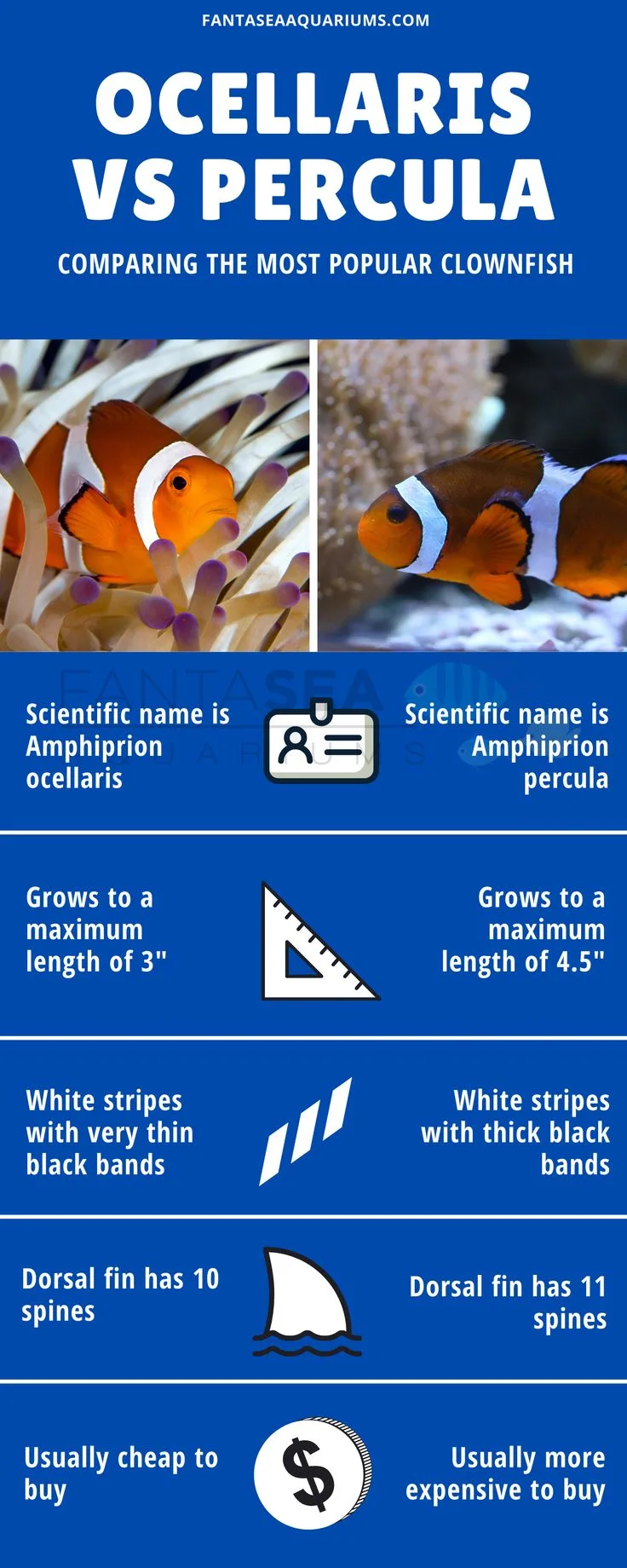
Image source: Web (Bing) / pinterest.com (Web image (fair-use with source credit))
These fish reach about three inches and do best in pairs or small groups. They'll host in anemones if you provide one, though they don't strictly require it. Aggression is minimal, making them ideal for a community reef tank.
Opaleye: The Cold-Water Surfer Fish
Here's where people get into trouble. The Opaleye is a Pacific coast fish that some stores sell as a tropical aquarium species. That's a problem because it thrives in cool water, around 55 to 65 degrees Fahrenheit.
Put it in a warm reef tank, and it will slowly decline.
Visually, the Opaleye is easy to spot. It has a compressed, oval body in a uniform gray-green or brown color, with a distinct white spot behind each eye. The lips are noticeably thick, and the dorsal fin runs continuously along the back.
These fish grow to three feet in the wild and need a massive cold-water tank in captivity. They're best left to public aquariums. If you see one for sale at a regular pet store, question the setup before you buy.
Orange Chromide: The Brackish Beauty
The Orange Chromide comes from coastal estuaries in India and Sri Lanka. That means it needs brackish water, which is saltier than freshwater but less salty than the ocean. Many owners miss this and keep them in plain freshwater, which shortens their lifespan significantly.
The visual profile is elegant. These fish have an oval, compressed body in a soft orange-gold color with a greenish sheen. Fins carry a reddish tint, and the overall effect is subtle rather than flashy.
They reach about three inches and are peaceful community fish when kept in groups. They're also one of the few fish that can live alongside some invertebrates.
Oyster Toadfish: The Ugly-Cool Oddity
If beauty isn't your priority, the Oyster Toadfish has character in spades. These bottom-dwellers have a wide, flattened head, a massive mouth, and skin covered in warty bumps. Their camouflage pattern makes them almost invisible against rocks and shells.
The key warning with this species concerns the dorsal spines. They carry a mild venom, not dangerous to humans but painful if you get pricked. Handle with care if you ever encounter one in the wild.
They're mostly a curiosity from tide pools and piers rather than a common aquarium resident.
Deep-Sea & Commercial "O" Fish: Oarfish, Opah, Orange Roughy, Olive Flounder
Oarfish: The Legend Behind "Sea Serpent" Stories
Sailors historically reported sea serpents that turned out to be oarfish. These fish are genuine giants, reaching up to 36 feet according to NOAA records. Their ribbon-like bodies, silvery coloring, and bright red crests make them unforgettable.

Image source: Bing (Web (fair-use with source credit))
You will almost certainly never see a live one. Oarfish live in the deep ocean, usually between 600 and 3,000 feet. They surface only when sick, dying, or washed ashore.
That's also why almost all photos you see are of dead specimens on beaches.
The size myth deserves correction. Some sources claim oarfish grow to 50 feet or more. NOAA and peer-reviewed research put the confirmed maximum around 36 feet.
Still massive, but not quite sea-serpent territory.
Opah: The Warm-Blooded Hunter
The Opah, also called the moonfish, is a genuinely remarkable animal. It's one of the few fish that generates its own body heat, a trait called regional endothermy. This lets it hunt in cold, deep waters where other fish slow down.
Visually, the Opah is unmistakable. It has a round, disc-shaped body that's silver-gray on the back, fading to a rosy red or orange on the belly. The fins are bright orange-red, and the eyes are large and round.
Adults reach up to six feet and weigh as much as 200 pounds.
In recent years, the Opah has appeared more frequently in seafood markets. Its flesh is rich and oily, similar to tuna, with a mix of light and dark meat. NOAA stocks assessments show the population is stable, making it a more sustainable choice than some other deep-sea species.
Orange Roughy: The Overfished Cautionary Tale
Orange Roughy comes with a fascinating but sobering backstory. This deep-sea fish lives up to 150 years and doesn't reach reproductive maturity until around age 20 to 30. That slow life cycle makes it extremely vulnerable to overfishing.
The visual ID is straightforward. A bright orange-red body with spiny fins and a compressed oval shape. When cooked, the flesh is white, mild, and flaky, which is why it became popular in restaurants during the 1980s and 1990s.
Here's the catch that every consumer should know. The FDA includes orange roughy on its high-mercury fish list. Pregnant women and young children specifically should avoid it.
Even for everyone else, eating it more than occasionally is not recommended. If you see it on a menu, the better choice is almost always a different fish.
Olive Flounder: The Flatfish With a Hidden Face
The Olive Flounder is a staple of Japanese cuisine, served raw as hirame in sushi. It's a flatfish, which means it spends its life lying on the seafloor with both eyes on the same side of its head.
The visual details are fascinating. When young, flounders swim upright like normal fish. As they mature, one eye migrates across the skull to join the other.
The Olive Flounder has both eyes on the left side of its body, which distinguishes it from several related species. Its coloring is a mottled brown or olive that blends with sandy or muddy bottoms.
These fish grow to about 30 inches. They're commercially important across East Asia, with aquaculture operations in Japan, Korea, and China. If you've ever seen a live one in an aquarium, you'll notice it buries itself in the sand with only its eyes visible, waiting for prey.