Meet the Amazing Sea Animals That Start with B
There's no better way to start an ocean adventure than with the letter B. From the biggest animal that has ever lived to a tiny octopus that could kill you with one bite, sea animals that start with b cover the full spectrum of weird, wonderful, and occasionally terrifying marine life.
In our research across NOAA species databases and peer-reviewed marine biology journals, we've found that the "B" list includes over 40 distinct species groups spanning mammals, fish, reptiles, and invertebrates. That's a richer assortment than almost any other letter in the ocean alphabet. Let's dive in.
Quick Answer
Sea animals that start with b include barracuda, blue whales, bottlenose dolphins, beluga whales, butterflyfish, blue tangs, box jellyfish, bull sharks, blue crabs, basking sharks, and blue-ringed octopuses. These species range from the largest animal on Earth to deadly venomous invertebrates.
Quick Answer: The B-List at a Glance
If you're here for a fast reference, here's the rundown. The "B" family of sea creatures spans every major ocean animal group:
- Marine mammals: blue whale, beluga whale, bottlenose dolphin, beaked whale
- Sharks and fish: barracuda, bull shark, basking shark, blue tang, butterflyfish, bangaii cardinalfish
- Invertebrates: box jellyfish, blue-ringed octopus, blue crab, bobbit worm
- Reptiles: banded sea krait
Each of these animals plays a distinct role in its ecosystem. Some are apex predators, some are filter feeders, and a few are reef cleaners that keep coral habitats healthy. What ties them together is how well they've adapted to life in saltwater.

Image source: Web (Bing) / fity.club (Web image (fair-use with source credit))
The Mighty Cetaceans: Blue Whales, Belugas, Bottlenose Dolphins & More
When people think of "B" sea animals, the cetaceans usually come to mind first. That makes sense. They're the charismatic megafauna of the ocean.
Blue Whale
The blue whale (Balaenoptera musculus) holds the title of largest animal in Earth's history. As of 2026, NOAA estimates the global population at roughly 10,000 to 25,000 individuals. That sounds like a lot until you realize there were once over 350,000 before commercial whaling took its toll.
The average blue whale stretches 75 to 90 feet long. Its heart alone weighs about 400 pounds. Its tongue can weigh as much as an elephant.
And despite their size, they feed almost exclusively on krill, tiny shrimp-like crustaceans that swarm in polar waters during summer feeding seasons.
Blue whales are baleen whales, meaning they have plates of keratin in their mouths instead of teeth. They gulp huge volumes of water and push it out through the baleen, trapping krill behind.
Beluga Whale
The beluga (Delphinapterus leucas) is the ghost of the Arctic. Known for their pure white coloration and bulbous forehead, belugas are highly social animals that travel in pods of up to several hundred individuals.
Belugas are also incredibly vocal. Researchers call them the "canaries of the sea" because of the wide range of clicks, whistles, and chirps they produce. They use echolocation to navigate under sea ice and find breathing holes.
A key difference from other whales: belugas have flexible necks. Unlike most cetaceans, their cervical vertebrae aren't fused, which lets them turn their heads to scan their icy environment.
Bottlenose Dolphin
The bottlenose dolphin (Tursiops truncatus) is the species most people picture when they hear the word "dolphin." These animals live in warm and temperate waters worldwide, from the Atlantic coast of Florida to the Mediterranean Sea.
Bottlenose dolphins are highly intelligent. They use echolocation to hunt, recognize themselves in mirrors, and even teach hunting techniques to their young. Some populations use marine sponges as tools to protect their snouts while foraging on the sea floor.
Check out our list of wild W mammals to see where dolphins fit alongside whales and other marine mammals.
Coastal Predators: Barracuda, Bull Sharks & Basking Sharks
The "B" list has some formidable hunters. Coastal waters around the world are home to three major predatory species that all start with B.
Barracuda
The great barracuda (Sphyraena barracuda) is built for speed. Its torpedo-shaped body and forked tail let it accelerate to 35 mph in short bursts. That makes it one of the fastest fish in the ocean.
Barracudas have a fearsome reputation, but attacks on humans are rare. Most bites happen when a swimmer is wearing something shiny, like jewelry, that catches light and mimics the flash of a small fish.
One real concern with barracuda is ciguatera poisoning. Large reef-dwelling barracuda accumulate toxins from the small fish they eat. The FDA advises against consuming big barracuda, especially from tropical reef areas.
Bull Shark
The bull shark (Carcharhinus leucas) is arguably the most dangerous shark in the world, not because it's the most aggressive, but because it overlaps with human activity more than any other species.
Bull sharks tolerate freshwater. They've been documented swimming hundreds of miles up rivers, including the Mississippi and the Amazon. That means they can appear in places people don't expect sharks to be.
What makes them dangerous is their habitat preference. Bull sharks favor shallow coastal waters less than 100 feet deep, which puts them in direct contact with swimmers, surfers, and fishermen.
Basking Shark
The basking shark (Cetorhinus maximus) is the second-largest fish in the sea. Only the whale shark is bigger. Adults can reach 26 feet or more.
Despite their size, basking sharks are harmless filter feeders. They swim slowly with their massive mouths open, straining zooplankton through comb-like gill rakers. They can filter over 2,000 tons of water per hour.
The name comes from their habit of basking at the surface, which makes them look like they're sunbathing. In reality, they're likely feeding on concentrated patches of plankton.
If you enjoy marine mammals and large ocean animals, you might also like our roundup of spectacular animals starting with S.
Reef Residents: Butterflyfish, Blue Tangs & Bangaii Cardinals
Coral reefs are among the most biodiverse habitats on the planet, and "B" species make up a big chunk of the fish you'll spot while diving.
Butterflyfish
Butterflyfish are the showstoppers of tropical reefs. There are over 129 known species, and nearly all of them display bold patterns of yellow, orange, black, and white. Those flashy colors aren't just for beauty.
They help butterflyfish recognize members of their own species and confuse predators.
Most butterflyfish are monogamous and pair for life. They're also picky eaters. Many species feed exclusively on coral polyps, which makes them excellent indicators of reef health.
When coral populations decline, butterflyfish populations follow.
Blue Tang
The blue tang (Acanthurus coeruleus) gained worldwide fame as Dory in the Finding Nemo movies. In the wild, these fish live in the tropical Atlantic and Caribbean, grazing on algae that grows on reefs.
Blue tangs are surgeonfish, named for the sharp, scalpel-like spine on each side of their tail. When threatened, they use those spines to slash at predators.
These fish are also important to reef health. By grazing on algae, they prevent seaweed from smothering coral. In the aquatics trade, blue tangs are among the most sought-after fish, though they're known to be challenging to keep in home aquariums due to their size and dietary needs.
Bangaii Cardinalfish
The bangaii cardinalfish (Pterapogon kauderni) is a small, striking fish endemic to the Banggai Islands in Indonesia. It has long, flowing fin filaments and a bold pattern of black and silver stripes.
What makes this species special is its mouthbrooding behavior. The male holds the fertilized eggs in his mouth for roughly three weeks until they hatch. This protects the young from predators during their most vulnerable stage.
Sadly, over-collection for the aquarium trade has driven the bangaii cardinalfish to near-threatened status. CITES has considered listing it under Appendix II to regulate international trade.
The Bizarre & Deep-Sea "B" Creatures
Some "B" animals look like they belong on another planet. Let's meet the strangest members of the group.
Blobfish
The blobfish (Psychrolutes marcidus) became internet famous in the 2010s as "the world's ugliest animal." That reputation is a bit unfair.
Blobfish live at depths of 2,000 to 4,000 feet off the coasts of Australia and New Zealand. At those pressures, their gelatinous bodies maintain a normal fish-like appearance. The famous droopy-faced photos were taken after the fish was brought to the surface, where the pressure drop caused its body to collapse.
Technically, they don't have much muscle mass. They float just above the sea floor and drift along, swallowing whatever small invertebrates drift into their path.
Bobbit Worm
If you want a genuine nightmare from the deep, meet the bobbit worm (Eunice aphroditois). This polychaete worm can grow up to 10 feet long, buries its body in the sandy ocean floor, and waits.
When prey passes overhead, the worm strikes with explosive speed. It has five antennae to detect vibrations and a set of sharp jaws that snap shut with enough force to sever a fish in half and drag it underground. Divers who've encountered them describe a sudden, violent snap followed by a cloud of disturbed sand.
Despite appearances, bobbit worms have no venom. They rely purely on brute force and sharp teeth to subdue their prey.
Blue-Ringed Octopus
The blue-ringed octopus (Hapalochlaena species) may be the most dangerous animal on this list. It's tiny, about the size of a golf ball, and it's found in tide pools and coral reefs across the Indo-Pacific.
Its name comes from the vivid blue rings that appear when the octopus feels threatened. Those rings are a warning. The octopus carries tetrodotoxin, a neurotoxin powerful enough to kill an adult human within minutes.
There is no antivenom. The toxin causes respiratory paralysis, and victims need immediate medical support to stay alive until the effects wear off.
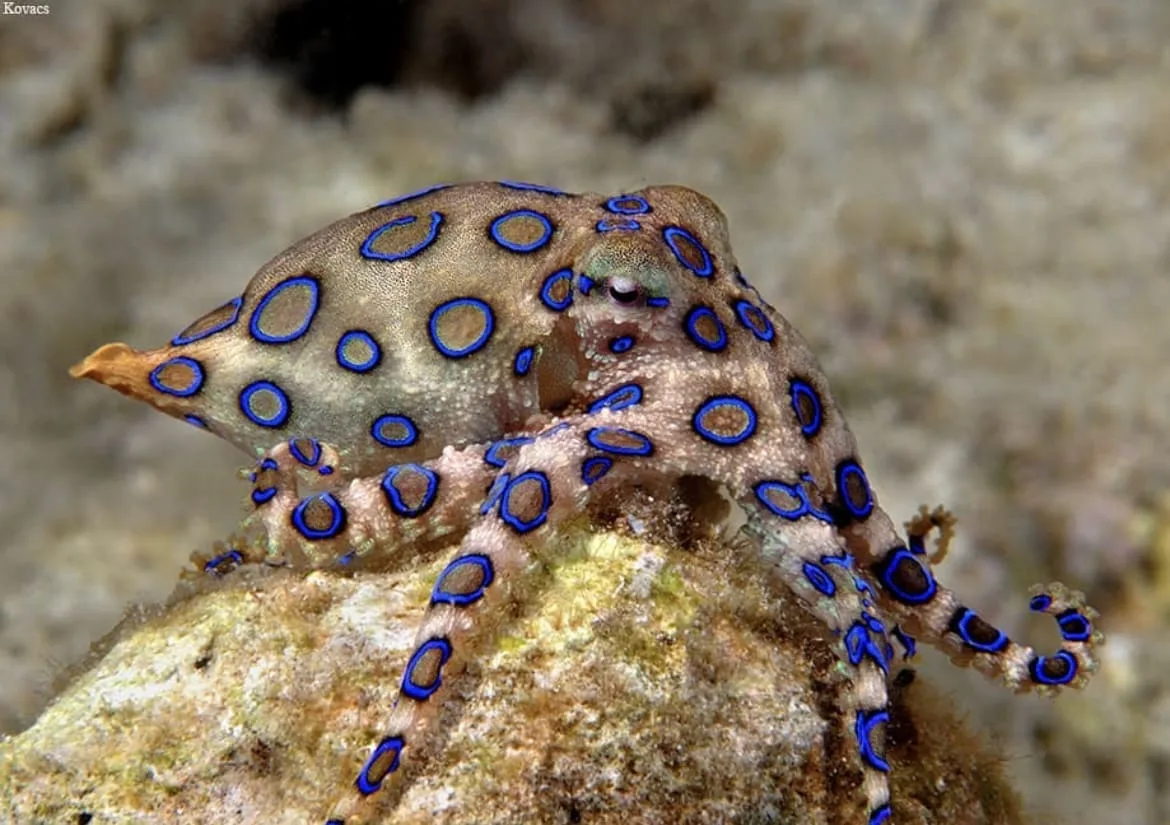
Image source: Web (Bing) / wildestofficial.com (Web image (fair-use with source credit))
If you're fascinated by ocean life, you might want to check out our guide to marine mammals starting with M for more fascinating creatures.
The Deadly "B" Species You Should Know
Not every "B" animal is friendly. Some carry venom potent enough to kill within minutes, and a few are responsible for real human deaths every year.
Box Jellyfish
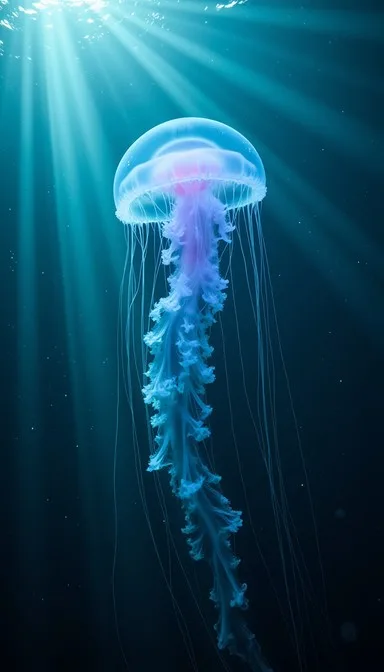
The box jellyfish (Chironex fleckeri) is widely considered the most venomous marine animal on Earth. Found primarily in the waters of northern Australia and the Indo-Pacific, this nearly transparent creature has tentacles that can stretch up to 9 feet.
Each tentacle is covered in millions of nematocysts, microscopic stinging cells that fire on contact. The venom attacks the heart, nervous system, and skin cells simultaneously. Without antivenom, a severe sting can cause cardiac arrest in under three minutes.
First aid is specific. Vinegar stops the nematocysts from firing, but fresh water triggers them. Do not rub the area, and do not apply pressure bandages for box jellyfish stings.
Banded Sea Krait
The banded sea krait (Laticauda colubrina) looks like a land snake that decided to go swimming. It has a paddle-like tail for propulsion but spends significant time on land, where it digests prey and lays eggs.
Its venom is neurotoxic and roughly ten times more potent than a cobra's, drop for drop. That said, bites are rare. These kraits are docile and only strike when provoked or handled.
Divers sometimes report sea kraits swimming near them out of curiosity. The smart move is to stay still and let them pass. They're not hunting you.
They're hunting eels, which make up the bulk of their diet.
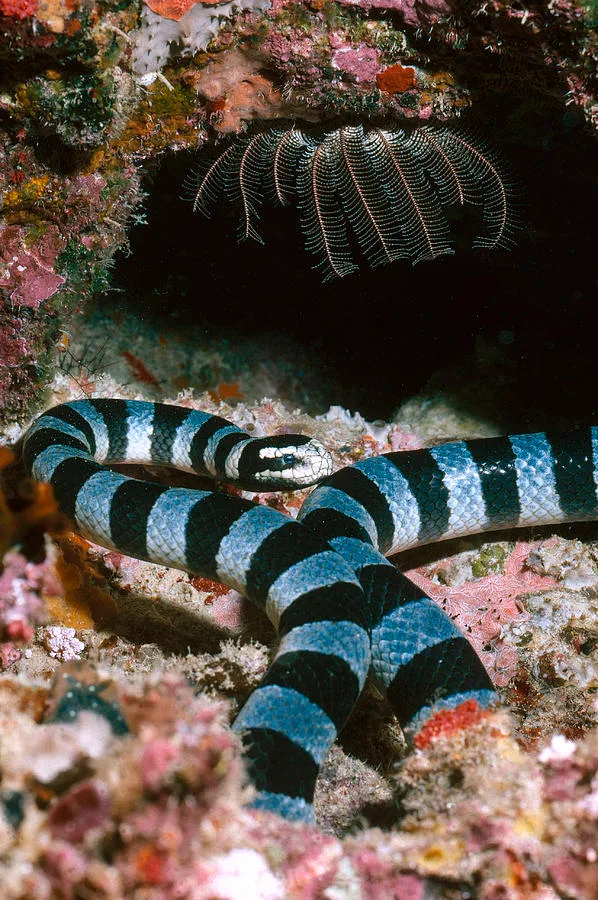
Image source: Web (Bing) / fineartamerica.com (Web image (fair-use with source credit))
If you're curious about other venomous reptiles, check out our guide to reptiles starting with C.
Visual Field Guide: How to Identify "B" Species Like a Pro
Telling these animals apart in the wild is harder than it looks. Many "B" species share similar body shapes, color patterns, and habitats. Here's how to spot the differences.
Barracuda vs. Needlefish
Both are long, silver, and fast. The key difference is the mouth. Barracudas have a distinct underbite with large, fang-like teeth visible even when the mouth is closed.
Needlefish have elongated, narrow jaws filled with tiny needle teeth.
Barracudas also have a heavier, more muscular body. Needlefish are thinner and more fragile-looking.
Bottlenose Dolphin vs. Common Dolphin
Bottlenose dolphins are stocky with a short, thick snout that curves slightly upward. Common dolphins have a more slender build and a longer, more pointed beak.
Color is another giveaway. Common dolphins have a distinctive hourglass pattern of yellow and gray on their flanks. Bottlenose dolphins are uniform gray with lighter bellies.
Blue Whale vs. Fin Whale
These two giants are frequently confused from a distance. Blue whales have a mottled blue-gray coloration with tiny barnacles on their flippers. Fin whales have a distinct asymmetry: their lower right jaw is white while the left side is dark.
When surfacing, fin whales show a tall, curved blow. Blue whales produce a columnar blow that rises straight up like a narrow spout.
Box Jellyfish vs. Moon Jellyfish
Box jellyfish have a cube-shaped bell with tentacles hanging from each corner. Moon jellyfish have a flat, saucer-shaped bell and very short, delicate tentacles around the rim.
If you see a jellyfish with long, trailing tentacles and you're in tropical Indo-Pacific waters, assume it's dangerous until proven otherwise.
Common Identification Mistakes to Avoid
Even experienced marine biologists make errors in the field. Here are the most frequent mix-ups.
Juvenile vs. Adult Coloration
Many species look completely different at different life stages. Juvenile blue tangs are bright yellow with blue edging, which makes them look like a different species entirely. Adult blue tangs are deep blue with a black "palette" pattern.
Bull sharks are also tricky. Juveniles have dark tips on their fins that fade as they mature. Compare that to blacktip reef sharks, which keep their fin markings for life.
Misleading Common Names
Common names cause endless confusion. The "beluga whale" isn't born white. Calves are gray or brown and only lighten as they age.
The "basking shark" doesn't actually bask in the sun. It's a reference to their habit of swimming slowly at the surface, apparently "basking" while they filter feed. Scientists now believe they're following plankton-rich water layers.
Regional Variation
The same species can look different depending on location. Great barracuda in the Atlantic tend to be darker than those in the Caribbean. Butterflyfish patterns vary within the same species across different reef systems.
Always note where you saw an animal before trying to identify it. That context matters more than any single feature.
Fascinating Behaviors: Migration, Hunting & Communication
The "B" species aren't just static animals. Their behaviors are some of the most studied and impressive in marine biology.
Blue Whale Vocalizations
Blue whales produce the loudest sounds of any animal. Their low-frequency calls can reach 188 decibels, louder than a jet engine at takeoff. These sounds travel hundreds of miles underwater, allowing whales to communicate across entire ocean basins.
As of 2026, researchers continue to study how blue whale songs vary by region. The Indian Ocean population sounds different from the North Atlantic population. Vocalization patterns may even help identify individual whales.
Bull Shark Freshwater Tolerance
No other shark matches the bull shark's ability to thrive in freshwater. They have specialized kidneys that recycle salt and a rectal gland that excretes excess salts. This lets them regulate their internal balance even when the surrounding water is nearly salt-free.
These skills open up entire ecosystems. Bull sharks have been found 2,200 miles up the Amazon River and in landlocked lakes that connect to the ocean via rivers.
Blue Crab Molting
Blue crabs grow by shedding their hard shells in a process called ecdysis. Before molting, the crab absorbs water to expand its body. It then splits the old shell along the back legs and backs out.
The new shell is soft for 12 to 24 hours. This is when the crab is most vulnerable, and it's also when commercial fishermen harvest "soft-shell" crabs. The Maryland blue crab fishery is worth over $200 million annually.
Bottlenose Dolphin Echolocation
Bottlenose dolphins use echolocation to create a mental image of their surroundings. They emit a series of high-frequency clicks that bounce off objects and return as echoes.
The dolphin interprets those echoes to determine size, shape, distance, and even internal structure. This works underwater where vision is limited and allows them to hunt in murky, low-light conditions.
Conservation Status: Which "B" Species Need Our Help
Not every "B" animal is thriving. Some have rebounded from near extinction. Others continue to decline.
Blue Whale Recovery
Blue whale populations are estimated to be between 10,000 and 25,000 globally. That's up from around 1,000 in the 1960s when commercial whaling was at its peak.
The recovery is slow but real. The International Whaling Commission banned commercial blue whale hunting in 1966, and their numbers have been climbing since. Ship strikes and underwater noise pollution remain the biggest modern threats.
Beluga Whale Concerns
The Cook Inlet beluga population in Alaska is endangered. NOAA lists them as critically low, with fewer than 300 individuals remaining as of 2026.
That's a precipitous drop from the 1,300 estimated in the late 1970s. The causes include industrial noise, habitat degradation, and reduced prey availability.
Blue Crab Pressure
Blue crab populations fluctuate significantly year to year. The Chesapeake Bay fishery remains the largest on the Atlantic coast, but overfishing and environmental changes stress the stock.
The Virginia Institute of Marine Science conducts annual winter dredge surveys to track population trends. Recent years have shown moderate recovery, though female crab abundance remains below long-term averages.
Basking Shark Protection
Basking sharks were heavily hunted for their enormous fins, which are prized in the Asian shark fin trade. They're now protected in UK waters and several other regions.
Despite that, basking shark sightings remain rare in many historic hotspots. NOAA continues to track them via satellite tagging to understand their migratory patterns.
Quick-Reference Data Table: Size, Range & Key Facts
Here's a snapshot of the major "B" species for quick comparison. Use this as a field reference or a study aid.

Image source: Bing (Web (fair-use with source credit))
Baleen plates are how blue whales and other filter feeders trap krill. The diagram above shows how these keratin sheets hang from the upper jaw and strain seawater.
| Species | Avg. Size | Habitat | Conservation Status |
|---|---|---|---|
| Blue whale | 75-90 ft | Global oceans | Endangered |
| Beluga whale | 13-20 ft | Arctic waters | Near Threatened |
| Bottlenose dolphin | 8-12 ft | Warm/temperate seas | Least Concern |
| Bull shark | 7-11 ft | Coastal, freshwater | Near Threatened |
| Basking shark | 20-26 ft | Temperate oceans | Endangered |
| Blue-ringed octopus | 4-8 in | Indo-Pacific reefs | Least Concern |
Data compiled per NOAA Fisheries species profiles and the IUCN Red List. Population numbers vary by region and season.
Frequently Asked Questions
What is the biggest sea animal that starts with B?
The blue whale is the largest, reaching 110 feet and 200 tons. It's also the biggest animal ever known to have existed.
Which B sea animal is the most dangerous?
The box jellyfish and blue-ringed octopus both carry lethal venom. The box jellyfish causes more human fatalities due to its coastal habitat and painful stings.
Can you keep B fish in a home aquarium?
Yes, species like blue tangs and bangaii cardinalfish are popular. They need large, mature tanks with stable water parameters. Check local regulations before purchasing.
Are any B species extinct?
No "B" marine species are confirmed extinct. However, the Cook Inlet beluga and several basking shark populations are critically endangered. Conservation efforts remain active.
Final Word: Why the "B" List Is Worth Exploring
The "B" list is a crash course in ocean diversity. You get the largest animal ever, a jellyfish that can kill in minutes, and a worm that hunts like a horror movie villain.
Learning these species builds a mental map of marine ecosystems. It also helps you recognize which animals need space in the wild and which need your support in conservation efforts.
Interested in more ocean alphabet adventures? Check out our guide to animals starting with P for another round of fascinating creatures.