Rare Cat Breeds That Start With Z: Zanzibar & Zee
You're staring at a list that should be longer. "Cat breeds that start with z" feels like it should yield at least a handful of options, right? Wrong.
The truth is far more interesting, and it's why most articles on this topic are either padded with fake breeds or just plain wrong.
The real answer, as of 2026, is that only two cat breeds consistently show up across registries when you filter for the letter "Z": the Zanzibar and the Ziggen. Both are rare, both are fascinating, and neither is officially recognized by the major cat associations. That's the part most listicles won't tell you, because it kills the word count.
Quick Answer
Only two breeds start with "Z": the Zanzibar and the Ziggen. Both are extremely rare. Neither is recognized by the CFA or TICA.
The Zanzibar comes from East Africa. The Ziggen is a newer experimental breed. Most other "Z" cats you see online are mislabeled or scams.
Expect to pay $1,500 to $3,500. Expect to wait 12 to 18 months for a kitten.
The "Z" Rarity Problem: Why This List Is So Short
Here's the thing about cat breeds: the alphabet isn't evenly distributed. The letter "S" gives you Siamese, Scottish Fold, Siberian, and a dozen more. The letter "Z" gives you almost nothing.
That's not an accident.
Breed development follows regional popularity, genetic diversity, and show circuit demand. The major registries like the CFA and TICA only recognize breeds with established standards, stable populations, and documented lineage. The Zanzibar and Ziggen simply haven't hit those thresholds yet.
The Zanzibar's population outside Tanzania is tiny, perhaps a few hundred individuals globally. The Ziggen is even newer, bred in Europe in the last couple of decades with no real registry backing.
That scarcity creates a vacuum. And vacuums attract noise. Search for "Z breeds" and you'll find references to the Zulu, the Zibeline, and the Zed.
Some of these are regional variants. Some are coat pattern names. Some are pure marketing fiction.
We'll untangle all of that shortly.
For now, understand this: when you're looking for a "Z" breed, you're not comparing mainstream pets. You're hunting for a needle in a haystack that most people don't even know exists.
Visual Identifiers: How to Actually Tell a Zanzibar from a Ziggen

Image source: Bing (Web (fair-use with source credit))
Because these cats are so rare, you're unlikely to see one in person. That makes visual identification critical, especially if you're vetting photos from a breeder. The Zanzibar and the Ziggen look nothing alike once you know what to look for.
The Zanzibar at a glance:
- Coat: Short, fine, and ticked, like a wild rabbit. The red or ruddy color is the most common, but silver and blue variants exist.
- Body: Slender and athletic, built for climbing. Think Abyssinian but slightly taller on the leg.
- Head: A modified wedge shape with a distinct brow. The eyes are large, almond-shaped, and usually amber or green.
- Ears: Large and cupped at the base, set wide apart.
The Ziggen at a glance:
- Coat: Medium-length, soft, and dense. Not quite a fluff-ball, but noticeably plush compared to the Zanzibar.
- Body: Stocky and cobby, more like a British Shorthair than an Abyssinian. Lower to the ground.
- Head: Round with a short muzzle and small, rounded ears.
- Tail: The tell-tale sign. The Ziggen has a slight, natural kink or curl at the tip, much like a Japanese Bobtail but less pronounced.
If someone sends you a photo of a "Zanzibar" with a fluffy coat or round face, walk away. It's not the breed you're looking for.
Side-by-Side: Zanzibar vs. Ziggen vs. Common Look-Alikes
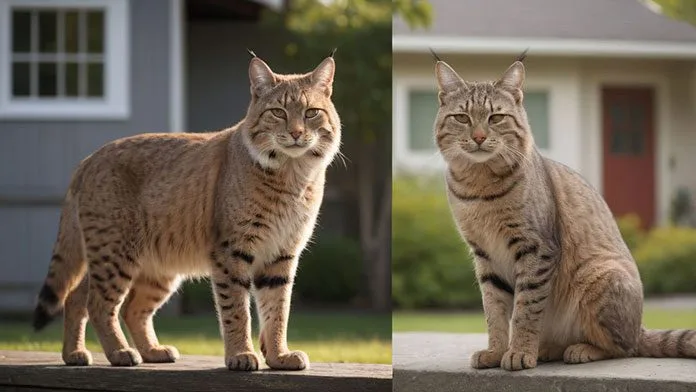
Image source: Bing (Web (fair-use with source credit))
The fastest way to get scammed is to not know what these cats resemble. Breeders selling "rare Z cats" will happily show you a photo of a standard domestic shorthair and call it a day. So let's make the differences painfully obvious.
| Trait | Zanzibar | Ziggen | Common Look-Alike |
|---|---|---|---|
| Coat length | Short, ticked | Medium, plush | Short, solid or classic tabby |
| Body type | Slender, athletic | Stocky, cobby | Average domestic |
| Head shape | Wedge with brow | Round with short muzzle | Rounded or triangular |
| Ears | Large, wide-set | Small, rounded | Medium, upright |
| Tail | Long, straight | Natural kink or curl | Long, straight |
| Temperament | Active, vocal, alert | Calm, dog-like attachment | Varies wildly |
| Origin | Zanzibar, Tanzania | Europe (experimental) | Anywhere |
The closest mainstream comparison point is the Abyssinian. If you've seen an Aby, you've basically seen a Zanzibar with different ear set and a more pronounced brow. The Ziggen, meanwhile, sits somewhere between a Somali and a British Shorthair, but you'll rarely find one outside of France or Germany.
For owners interested in less common pets, checking other alphabet guides for exotic animals can be just as eye-opening. You might not find a Z cat, but the journey is similar.
The "Fake Z" Problem: Zulu, Zibeline, and Mislabeled Cats

Image source: Bing (Web (fair-use with source credit))
Now we get to the messy part. Every alphabetic list has its phonies, but the letter "Z" takes the cake for outright inventions. Here's what you're actually dealing with when you see these names floating around.
The Zulu Cat. Sounds exotic, right? South African roots, spotted coat, wild appearance. The problem is that there's no documented breeding program, no registry standard, and no verifiable population.
What you'll actually find under this label is either a Savannah cat cross, an Egyptian Mau look-alike, or a standard spotted tabby with a good marketing team. There is no "Zulu" breed. Period.
The Zibeline. This one confuses people because it's real, just not what you think. "Zibeline" is an old European term for a specific coat color and texture in Burmese and Tonkinese cats. It describes the sable-brown, silky look, not a distinct breed.
When a seller lists "Zibeline kittens," they're almost always selling Burmese cats with a fancy label.
The Zed. You'll see this on forum posts and some low-effort blogs. "Zed cat" is a placeholder name. It's what happens when someone writes a blog post about animals that start with Z, can't find a third breed, and makes one up.
No breeder, no standard, no photos. Skip it.
Here's your takeaway: if a breed name doesn't appear in at least one minor registry or have a documented breeding community, it doesn't exist. The Zanzibar and Ziggen both have small, real communities behind them. The Zulu and the Zed do not.
When you're browsing rare animal lists, the same logic applies across the board. A surprising number of alphabet entries are regional names or coat patterns dressed up as species.