Meet the P-Insects: A Guide to Bugs Beginning with P
If you've ever found yourself staring at a spiky, striped, or outrageously fluffy bug and wondering what on earth it is, you've probably considered the insects that start with p. It's a surprisingly long list, from garden heroes to genuine health risks, and telling them apart matters more than you'd think. The difference between a harmless lookalike and a venomous caterpillar can come down to a single glance.
Here's the thing: the "P" group includes some of the most beneficial predators you can host, alongside a few species that demand serious respect. In our research for this guide, we pulled data from university extension programs and the USDA, and one statistic stands out: the Colorado potato beetle causes over $100 million in crop damage annually in the US alone. That's why knowing your "P" bugs isn't just trivia, it's practical knowledge that protects your garden, your home, and your skin.
Let's dig in.
Quick Answer
The most common insects that start with p include the praying mantis, painted lady butterfly, paper wasp, pill bug, Colorado potato beetle, puss caterpillar, and the Polyphemus moth. Some are beneficial predators. Others are agricultural pests.
A few are genuinely dangerous to touch. Most are harmless if you leave them alone.
Why Visual Identification Matters for "P" Insects
Let's be blunt: misidentifying a "P" insect can hurt. A lot.
The puss caterpillar looks like a tiny, fuzzy Tribble from Star Trek. It's adorable. It's also one of the most venomous caterpillars in North America, and its hidden spines deliver a sting that victims describe as feeling like a broken bone.
Meanwhile, the massive Palo Verde beetle looks like it escaped from a horror film, yet it's completely harmless to humans.
That's the core problem with this group. The visual cues that usually help us judge danger are reversed. Fuzzy often means dangerous.
Huge often means harmless. And brown and striped could mean a beneficial predator or a crop-devouring pest.
When you're out in the garden at dusk and something lands on your arm, you don't have time to flip through a 500-page entomology textbook. You need rapid, reliable visual patterns that distinguish the good from the bad and the benign from the venomous.
This guide gives you exactly that. We've organized these insects by where you'll actually encounter them, not by taxonomic order. That way, whether you're checking your tomato plants, lifting a flowerpot, or walking through a desert patio at night, you'll know what you're looking at and what to do about it.
How to Use This Identification Guide
Before we dive into the profiles, here's how to get the most out of this guide. You don't need a magnifying glass or a biology degree. You just need to ask yourself three quick questions when you spot an unknown bug.
Question 1: Where Are You?
Location eliminates half the possibilities immediately. A giant beetle flying at your porch light in Arizona is almost certainly a Palo Verde beetle. That same beetle in Ohio?
Impossible. Likewise, a fuzzy caterpillar on an oak tree in Texas is a prime suspect for the puss caterpillar, while the same-looking fuzzball in Oregon probably isn't.
Question 2: What Time of Year Is It?
Seasonality is a powerful filter. Paper wasps become noticeably more aggressive in late summer when their colonies peak and food gets scarce. Palo Verde beetles only emerge during the monsoon season, typically July through August.
And if you see a giant silk moth like the Polyphemus, it's almost certainly in its short adult stage during late spring or early summer.
Question 3: What Is It Doing?
Behavior tells you more than appearance sometimes. A bug that immediately curls into a perfect ball when touched is a pill bug, full stop. A wasp that's methodically chewing wood fibers off your deck railing is a paper wasp building a nest.
A caterpillar that's devouring your potato leaves with hundreds of friends is a Colorado potato beetle larva, regardless of its exact shade.
Ask those three questions first. Then match what you see against the profiles below. Each profile includes the key physical identifiers, typical habitat, and the risk level so you know whether to grab a camera or back away slowly.
The Garden Gladiators: Predatory "P" Insects You Want Around
Some insects are worth their weight in gold because they do the pest control for you. These are the predators, and they're the ones you want patrolling your tomatoes and roses.
The Praying Mantis: The Apex Ambush Hunter
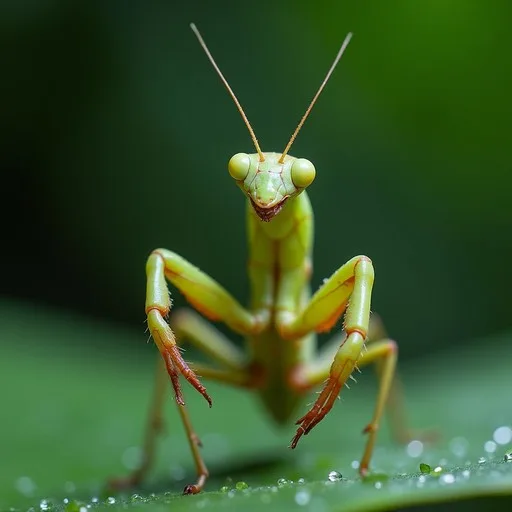
Image source: Web (Bing) / stockcake.com (Web image (fair-use with source credit))
The praying mantis is probably the most famous insect that starts with p, and for good reason. It's not just one species; there are roughly 2,400 species worldwide, ranging from tiny 0.5-inch specimens to giants that stretch a full six inches.
Key identifiers to look for:
- Triangular head that rotates nearly 360 degrees
- Raptorial forelegs folded in a "praying" position
- Elongated body with camouflage coloration (green, brown, or mottled)
- Large compound eyes that track movement
These are ambush predators. They sit perfectly still, swaying slightly to mimic vegetation, then strike with lightning speed. In fact, a mantis can grab prey in about 50 milliseconds, faster than the human eye can track.
Their diet includes flies, crickets, moths, and even small frogs or lizards if the mantis is large enough.
The honest downside: they're not picky eaters. A hungry mantis will happily consume beneficial pollinators like bees and butterflies alongside the pests. They operate on a "see food, eat food" basis.
Where to find them: tall grass, shrubbery, and garden borders. In late fall, keep an eye out for their tan, foam-like egg cases (oothecae) attached to twigs and stems. Each case can hold up to 200 eggs, so if you spot one in winter, leave it.
That's next season's pest control arriving.
The Paper Wasp: The Defensive Architect

Image source: Web (Bing) / narodnatribuna.info (Web image (fair-use with source credit))
Paper wasps get a worse reputation than they deserve. They're actually beneficial insects that hunt caterpillars, beetle larvae, and flies to feed their young. The problem is their defensive nature and their tendency to build nests where humans frequently walk.
Key identifiers to look for:
- Slender body with a narrow waist
- Long legs that dangle in flight
- Brown or reddish-brown coloration with yellow markings
- Open, umbrella-shaped hexagonal nest made of papery material
Paper wasps construct their nests by chewing wood fibers and mixing them with saliva, creating that distinctive gray, paper-like texture. You'll typically find these nests hanging from eaves, porch ceilings, grills, and swing sets.
Aggression levels: here's what most people get wrong. Paper wasps are generally docile when away from their nest. But if you approach the nest itself, they become genuinely defensive and will sting repeatedly.
The sting rates 2.0 on the Schmidt Sting Pain Index, described as "hot and smoky, almost irreverent."
Pro-tip for coexisting: if a nest is in a low-traffic area like a garden corner, leave it. Those wasps are working hard to kill pests that would otherwise destroy your plants. If the nest is near a door handle, high-traffic walkway, or kids' play area, call a professional.
Don't try to knock it down yourself, especially from a ladder. That's how people end up in urgent care.
The Dressed to Impress: Butterflies and Moths Starting With "P"
This is the visually spectacular category. These are the species that make people pause and pull out their phones for a photo. They're also the ones where misidentification happens most often.
The Painted Lady: The Migratory Marvel
You've seen these butterflies even if you didn't know their name. The painted lady (Vanessa cardui) is one of the most widespread butterfly species on Earth, found on every continent except Australia and Antarctica.
Key identifiers to look for:
- Orange wings with black and white spots
- Brownish-black wing tips with white patches
- Smaller wingspan than a monarch (2 to 3 inches)
- Fast, erratic flight pattern close to the ground
The remarkable migration: painted ladies are serious travelers. Research from the University of California and other institutions tracks populations that migrate from the deserts of northern Mexico all the way to Canada, a multi-generational journey covering up to 9,000 miles. No single butterfly makes the entire trip; instead, several generations pass the baton northward over the spring and summer.
Where to spot them: they love thistles, which is ironic since thistles are usually considered a weed. They also frequent asters, sunflowers, and zinnias in late summer bloom. If you're trying to attract them, plant a patch of native thistles or tall verbena and watch the show.
The Polyphemus Moth: The Giant Night Flyer
If you're not a fan of moths, you might want to brace yourself. The Polyphemus moth (Antheraea polyphemus) is one of the largest moths in North America, with a wingspan that can reach a stunning 6 inches.
Key identifiers to look for:
- Large, golden-brown wings with pinkish edges
- Two large, translucent eyespots on the hindwings
- Feathery antennae (especially pronounced in males)
- Fuzzy, thick body compared to butterflies
The eyespot defense: those big spots aren't just decoration. When threatened, the moth flashes its hindwings to reveal the eyespots, making it look like an owl staring back at predators. It's a remarkably effective bluff.
A short, purpose-driven life: here's the surprising part. Adult Polyphemus moths don't eat. They emerge from their cocoons with only one mission: finding a mate.
They live for about a week, then die. Their entire adult existence is reproduction.
Where to find them: they're nocturnal, so you'll rarely see them in flight. Instead, you'll find them resting on walls near porch lights in the morning, or on tree trunks during the day. Their larvae feed on oak, birch, and maple leaves, so wooded areas are prime habitat.
The Puss Caterpillar: The Venomous "Pet"
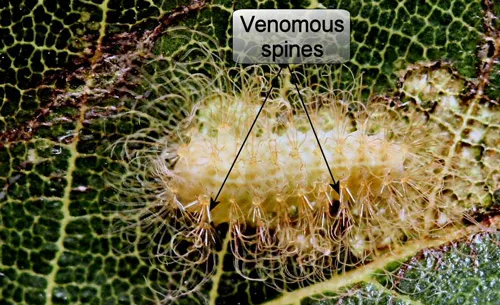
Image source: Bing (Web (fair-use with source credit))
Now we get to the one that demands your full attention. The puss caterpillar (Megalopyge opercularis) is the larval stage of the southern flannel moth, and it's the most venomous caterpillar in North America. As of 2026, documented cases of severe stings continue to be reported across the southern United States, particularly in Texas and Florida.
Key identifiers to look for:
- Dense, woolly coat of hair covering the entire body
- Color ranges from golden brown to gray to cream
- Looks soft and furry, like a Tribble or a tiny Persian cat
- Typically 1 to 1.5 inches long
- Often curled into a horseshoe shape when resting
The hidden danger: that fluffy coat isn't fur. It's a dense mat of hollow spines connected to venom glands. When you brush against them, the spines break off in your skin and release the venom.
What the sting feels like: victims describe it as a severe burning sensation that radiates up the limb. Some report pain so intense it feels like a broken bone. The pain can spread to the armpit or groin, and nausea, headache, and fever sometimes follow.
While rare, hospitalizations occur for severe reactions.
What to do if stung: place tape over the area and pull it off repeatedly to remove any remaining spines. Wash thoroughly with soap and water. Apply an ice pack.
If pain is severe or you experience any breathing difficulty, seek emergency care immediately.
The Under the Rock Crew: Recyclers and Occasional Pests
This category contains the bugs you find when you lift a flowerpot, turn over a log, or notice tiny specks moving across your bookshelf. They're not glamorous, but they play essential roles.
The Pill Bug: The Backyard Recycler (Not Actually an Insect)
Here's a fun fact that surprises most people: the pill bug (Armadillidium vulgare) is not an insect. It's a terrestrial crustacean, making it more closely related to shrimp and crabs than to butterflies or beetles. That's why they need damp environments; their modified gills require moisture to function.
Key identifiers to look for:
- Oval, segmented body that's uniformly gray or brown
- Seven pairs of legs
- Antennae and a distinct head
- The iconic ability to roll into a perfect ball when disturbed
That rolling behavior is called conglobation, and it's their defining defense mechanism. When threatened, they curl into a tight armored sphere, protecting their soft underside.
Why they matter: pill bugs are nature's recycling crew. They feed on decaying plant matter, breaking it down and returning nutrients to the soil. In a garden, they're actively improving soil structure and fertility.
When they become a nuisance: occasionally, pill bugs will damage tender seedlings or feed on strawberries that touch the ground. This usually happens when populations explode in overly damp, mulched areas. If this becomes a problem, reduce excess moisture and create some distance between organic mulch and your most tender plants.
The "doodlebug" confusion: some regions call them doodlebugs, potato bugs, or roly-polies. Whatever you call them, they're harmless to humans and pets. They don't bite, they don't spread disease, and they don't infest homes.
Psocids (Booklice): The Humidity Alarm
These aren't insects that start with p in the common sense, but they are technically classified under the order Psocodea. Practically, people call them booklice, and they're the smallest members of this guide, measuring just 1 to 2 millimeters long.
Key identifiers to look for:
- Extremely tiny, almost dust-like
- Pale gray, white, or light brown coloring
- Long antennae relative to body size
- Found in damp, dark areas like bookshelves, pantries, and basements
What they're actually doing: booklice don't eat books. They feed on microscopic molds and fungi that grow in humid conditions. Their sudden appearance isn't an infestation; it's an indicator.
They're telling you that you have a moisture problem.
The fix: lower the humidity below 50 percent using a dehumidifier, repair any leaks, and improve ventilation. Once the mold source is gone, the booklice follow within a couple of weeks. No pesticides needed.
The Agricultural Enemies: "P" Insects That Damage Crops
Now we move to the ones that cost farmers and gardeners real money. These are the pests that keep agricultural extension offices busy every growing season.
The Colorado Potato Beetle: The Leaf Stripper

Image source: Web (Bing) / britannica.com (Web image (fair-use with source credit))
If you grow potatoes, tomatoes, or eggplants, you need to know this beetle. The Colorado potato beetle (Leptinotarsa decemlineata) is one of the most destructive agricultural pests in North America, causing over $100 million in crop damage annually according to USDA research.
Key identifiers to look for:
- Yellow-orange body with 10 distinctive black stripes
- Orange egg clusters on the underside of leaves
- Fatty, humpbacked orange larvae with black spots
- Adults are about 3/8 inch long
The rapid lifecycle: each female can lay up to 500 eggs in a single season. The larvae emerge within a week, begin feeding immediately, and can strip a plant to bare stems in days. Multiple generations can occur in one growing season, which means the damage compounds quickly.
The pesticide problem: this beetle is famous for developing resistance to pesticides. In fact, it's considered a model organism for studying insecticide resistance evolution. If you rely on chemical sprays, you'll likely need to rotate between different chemical classes to stay ahead of resistance.
The gardener's solution: for home gardens, hand-picking is genuinely the most effective strategy. Check the undersides of leaves every few days, crush any orange egg clusters you find, and drop adult beetles into a bucket of soapy water. It's tedious, but it works, and it avoids contributing to resistance.
Frequently Asked Questions
What is the most dangerous insect that starts with p?
The puss caterpillar is the most dangerous "P" insect. Its venomous spines deliver a sting that causes severe radiating pain, nausea, and sometimes requires hospitalization. It's found primarily in the southern United States.
Are pill bugs considered insects?
No. Pill bugs are terrestrial crustaceans in the order Isopoda, making them closer relatives to shrimp and crabs than to insects. They have gill-like structures that require moisture, which is why you'll only find them in damp environments.
Do praying mantises eat harmful garden pests?
Yes, but they're not selective. Mantises consume flies, crickets, and moths, which makes them useful for pest control. However, they also eat beneficial insects like bees and butterflies.
Their hunting strategy is opportunistic, not strategic.
How do I get rid of booklice in my home?
Booklice indicate a moisture problem. Reduce indoor humidity below 50 percent with a dehumidifier, fix leaks, and improve ventilation. Once the damp condition is resolved, the booklice will disappear within a few weeks.
No insecticides are necessary.
What should I do if a paper wasp is building a nest near my door?
Call a professional if the nest is within 10 feet of high-traffic areas. Paper wasps defend their nests aggressively, and stings are painful. If the nest is in a distant corner of your yard, simply leave it alone.
The wasps will move on by late fall.