Curious Sea Animals That Start with C
The ocean is packed with creatures whose names start with the letter C, but most people can only name a handful before drawing a blank. If you've ever tried to list sea animals that start with c, you already know the struggle: you get clownfish and crab, then suddenly you're stuck. That's a shame because the C-list includes some of the most fascinating, colorful, and occasionally dangerous animals in the sea.
The real problem is that many of these creatures look nothing alike. Some are tiny drifters you need a microscope to see. Others are 20-foot predators lurking in mangrove estuaries.
And a few are so beautiful they tempt you to reach out and touch them, which is exactly what you shouldn't do. As of 2026, marine biologists have cataloged over 240,000 known marine species, and a surprising number of the charismatic ones start with C. Let's unpack them properly, with visual cues that actually help you tell them apart.
Quick Answer
The most common sea animals that start with c are clownfish, crab, cuttlefish, conch, clam, coral, cobia, and copepods. The most dangerous are cone snails, cookiecutter sharks, and saltwater crocodiles. The most unusual is the coelacanth, a "living fossil" fish thought extinct for 66 million years.
The smallest are copepods, which measure around 1 millimeter. The smartest is the coconut octopus, known for using tools.
Why Visuals Matter for Identifying C-Named Sea Life
Let me explain why this list gets tricky without images. You could read a hundred descriptions and still mix up a cuttlefish with a squid, or a comb jelly with a true jellyfish. The differences are subtle, and they matter.
A true jellyfish can sting you. A comb jelly, despite looking similar, has no stinging cells at all. That's a pretty important distinction if you're swimming.
Here's the thing about marine life: common names are messy. "Crab" technically covers thousands of species with very different body shapes. "Coral" is an animal, not a plant or a rock, but it looks like both.
And "conch" refers to several different shell families depending on where you live. Words alone can't sort this out. You need to see the animals to understand what makes each one distinct.

Image source: Web (Bing) / wallpapers.com (Web image (fair-use with source credit))
That's why this guide leans heavily on visual cues and identification pointers. When you're out tide-pooling or snorkeling, you don't have time to read a paragraph. You need to glance at a creature and know instantly whether it's safe to touch, what it eats, and why it matters to the ecosystem.
That speed comes from training your eye on the right details.
The Big Crustaceans: Crabs, Crayfish, and Lobster Relatives
This is where most people start and also where the confusion begins. Crabs, lobsters, and crayfish all belong to a group called decapods, meaning "ten-footed." But they're not interchangeable animals. If you're trying to identify what you saw scuttling along the ocean floor, here's how to separate them quickly.
True Crabs vs. False Crabs
The first thing to understand is that not everything called a "crab" is actually a true crab. True crabs, like blue crabs and Dungeness crabs, have a short, wide carapace and a folded abdomen tucked underneath. Their back legs are shorter than their front legs.
False crabs, like king crabs and hermit crabs, have longer legs and a more symmetrical body shape. The distinction matters for fishermen and seafood lovers because true crabs and false crabs have different meat yields and flavor profiles.
The Chinese Mitten Crab
One species worth knowing is the Chinese mitten crab, named for the fuzzy hair-like growth on its claws. It's native to East Asia but has invaded waterways across Europe and North America. This crab is a burrowing species that damages riverbanks and competes with native wildlife.
If you spot one, many regions ask you to report the sighting rather than toss it back.
Caribbean Spiny Lobster vs. Maine Lobster vs. Crayfish
Now let's clear up another common mix-up. The Caribbean spiny lobster has no large front claws. It relies on long antennae and spiny armor for protection.
The Maine lobster, also called the American lobster, has those big, meaty claws everyone pictures. Crayfish are the freshwater cousins, generally much smaller and found in streams rather than the ocean. If it's in saltwater, it's a lobster or spiny lobster.
If it's in a creek, it's a crayfish.

Image source: Bing (Web (fair-use with source credit))
Here's a quick comparison table to make it even clearer:
| Feature | True Crab | Spiny Lobster | Maine Lobster | Crayfish |
|---|---|---|---|---|
| Habitat | Marine, brackish | Marine, warm waters | Marine, cold waters | Freshwater |
| Front claws | Yes, small | No | Yes, large | Yes, small |
| Antennae | Short | Long, spiny | Long, smooth | Short |
| Size range | 2-25 cm | Up to 60 cm | Up to 60 cm | 7-18 cm |
| Common region | Worldwide | Caribbean, Pacific | North Atlantic | Rivers, lakes |
Cephalopods: The Smart "C" Animals
Cephalopods are the geniuses of the ocean, and the C-list includes some of the most extraordinary members of this group. If you love animals that defy expectations, this section is where things get wild. These creatures have decentralized nervous systems, which means their arms can think independently.
They change color in milliseconds. Some even use tools.
Cuttlefish: Masters of Camouflage
The cuttlefish might be the most underrated animal in the ocean. It has eight arms, two feeding tentacles, and a wavy fin running along its body. Inside its body is a porous internal shell called a cuttlebone, which helps it control buoyancy.
But the real talent is camouflage. Cuttlefish can change color and texture in under a second, matching almost any surface they rest on. Research published by marine biologists at the University of Queensland shows they can even impersonate water currents to confuse predators.
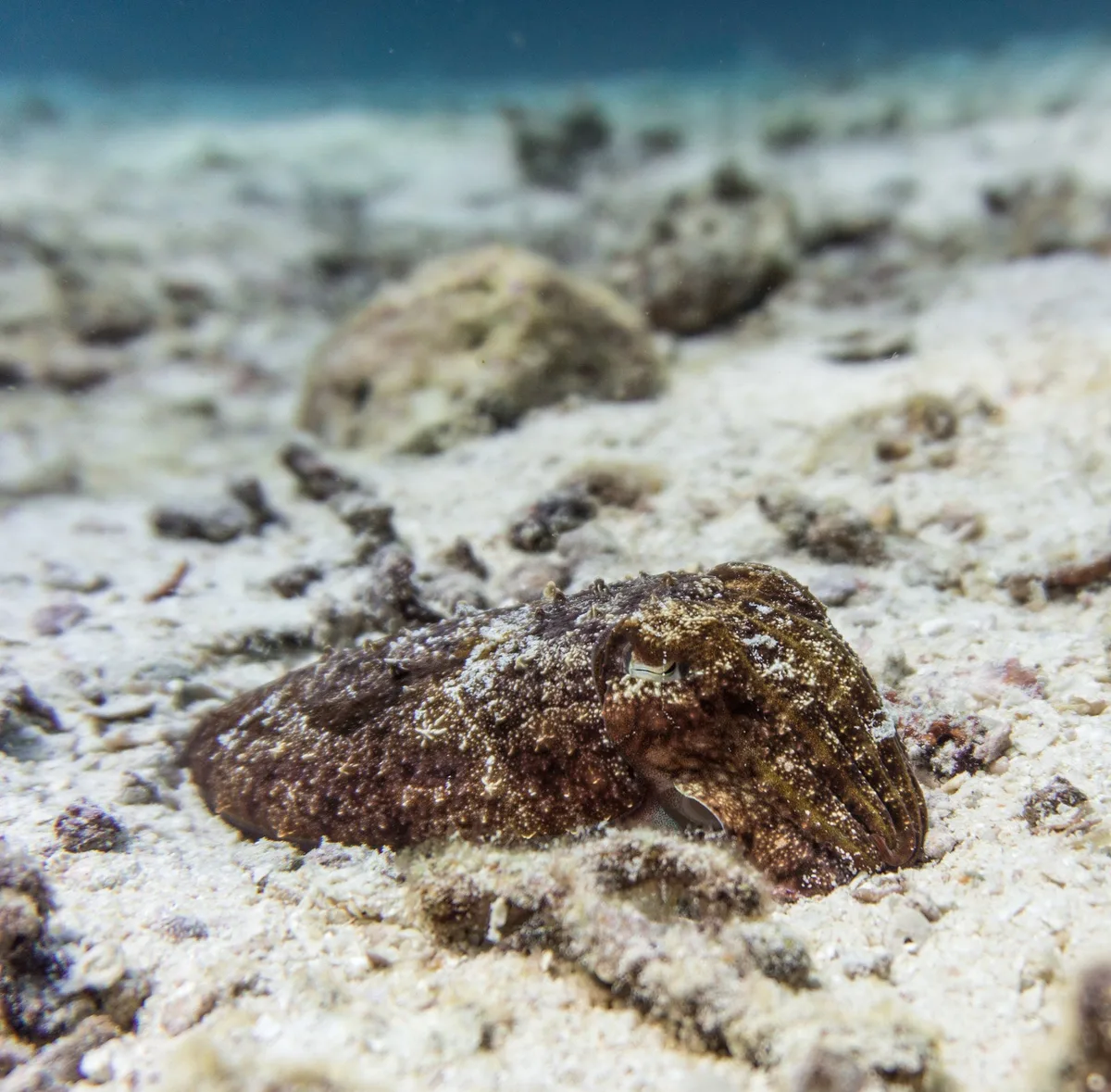
Image source: Bing (Web (fair-use with source credit))
Coconut Octopus: The Tool User
The coconut octopus takes intelligence to another level. If you've seen videos online, you know this animal retrieves discarded coconut shells, carries them under its arms, and reassembles them into a shelter when threatened. This is genuine tool use, a behavior once thought unique to humans.
Aggregate reviews of cephalopod research indicate this species can solve puzzles, remember locations, and recognize individual humans.
Chambered Nautilus: The Living Fossil
The chambered nautilus is often grouped with cephalopods but looks completely different. It lives inside a spiral shell divided into chambers. The animal occupies the outermost chamber and controls gas levels in the rest to rise or sink.
Unlike its fast-moving cousins, the nautilus is a slow, deliberate animal that has remained nearly unchanged for 500 million years.
Colorful Reef Dwellers: Clownfish, Coral, and Cleaner Species
Coral reefs cover less than one percent of the ocean floor but support about 25 percent of all marine life. Many of the most recognizable reef animals start with C. These are the creatures you'll actually see while snorkeling, and knowing them makes the experience far richer.
Clownfish and Their Anemone Symbiosis
Clownfish are the poster child of reef life, largely thanks to a certain animated movie. But the real story is more fascinating. Clownfish live among the stinging tentacles of sea anemones.
They're immune to the venom because of a protective mucus layer on their skin. In exchange for shelter, clownfish chase off anemone-eating predators and provide nutrient-rich waste that feeds their host. It's a textbook example of mutualism, where both partners benefit.
There are about 30 species of clownfish, ranging from 5 to 15 centimeters long. The most common in the aquarium trade is the false clownfish, also called the ocellaris clownfish. If you're considering a home saltwater tank, this species is the most forgiving entry point, though you'll need a tank of at least 20 gallons and stable water parameters.
Coral: Animal, Not Plant
Here's a fact that surprises most people: coral is an animal. Each coral polyp is a tiny, soft-bodied creature related to jellyfish. It secretes a hard calcium carbonate skeleton around itself, and millions of polyps together form the structures we call reefs.
The vibrant colors come from microscopic algae called zooxanthellae living inside the coral tissue. When ocean temperatures rise too high, coral expels these algae and turns white, a process called bleaching. That's a stress response, not a death sentence, but prolonged bleaching will eventually kill the colony.
Cleaner Wrasse: The Reef's Dentist
The cleaner wrasse is a small fish with a very specific job. It operates "cleaning stations" where larger fish line up to have parasites and dead skin removed. The cleaner gets a meal; the client gets a health check.
This relationship is so established that some reef fish will queue up for their turn. If you're watching a reef and notice a group of fish hovering around one spot, there's likely a cleaner wrasse working the shift.
Crown-of-Thorns Starfish: The Reef's Predator
Not all C-named reef dwellers are friendly. The crown-of-thorns starfish is a large, venomous starfish that feeds on coral polyps. It has 14 to 23 arms covered in sharp, toxic spines.
Outbreaks of these starfish can devastate entire reef systems. The Great Barrier Reef has experienced multiple severe outbreaks since the 1960s, and marine park authorities run active culling programs to keep populations in check.
Shellfish and Mollusks: Clams, Conch, Cockles, and Chitons
The shellfish category is where common names get messiest. "Clam" alone covers hundreds of species. "Conch" means different things in different countries.
And "cockle" and "clam" are often used interchangeably at seafood counters, even though they're distinct animals. Let's untangle this.
Clam vs. Cockle vs. Oyster
Clams have smooth or lightly ribbed shells and a muscular foot they use to burrow into sand or mud. Cockles have rounder, heart-shaped shells with prominent radial ribs. Oysters have rough, irregular shells and typically attach themselves to hard surfaces rather than burrowing.
If you're holding a shell at the beach, check the shape and texture. Smooth and oval means clam. Ridged and round means cockle.
Crusty and irregular means oyster.
| Shell Type | Shape | Surface | Habitat |
|---|---|---|---|
| Clam | Oval, elongated | Smooth or fine lines | Buried in sand or mud |
| Cockle | Round, heart-shaped | Prominent radial ribs | Shallow burrows in sand |
| Oyster | Irregular, elongated | Rough, layered | Attached to rocks or other shells |
Conch: Anatomy and Conservation
The queen conch is the one most people know, with its spiral shell and pink inner lip. This animal is a large marine snail, and it's been harvested for food and decoration for centuries. There's a problem though.
Overfishing has made queen conch populations vulnerable across the Caribbean and parts of Florida. The Florida Fish and Wildlife Conservation Commission has banned all commercial and recreational conch harvesting in state waters, and CITES regulates international trade. If you're buying conch meat or shells, verify the source is legal and sustainable.
Chiton: The Armored Grazer
Chitons are strange little creatures you'll only notice if you look closely at intertidal rocks. They have eight overlapping shell plates on their backs, like a suit of armor. They cling to rocks and scrape algae with a tough, tooth-like structure called a radula.
What's remarkable is that their teeth contain magnetite, the hardest biological material known. Scientists study chiton teeth for insights into materials engineering.
Cone Snail: Beautiful but Deadly
The cone snail deserves a mention here because its shell is so beautiful that people pick it up without thinking. That's a mistake. Cone snails are venomous predators.
They harpoon their prey with a modified tooth that delivers a potent neurotoxin. Some species, like the geography cone, have venom potent enough to kill a human. There's no antivenom, and the toxins cause paralysis that can stop breathing.
If you see one, admire it from a distance and keep your hands away.
If you've enjoyed exploring these ocean animals, you might also like our guide to reptiles starting with C. You can also check out spectacular animals starting with S for another deep dive into the animal kingdom.
Fish with "C" names span everything from open-ocean game fish to deep-sea oddities that look like they belong in a science fiction movie. Some you can catch for dinner. Others you'd need a submersible to even glimpse.
Let's run through the ones worth knowing.
Cobia: The Open-Water Game Fish
Cobia is a sleek, brownish fish that grows up to 2 meters long and weighs as much as 68 kilograms. It's found in warm waters worldwide, often shadowing sharks, rays, and sea turtles to scavenge scraps. Anglers love cobia because they fight hard and taste great.
Commercial fisheries target them too, which has led to strict catch limits in U.S. waters. The Gulf of Mexico and Florida's Atlantic coast are prime spots, but you'll need a saltwater fishing license and to check current size regulations before keeping one.
Croaker: The Noisy Bottom Dweller
Croakers get their name from the loud croaking sound they make by vibrating muscles against their swim bladder. It's a sound that carries surprisingly well underwater. There are several species, including the Atlantic croaker and the spot croaker, both popular targets for recreational fishermen along the eastern U.S. coast.
These fish are bottom feeders, eating worms, crustaceans, and small fish. If you're fishing in the shallows and hear a rhythmic drumming, there's likely a school of croakers nearby.
Cabezon: The Pacific Coast Oddity
Cabezon is a large sculpin found along the Pacific coast from Alaska to Baja California. It has a massive head, mottled coloring, and no scales. The flesh is edible, but there's a catch: cabezon eggs are toxic.
The toxin doesn't affect the adult fish, and cooking doesn't destroy it, so it's important to clean the fish carefully and avoid the roe entirely. Spearfishermen and rock anglers in the Pacific Northwest know this well.
Coelacanth: The Deep-Sea "Living Fossil"
The coelacanth is the animal that made scientists look foolish. It was thought to have gone extinct 66 million years ago, until a live one was caught off South Africa in 1938. Since then, populations have been found in the Comoros Islands, Indonesia, and along the East African coast.
These fish live at depths of 100 to 500 meters, grow up to 2 meters long, and can weigh up to 90 kilograms. They have lobed fins that move like limbs, which is why they're considered a key link in the evolution of fish to land animals. Seeing one in the wild is extraordinarily rare, so most of what we know comes from submersible footage.
Cusk and Cusk-Eels: Deep-Water Residents
Cusk is a cold-water cod-like fish found in the North Atlantic. It's prized for its firm, white flesh and is often sold as a substitute for cod. Cusk-eels, despite the name, aren't true eels.
They're elongated fish found in both shallow and deep waters, sometimes as deep as 6,000 meters. They're not commonly seen by divers, but they're an important part of the deep-sea food web.
The Hidden "C" Animals: Copepods, Comb Jellies, and Christmas Tree Worms
Here's where the C-list gets interesting. Some of the most ecologically important animals starting with C are also the smallest and least known. They don't make the cover of nature magazines, but without them, the entire ocean food chain would collapse.
Copepods: The Tiny Yet Mighty Crustaceans
Copepods are microscopic crustaceans found in every ocean on Earth. They range from 0.2 to 10 millimeters long, and they're the most abundant multicellular animals on the planet. Copepods form the base of the marine food web, feeding on phytoplankton and serving as food for fish, whales, and seabirds.
Scientists estimate that copepods consume and recycle more carbon than all other marine animals combined. If you've ever seen a whale lunge-feeding, you've watched it gorge on copepod swarms.
Comb Jellies: Bioluminescent Drifters
Comb jellies, also called ctenophores, look like glowing, gelatinous orbs drifting in the water column. Unlike true jellyfish, they have no stinging cells. Instead, they use sticky cells called colloblasts to capture prey.
Many species are bioluminescent, producing flashes of blue or green light when disturbed. You'll often see them washed up on beaches as clear, blob-like creatures that disappear quickly in the sun. Despite their delicate appearance, they're voracious predators of copepods and larval fish.
Christmas Tree Worm: The Coral's Colorful Guest
The Christmas tree worm is one of the most spectacular sights on a coral reef, even though each worm is only a few centimeters long. It lives in a tube burrowed into coral and extends two spiraled, feathery crowns shaped like tiny Christmas trees. Those crowns are actually breathing and feeding appendages.
If you approach too closely, they retreat instantly into their tubes. Patience pays off if you want a photo, because they'll emerge again within a minute or two.
Chitons Revisited: The Tide-Pool Grazers
We covered chitons earlier, but they deserve another mention here because they're so often overlooked. Their eight-plate armor makes them look less like animals and more like segmented rocks. At low tide, you can find them clinging to rocks in clusters.
Gently touching one reveals it's alive, though it won't move much. Chitons are slow but remarkably tough, and their magnetite-tipped teeth let them scrape algae off rock surfaces that would wear down ordinary teeth.
Dangerous "C" Animals: What to Avoid and How to Stay Safe
Not every C-named creature is friendly. Some are venomous. Some have sharp teeth.
And one, at least, is a literal apex predator that belongs more to the land than the sea. Let's talk about the ones you should respect and avoid.
Cone Snail: The Venomous Shell

Image source: Web (Bing) / pinterest.fr (Web image (fair-use with source credit))
The cone snail already came up in the shellfish section, but it deserves a safety spotlight. Its venom contains a cocktail of neurotoxins that can cause paralysis and respiratory failure. There's no antivenom, and the sting itself might feel like a bee sting at first.
Within minutes, symptoms escalate. If you're shell collecting in the Indo-Pacific, the Caribbean, or anywhere else cone snails live, follow this rule: look, don't touch. Even a dead snail can have a venomous tooth capable of injecting.
Cookiecutter Shark: The Small but Serious Bite
The cookiecutter shark is only about 50 centimeters long, but it has a bite that terrifies marine biologists. It latches onto larger animals and uses its circular, saw-like jaws to carve out a plug of flesh, leaving a wound that looks like a cookie cutter. Attacks on humans are rare, but they do occur, mostly at night when the shark migrates up from deep water.
Swimmers and divers in tropical waters have returned to shore with strange, crater-like bites on their legs. The wounds heal slowly and can require medical treatment.
Saltwater Crocodile: The Apex Predator
The saltwater crocodile is the largest living reptile, with males reaching over 6 meters and weighing more than 1,000 kilograms. It's found across Southeast Asia, northern Australia, and the eastern coast of India. Unlike other crocodilians, salties are comfortable in open ocean, traveling long distances between islands.
They're ambush predators that attack from the water's edge, and they've killed more people than any other crocodile species. If you're in saltwater crocodile territory, obey all warning signs, stay away from the water's edge at dawn and dusk, and never clean fish near the shoreline. As of 2026, the Northern Territory government in Australia maintains an active crocodile management program to reduce human-crocodile conflict.
Ciguatera Risk: Why Reef Fish Can Be Dangerous to Eat
Ciguatera poisoning is a foodborne illness caused by eating reef fish that have accumulated toxins from marine algae. Cobia and other large predatory fish can carry these toxins in their flesh. The symptoms include gastrointestinal distress, neurological issues, and sometimes a strange reversal of temperature perception where cold feels hot.
There's no cure, and the toxins aren't destroyed by cooking. If you're eating reef-caught fish in tropical regions, ask local authorities about current ciguatera warnings. In many cases, larger fish are riskier because they've had more time to accumulate toxins.
Crown-of-Thorns Starfish: Spines That Hurt
The crown-of-thorns starfish has venomous spines that can cause intense pain, swelling, and infection if they puncture your skin. Divers working on reefs are at the highest risk, especially during culling operations. The spines can break off under the skin and are difficult to remove.
If you get stung, clean the wound thoroughly and seek medical attention, especially if you experience muscle weakness or numbness.
Common Visual Mistakes People Make with C-Animals
You'd be surprised how often people misidentify these creatures. Some mistakes are harmless. Others can get you stung, bitten, or fined by wildlife authorities.
Here are the mix-ups that happen most often.
Coral Mistaken for Plants or Rocks
Every scuba instructor has heard it: "Is that coral alive?" Yes, it is. Coral polyps are animals, and the reef structure is their collective skeleton. The mistake is understandable because coral doesn't move, but the ecological consequences are real.
Touching or breaking coral kills polyps and damages habitat. The same confusion leads some people to collect coral fragments as souvenirs, unaware that this is illegal in many protected areas around the world.
Cuttlefish vs. Squid vs. Octopus
These three cephalopods get confused constantly. Here's a fast way to separate them:
- Cuttlefish have a broad, oval body with a wavy fin along both sides. They have a cuttlebone inside, which you can often find washed up on beaches.
- Squid have a torpedo-shaped body with fins only at the tip. They have pens, a stiff internal structure made of chitin, and longer bodies relative to their width.
- Octopuses have rounded heads and eight arms but no fins and no internal shell.
Comb Jelly vs. True Jellyfish
True jellyfish have stinging cells and a bell that pulses rhythmically. Comb jellies have eight rows of tiny, hair-like cilia that beat in sequence, creating a rainbow effect when light hits them. They also lack stinging cells entirely.
If it stings, it's a true jellyfish. If it's harmless but shimmers, it's a comb jelly.
Cockle vs. Clam at the Seafood Counter
This one matters for cooking time and texture. Cockles are chewier and sweeter, and they cook in just a couple of minutes. Clams are more tender and versatile, but they can be tough if overcooked.
At the seafood counter, look at the shape. Cockles are round with prominent ridges. Clams are usually oval with smoother shells.
When in doubt, ask the fishmonger, since some species are sold under regional names that blur the distinction.
Crayfish vs. Lobster
Crayfish settle this in their name for those in some regions, but elsewhere they're called "crawfish" or "crawdads." Either way, they're freshwater animals. Lobsters are marine. If you caught it in a river or a creek, it's a crayfish.
If it came from the ocean, it's a lobster or spiny lobster. Cooking and flavor profiles are similar, but the sizes are different, so timing adjustments matter.
Coconut Octopus vs. Mimic Octopus
The coconut octopus has distinct white markings on its arms and a brownish body. The mimic octopus can change its shape and color to imitate venomous species like lionfish and sea snakes. Both are found in the Indo-Pacific and both are exceptionally intelligent, but they have different hunting strategies and habitats.
If you see one walking across the seafloor carrying shells, it's likely a coconut octopus.
Where to See C-Named Sea Animals in the Wild
If you're inspired to see some of these creatures in person, here's where to look. Timing, location, and water conditions matter, so plan ahead.
Tide Pools: Chitons, Small Crabs, and Anemones
Tide pools are the most accessible hunting ground. At low tide, look under rocks and in crevices. Chitons cling to rock surfaces, hermit crabs scuttle across the bottom, and small green anemones wave their tentacles in the water.
The Pacific Northwest, especially Oregon and Washington, offers some of the best tide-pooling in North America.
Coral Reefs: Clownfish, Butterflyfish, and Cleaner Wrasse
For reef species, your best bet is the Great Barrier Reef in Australia, the Red Sea, or the Caribbean. Clownfish are most visible in shallow water with large anemones. Copperband butterflyfish and cleaner wrasse are common at cleaning stations along reef edges.
If you're patient, you'll spot a cuttlefish or two, especially early in the morning.
Open Ocean: Cobia and Cookiecutter Shark Territory
Cobia are easiest to see in the Gulf of Mexico, especially around buoys and floating debris. Cookiecutter sharks stay in deep water during the day, so you're unlikely to see one while snorkeling. Night divers in Hawaii and the tropical Pacific have reported encounters, but it's rare.
Respect the ocean and keep your distance.
Estuaries and Mangroves: Saltwater Crocodiles
The best place to see saltwater crocodiles in the wild is the Adelaide River in Australia's Northern Territory. Boat tours run daily, and the crocs are accustomed to visitors. Keep your hands and feet inside the boat.
These are wild predators, not zoo animals, and the guides take safety seriously for a reason.
Deep Sea: Coelacanth and Cusk-Eels
Deep-sea species are almost impossible to see without a submersible or a deep-sea camera system. Researchers at the Monterey Bay Aquarium Research Institute and similar institutions regularly capture footage of these animals. If you want to see a coelacanth, your best option is a documentary or an aquarium exhibit that features preserved specimens.
As of 2026, very few public aquariums have successfully displayed live coelacanths.
Quick Identification Checklist for C-Animals
When you encounter an unfamiliar marine animal, run through this checklist. It'll help you narrow down the species and make smart decisions about how to interact with it.
| Cue | What to Look For | What It Tells You |
|---|---|---|
| Shell shape | Spiral, oval, or ridged | Mollusk family and species |
| Number of arms | 8 arms, 10 arms, or many | Cephalopod vs. crustacean vs. starfish |
| Body texture | Smooth, spiny, armored | Defense strategy and classification |
| Color patterns | Stripes, spots, mottled | Species identification and camouflage ability |
| Habitat | Tide pool, reef, open water | Likely species and safety considerations |
| Venom indicators | Bright colors, spines, cone shape | Avoid handling |
Use this checklist before you touch anything. It takes ten seconds and could save you from a painful sting or a fine.
Frequently Asked Questions
What is the biggest sea animal that starts with C?
The biggest is the saltwater crocodile, which can reach over 6 meters and weigh more than 1,000 kilograms. Among purely marine animals, the coconut crab holds the title for the largest land-living arthropod, but it's not fully aquatic. The cobia is the largest C-named fish, reaching up to 68 kilograms.
Are all crabs actually crabs?
No. King crabs and hermit crabs are false crabs. They're related to true crabs, but they have different body structures and evolutionary histories.
True crabs have a short, wide carapace and a folded abdomen underneath. False crabs have longer legs and a more symmetrical body shape.
Is coral a plant or an animal?
Coral is an animal. Each coral polyp is a tiny invertebrate related to jellyfish. The reef structure is the collective calcium carbonate skeleton they build.
The colorful algae inside coral tissue, called zooxanthellae, photosynthesize and provide energy, which is why healthy coral reefs need plenty of sunlight.
Can you keep a clownfish in a home aquarium?
Yes, with the right setup. Clownfish are one of the easiest marine fish to keep in captivity. You'll need a tank of at least 20 gallons, stable salinity, and a cycled filter.
Anemones are optional and require more careful water chemistry, so many beginners skip them and let the clownfish host on coral or other tank decorations.
Which C-animals are safe to touch?
Some are safe, but caution is a better default. Clownfish, copepods, and comb jellies are harmless. Rabbitfish and some crabs can pinch or nip.
Cone snails, crown-of-thorns starfish, and saltwater crocodiles should never be touched under any circumstances. When in doubt, observe and photograph, but don't contact.
Why is the coconut octopus famous?
The coconut octopus is famous for its tool use. It retrieves coconut shells and reassembles them into a protective shelter. This behavior was documented by researchers and represents one of the clearest examples of invertebrate tool use in the natural world.
From the microscopic copepod to the massive saltwater crocodile, the list of sea animals that start with C covers nearly every corner of the ocean. Some are safe to admire. Others demand respect.
Knowing the difference comes down to a few visual cues and a healthy dose of caution. Take those with you on your next beach trip, and you'll see the ocean with entirely new eyes.
Fish With "C" Names: From Cobia to Coelacanth
The fish category spans everything from dinner-table favorites to deep-sea legends. Each one has a distinct story worth knowing.
Cobia: The Open-Water Game Fish
Cobia grow up to 2 meters long and weigh as much as 68 kilograms. They're found in warm waters worldwide, often shadowing sharks and sea turtles to scavenge scraps. Anglers prize them for their fighting spirit and firm, white flesh.
Commercial fisheries target them too, so U.S. regulators enforce strict size and bag limits. Check local rules before you keep one.
Croaker: The Noisy Bottom Dweller
Croakers get their name from the loud drumming sound they produce by vibrating muscles against their swim bladder. The Atlantic croaker and spot croaker are popular targets along the eastern U.S. coast. They're bottom feeders, eating worms and small crustaceans.
If you hear rhythmic pulses underwater, a school of croakers is likely nearby.
Cabezon: The Pacific Coast Oddity
The cabezon is a large sculpin found from Alaska to Baja California. It has a massive head, mottled skin, and no scales. The flesh is edible, but the eggs are toxic.
Cooking doesn't destroy the toxin, so careful cleaning is essential. Spearfishermen in the Pacific Northwest know this hazard well.
Coelacanth: The Deep-Sea "Living Fossil"
The coelacanth was thought extinct for 66 million years until one surfaced off South Africa in 1938. Today, populations live at depths of 100 to 500 meters around the Comoros Islands and Indonesia. They grow up to 2 meters long and weigh up to 90 kilograms.
Their lobed fins move like limbs, offering a window into how fish evolved into land animals.
Cusk and Cusk-Eels: Deep-Water Residents
Cusk is a cold-water fish found in the North Atlantic, prized for its white flesh. Cusk-eels aren't true eels, despite the name. They're elongated fish found from shallow estuaries down to 6,000 meters deep.
Divers rarely see them, but they're vital links in the deep-sea food web.
The Hidden "C" Animals: Copepods, Comb Jellies, and Christmas Tree Worms
Some of the most important C-named animals are also the smallest and least visible. Without them, the entire ocean ecosystem would collapse.
Copepods: The Tiny Yet Mighty Crustaceans
Copepods range from 0.2 to 10 millimeters long, making them the most abundant multicellular animals on Earth. They feed on phytoplankton and serve as food for fish, whales, and seabirds. Scientists estimate copepods recycle more carbon than all other marine animals combined.
When you see a whale lunging at the surface, it's likely feeding on copepod swarms.
Comb Jellies: Bioluminescent Drifters
Comb jellies, or ctenophores, drift through the water with eight rows of shimmering, hair-like cilia. Unlike true jellyfish, they have no stinging cells. They capture prey with sticky cells instead.
Many species flash blue or green bioluminescence when disturbed. Beachcombers often find them as clear, gelatinous blobs that vanish quickly in the sun.
Christmas Tree Worm: The Coral's Colorful Guest
The Christmas tree worm extends two spiraled, feathery crowns shaped like tiny Christmas trees. Each worm is only a few centimeters long and lives in a tube burrowed into living coral. Those crowns are breathing and feeding structures.
Approach too quickly and they vanish instantly into their tubes. Patience rewards you with a slow, colorful reappearance.
Dangerous "C" Animals: What to Avoid and How to Stay Safe
Not every C-animal is safe to admire up close. A few demand serious respect.
Cone Snail: The Venomous Shell
Image source: Web (Bing) / pinterest.fr (Web image (fair-use with source credit))
The cone snail's venom contains neurotoxins that cause paralysis and respiratory failure. There's no antivenom, and symptoms escalate within minutes. Even a dead snail can deliver a fatal sting from its harpoon-like tooth.
In the Indo-Pacific and Caribbean, follow one rule: look, don't touch.
Cookiecutter Shark: The Small but Serious Bite
The cookiecutter shark reaches only 50 centimeters, but its jaws carve out round plugs of flesh from larger animals. Attacks on humans are rare and mostly occur at night when the shark migrates upward from deep water. Swimmers and divers have returned with crater-like bites on their legs.
Wounds heal slowly and often need medical care.
Saltwater Crocodile: The Apex Predator
The saltwater crocodile is the largest living reptile, reaching over 6 meters and 1,000 kilograms. It thrives in open ocean, traveling long distances between islands. Salties attack from the water's edge and have killed more people than any other crocodile.
In northern Australia, obey all warning signs and stay away from the shoreline at dawn and dusk.
Ciguatera Risk: Why Reef Fish Can Be Dangerous to Eat
Ciguatera poisoning comes from eating reef fish that accumulate toxins from marine algae. Cobia and other large predators can carry these toxins. Symptoms include gastrointestinal distress and a strange temperature reversal where cold feels hot.
There's no cure, and cooking doesn't neutralize the poison. Check local ciguatera warnings before eating reef-caught fish.
Common Visual Mistakes People Make with C-Animals
Even experienced beachgoers mix up these creatures. Some errors are harmless. Others can sting, bite, or result in fines.
Coral Mistaken for Plants or Rocks
"Coral is an animal," every marine biologist says. Yet the mistake persists because coral doesn't move. Touching coral kills polyps, and collecting fragments is illegal in most protected reef areas.
If it's attached and colorful on a reef, treat it as living and untouchable.
Cuttlefish vs. Squid vs. Octopus
Cuttlefish have a broad, oval body with a wavy fin along both sides. Squid have torpedo-shaped bodies with fins only at the tip. Octopuses have rounded heads, eight arms, and no fins or internal shell.
Look at the body shape and the fin position, and you'll never confuse them again.
Comb Jelly vs. True Jellyfish
True jellyfish sting. Comb jellies don't. True jellyfish have a pulsating bell.
Comb jellies shimmer with rows of cilia that create a rainbow effect. If it stings, it's a true jellyfish. If it's harmless but glows, it's a comb jelly.
Cockle vs. Clam at the Seafood Counter
Cockles are round with prominent radial ribs and a chewy texture. Clams are oval with smoother shells and tender meat. Cooking times differ too.
Cockles open in just a couple of minutes. Clams can handle slightly longer heat. When in doubt, ask the fishmonger.
Where to See C-Named Sea Animals in the Wild
You don't need a submarine to see most of these animals. You just need to know where to look.
Tide Pools: Chitons, Small Crabs, and Anemones
Tide pools offer the easiest access. At low tide, check under rocks and ledges. Chitons cling to surfaces like armored shields.
Hermit crabs scuttle across the sand, and small green anemones wave their tentacles in the shallows. The Pacific Northwest has world-class tide-pooling.
Coral Reefs: Clownfish, Butterflyfish, and Cleaner Wrasse
The Great Barrier Reef, Red Sea, and Caribbean all host clownfish and butterflyfish. Look for them near large anemones and cleaning stations. Early morning is the best time to spot cuttlefish hunting.
Patience and slow movements make all the difference.
Open Ocean: Cobia and Cookiecutter Shark Territory
Cobia congregate around buoys and floating debris in the Gulf of Mexico. Cookiecutter sharks stay deep during daylight, making encounters rare. Night divers in the tropical Pacific have reported them, but it's uncommon.
Keep a respectful distance.
Estuaries and Mangroves: Saltwater Crocodiles
The Adelaide River in Australia's Northern Territory is the most reliable place to see salties. Boat tours run daily, and the crocodiles are visible near the banks. Keep hands and feet inside the boat at all times.
These are wild predators, and safety protocols exist for good reason.
Deep Sea: Coelacanth and Cusk-Eels
Deep-sea animals are nearly impossible to see without submersibles or remote cameras. Research institutions like the Monterey Bay Aquarium Research Institute regularly capture footage. For most people, documentaries and aquarium exhibits are the practical option.
As of 2026, very few public aquariums have displayed live coelacanths.
Quick Identification Checklist for C-Animals
| Cue | What to Look For | What It Tells You |
|---|---|---|
| Shell shape | Spiral, oval, or ridged | Mollusk family and species |
| Number of arms | 8, 10, or many | Cephalopod vs. crustacean vs. starfish |
| Body texture | Smooth, spiny, armored | Defense strategy and classification |
| Color patterns | Stripes, spots, mottled | Species identification and camouflage ability |
| Habitat | Tide pool, reef, open water | Likely species and safety considerations |
| Venom indicators | Bright colors, spines, cone shape | Avoid handling |
Frequently Asked Questions
What is the biggest sea animal that starts with C?
The saltwater crocodile is the largest, reaching over 6 meters and 1,000 kilograms. Among purely marine fish, the cobia holds the title, growing up to 68 kilograms.
Are all crabs actually crabs?
No. King crabs and hermit crabs are false crabs. True crabs have a short, wide carapace and a folded abdomen underneath.
False crabs have longer legs and a more symmetrical body shape.
Is coral a plant or an animal?
Coral is an animal. Each polyp is a tiny invertebrate related to jellyfish. The reef is the collective calcium carbonate skeleton they build.
Can you keep a clownfish in a home aquarium?
Yes, with a tank of at least 20 gallons and stable water parameters. Clownfish are among the easiest marine fish to keep. Anemones are optional and require more careful water chemistry.
Which C-animals are safe to touch?
Clownfish, copepods, and comb jellies are harmless. Most crabs can pinch. Cone snails, crown-of-thorns starfish, and saltwater crocodiles should never be touched under any circumstances.
Why is the coconut octopus famous?
The coconut octopus is famous for its tool use. It retrieves coconut shells and reassembles them into a protective shelter. This behavior represents one of the clearest examples of invertebrate tool use in nature.
From the microscopic copepod to the massive saltwater crocodile, the list of sea animals that start with C covers every corner of the ocean. Some are safe to admire. Others demand respect.
Knowing the difference comes down to a few visual cues and a healthy dose of caution. Take those with you on your next beach trip, and you'll see the ocean with entirely new eyes. If you enjoy alphabet-themed animal guides, you might also like our roundup of mammals starting with M or this list of certain reptiles starting with C.
For another marine-themed read, check out animals that start with O.
Final Reference Guide: The C-List at a Glance
Here's the scannable version. Keep it saved for your next beach trip or aquarium visit.
| Type | Species | Key Trait |
|---|---|---|
| Crustacean | Crab, crayfish, lobster | Claws, molting, ten legs |
| Cephalopod | Cuttlefish, coconut octopus, nautilus | Camouflage, tool use, ancient shell |
| Reef dweller | Clownfish, coral, cleaner wrasse | Symbiosis, reef building, cleaning stations |
| Shellfish | Clam, cockle, conch, chiton | Burrowing, armor plates, venomous cone snail |
| Fish | Cobia, croaker, cabezon, coelacanth | Game fish, sound production, living fossil |
| Hidden | Copepod, comb jelly, Christmas tree worm | Microscopic, bioluminescent, colorful crown |
The ocean keeps surprising us. Every year brings new footage of a coelacanth drifting through the deep or a coconut octopus solving another puzzle. Learn the basics, respect the hazards, and stay curious.
The C-list is a doorway into the strangest, smartest, and most beautiful corners of marine life.