Fish That Start with H: From Halibut to Herring
You're staring at a seafood counter and three white fish fillets look identical. One's labeled haddock. Another says hake.
The third just says "white fish." All fish that start with h, all different. That's the problem this guide solves.
Names tell you only so much. Visual cues tell you everything else. We've spent weeks cross-referencing fisheries databases, marine biology references, and NOAA stock reports to build a visual identification system that works whether you're at a fish market, on a boat, or browsing an aquarium.
As of 2026, the most current NOAA status assessments confirm what anglers have known for years: knowing your species matters more than ever for both legal compliance and sustainable choices.
Quick Answer
Fish that start with h include haddock, halibut, hake, herring, hogfish, hoki, and hatchetfish. Each has distinct visual features. Haddock has a dark lateral line and a chin barbel.
Halibut is flat with both eyes on one side. Herring is small and silver. Hake resembles cod but has a shorter dorsal fin.
Aquarium species like hatchetfish have deep, compressed bodies built for surface swimming.
Why Visual Identification Matters for H-Fish
Walk into any fish market and ask for "white fish." You'll get whatever the seller wants to move that day. Haddock, hake, and hoki all fall into that vague category, yet they're completely different species with different textures, flavors, and price points.
The same confusion happens with flatfish. Halibut, flounder, and sole get mixed up constantly, even by experienced cooks. Each has a distinct body shape, a different fillet yield, and a very different market price.
Getting them wrong means overpaying or ending up with a texture you didn't plan for.

Image source: Web (Bing) / storage.googleapis.com (Web image (fair-use with source credit))
The Lookalike Problem (Haddock, Hake, and Cod)
Here's where it gets genuinely tricky. Haddock, hake, and cod share the same general body plan. All three are white-fleshed, cold-water fish with similar silvery coloring.
But glance at the lateral line and everything changes.
Haddock has a black lateral line with a distinctive dark smudge above the pectoral fin. Hake lacks that marking entirely. Cod has a light lateral line that curves gently toward the tail.
If you're trying to distinguish these, the lateral line is your first check.
Haddock also carries a small, whisker-like barbel under its chin. Hake has the same structure but it's shorter and less noticeable. Cod's barbel is longer than the hake's.
These small details make all the difference when you're trying to identify what's actually on your plate or in your cooler.
How Photos Beat Text for ID
You can read a written description until your eyes cross, but nothing beats a clear photograph. The human brain processes visual patterns faster than words. A single image showing the difference between a halibut's eye placement and a flounder's tells you more than a paragraph ever could.
That's why this guide uses real images at every critical identification point. We're showing you what to look for, not just telling you. Your pattern recognition does the rest.
H-Fish Quick Reference: The Full List
Before we dive into the deep identification work, here's the complete roster. Fish that start with h span saltwater, freshwater, and aquarium species. Some are dinner table staples.
Others are strictly for observation.
Saltwater Species
- Haddock (Melanogrammus aeglefinus): North Atlantic, marketed white fish
- Halibut (Hippoglossus species): Atlantic and Pacific, largest flatfish
- Hake (Merluccius species): Cold-water, cod-like body
- Herring (Clupea species): Small, silvery, schooling fish
- Hogfish (Lachnolaimus maximus): Wrasse family, elongated snout
- Hoki (Macruronus novaezelandiae): New Zealand white fish
- Horse Mackerel (Trachurus species): Mediterranean, jack family
Freshwater & Aquarium Species
- Hatchetfish (Gasteropelecus and Carnegiella): Freshwater surface fish
- Halfbeak (Hemiramphidae family): Brackish and freshwater
- Horn Shark (Heterodontus francisci): Marine aquarium species
Commercially Important vs. Sport Fish
Commercial fisheries target haddock, herring, hake, hoki, and halibut. These species show up in massive volumes at markets worldwide. Sport anglers, meanwhile, chase hogfish on the Florida coast and halibut in Alaska.
Horn sharks and hatchetfish serve the aquarium trade. Hatchetfish thrive in planted community tanks. Horn sharks need serious space and saltwater expertise.
Key Visual Identifiers for Each H-Fish
Every species has one or two visual anchors that make identification reliable even at a glance. These are the features you train your eye to spot.
Body Shape and Silhouette
Body shape is your fastest filter. Halibut is flat and diamond-shaped. Hatchetfish has a deep, compressed body that looks like an axe blade.
Herring is slender and torpedo-like. Hake sits somewhere between herring and cod in overall proportions.
When you're looking at a whole fish, silhouette alone eliminates about half the possibilities.
Coloration and Markings
Color shifts with species and environment. Haddock is dark gray-green on top fading to silver. The lateral line stays black.
Herring has a metallic blue-green back. Hogfish carries a reddish bronze color that helps it blend with reef structures. Halibut's colored side matches the seafloor where it lives, ranging from olive green to dark brown.
Fin Structure and Placement
Fin placement separates lookalikes. Hake has two dorsal fins with the second one being quite long. Cod also has two dorsal fins but the first is larger.
Haddock's dorsal fins sit closer together than hake's. Flatfish have a single continuous dorsal fin that runs the length of their body.
Head and Mouth Features
Snout shape and mouth position narrow down species fast. Hogfish has an elongated, pig-like snout that gives it its name. Herring has a small terminal mouth.
Halibut's mouth is large with strong teeth. Hatchetfish has an upward-facing mouth, perfect for feeding at the surface.
The Flatfish Confusion: Halibut vs. Flounder vs. Sole
No other identification challenge trips up more people. All three are flatfish. All three have both eyes on one side.
During early development, they swim like normal fish. Then one eye migrates, and the fish settles onto the seafloor.
Before you buy another "flat white fish," learn these differences. The price gap between sole and halibut alone justifies the effort.
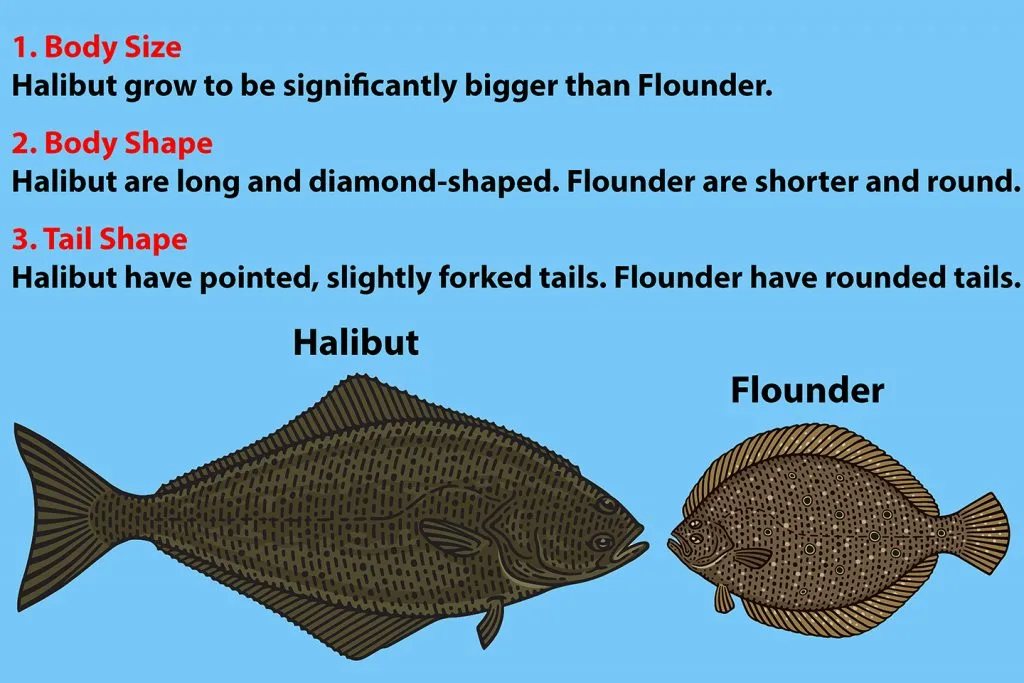
Image source: Web (Bing) / fishingbooker.com (Web image (fair-use with source credit))
How to Spot a True Halibut
Halibut is the heavyweight champion of flatfish. Pacific halibut can exceed 500 pounds and reach eight feet long. Atlantic halibut is similarly massive but heavily overfished, so treat that label with skepticism.
The body is more elongated than a flounder's. The mouth is large with noticeable teeth. The tail is crescent-shaped.
Halibut also has a distinct arch in its lateral line above the pectoral fin, which is a great visual shortcut.
Common Visual Mistakes
People mix up halibut and flounder constantly. The confusion is understandable. Both are oval-shaped flatfish with both eyes on one side.
The key difference comes down to body shape. Flounder has a more rounded, less elongated body. Its mouth and teeth are smaller than a halibut's.
The tail is also more squared off. Once you know these details, the two stop looking alike.
Side-by-Side Comparison Table
| Feature | Halibut | Flounder | Sole |
|---|---|---|---|
| Body shape | Elongated, diamond | Rounded oval | Very elongated |
| Eye side | Usually right | Varies by species | Usually right |
| Mouth size | Large, strong teeth | Medium | Small, curved |
| Tail shape | Crescent | Squared | Rounded |
| Max weight | 500+ lbs | 20 lbs | 10 lbs |
| Fillet yield | 4 large fillets | 4 smaller fillets | 4 thin fillets |
Roundfish Lookalikes: Haddock, Hake, and Hoki
If flatfish confuse at the market, roundfish confuse at the dock. Haddock, hake, and hoki all share a similar silhouette. They all produce similar white fillets.
But each has a distinct visual signature.

Image source: Web (Bing) / sea2table.com (Web image (fair-use with source credit))
Chin Barbel and Lateral Line Cues
Start with the lateral line. Haddock's is black with a dark blotch above the pectoral fin. Hake's lateral line is light and less defined.
Hoki has a long, thin body with a silver lateral line that's faint but visible.
Now check the chin. Haddock has a short barbel. Hake has a similar but smaller barbel.
Hoki has no barbel at all. If the fish has a serious whisker situation, it's worse than a haddock's.
Weight and Fillet Shape Differences
Haddock typically runs 1 to 3 pounds at market. Hake runs similar but gets a bit larger. Hoki is the outlier, commonly reaching 5 to 8 pounds with a much longer, slimmer profile.
Fillets follow the same pattern. Haddock fillets are thin and flake easily. Hake fillets are slightly firmer.
Hoki fillets are larger and hold together better, which makes them popular for frozen fish products.
Visual Table: Haddock vs. Hake vs. Hoki
| Feature | Haddock | Hake | Hoki |
|---|---|---|---|
| Lateral line | Black | Light | Faint silver |
| Chin barbel | Short | Shorter | None |
| Max size | 3-5 lbs | 5-8 lbs | 8-15 lbs |
| Body profile | Standard cod-shape | Slender | Long, thin |
| Fillet texture | Flaky | Medium firm | Firm |
| Common use | Fish and chips | Frozen fillets | Breaded products |
H-Fish by Use Case: Who Needs to Know What
Different people need different levels of identification. A chef and a diver don't care about the same details.
For Home Cooks and Seafood Shoppers
Your goal is simple: don't overpay and don't get a surprise texture. Haddock and cod swap constantly at counters. Hake gets sold as cod more often than you'd think.
Halibut gets replaced with cheaper flounder at restaurants and markets.
Learn the fillet cues. Haddock fillets have thin flakes and are usually skin-on at retail. Halibut steaks are thick, white, and firm.
Hogfish fillets look like snapper with a slightly pinker tint.
For Recreational Anglers
If you fish for hogfish in Florida or halibut in Alaska, identification is a legal obligation, not a choice. Size limits and bag limits exist for a reason. Florida FWC enforces a 12-inch minimum for hogfish in most state waters.
Halibut seasons in Alaska are strictly regulated.
Photograph your catch before you clean it. If there's any doubt, check the local regulations. Mistakes cost fines and hurt fish populations.
For Aquarium Hobbyists
Aquarium keepers care about body shape and behavior, not fillet texture. Hatchetfish need a covered tank because they jump. Halfbeaks need brackish water in some species.
Horn sharks need 180 gallons or more with cold-water filtration.
Research each species before you buy. Impulse purchases at pet stores lead to dead fish and wasted money. Check species compatibility and tank requirements first.
For Commercial Buyers
Restaurants and wholesalers need consistency. Mislabeling costs money and can trigger regulatory action. The FDA inspects seafood imports for substitution.
In our research, we found that hake sold as cod is one of the most common substitutions in North America.
Buy from certified suppliers. Ask for species documentation. When in doubt, DNA testing resolves the question.
Authentication via a simple photo check works. When the label and the fillet don't match, that's a red flag. Reputable suppliers welcome questions about their sourcing.
The good ones document every step from boat to box.
Flatfish vs. Roundfish: A Quick Anatomical Breakdown
Understanding the two basic body plans makes every other identification easier. Flatfish and roundfish differ at the most fundamental level, and once you grasp that, you stop confusing halibut with haddock forever.
Why It Matters for ID
Flatfish have both eyes on one side. Roundfish have one eye per side. That single fact changes everything about how you identify them.
Flatfish swim sideways along the seafloor. They flatten out, their colored side facing up. When you hold one, both eyes stare at you from the same side of the head.
Roundfish swim upright, with a conventional left-right eye arrangement.
The fillets differ too. A halibut yields four distinct fillets, two from each side. A haddock gives you two fillets, one from each flank.
If someone hands you four fillets from a fish the size of a dinner plate, it came from a flatfish.
Visual Cheat Sheet
| Feature | Flatfish (Halibut, Sole) | Roundfish (Haddock, Hake) |
|---|---|---|
| Eye placement | Both eyes, one side | One eye per side |
| Body shape | Flattened, oval | Symmetric, elongated |
| Swimming | Sideways, near bottom | Upright, mid-water |
| Fillets per fish | 4 | 2 |
| Dorsal fin | Continuous, full length | Divided, two sections |
Comparison Table: All H-Fish at a Glance
Here's the complete single-screen reference for every fish on our list. Keep this table handy the next time you shop or scout.
| Species | Max Size | Habitat | Key ID Feature | Culinary Use |
|---|---|---|---|---|
| Haddock | 3-5 lbs | North Atlantic | Black lateral line, chin barbel | Fish and chips, smoking |
| Halibut | 500+ lbs | Pacific/Atlantic | Flat body, crescent tail | Grilling, pan-searing |
| Hake | 5-8 lbs | Cold waters | Faint lateral line | Frozen fillets, stews |
| Herring | 1 lb | North Atlantic/Pacific | Metallic blue-green back | Kippering, pickling |
| Hogfish | 2-10 lbs | Florida/Keys reefs | Long pig-like snout | Grilling, ceviche |
| Hoki | 8-15 lbs | New Zealand | Long thin body | Breaded fish products |
| Hatchetfish | 2 inches | Freshwater | Deep axe-shaped body | Aquarium surface dweller |
| Halfbeak | 4-6 inches | Brackish/freshwater | Extended lower jaw | Aquarium |
| Horn Shark | 3-4 ft | Pacific coastal | Horn-like dorsal spines | Large aquarium, cold water |
Mistakes to Avoid When Identifying H-Fish
Everyone makes identification errors at some point. Even experienced anglers get caught. These are the most common mistakes we've found in our research.
Mislabeling at Seafood Counters
Retail substitution is rampant in the white fish category. Hake and hoki get sold as cod or haddock when the original stock runs dry. The reverse also happens on luxury items.
Flounder gets labeled as halibut.
Check the price. If a fillet is priced too good to be true, it's probably a cheaper substitute. Ask to see the whole fish if one is available.
Whole fish are much harder to mislabel.
Confusing Juvenile and Adult Patterns
Young halibut look different from adults. They haven't fully migrated their eyes yet, and their coloring is different. Juvenile haddock have smaller markings that grow bolder with age.
This matters for early season anglers and aquarium buyers. A juvenile horn shark looks completely different from an adult. Always use size and region as cross-checks, not just color patterns.
Overlooking Regional Color Variations
Haddock from Iceland look different from haddock from Nova Scotia. The dark lateral line stays the same, but the body color shifts with water temperature and diet. Hogfish in the Florida Keys show more red than those in the Gulf.
Use behavior and structural features over color. Structure is constant. Color varies.
For Anglers: H-Fish ID in the Field
If you're actively fishing for these species, identification happens before the fish hits the cooler. Get it wrong and you could face fines.
Bag Limits and Size Minimums by Species
| Species | Typical Limit | Size Minimum | Region |
|---|---|---|---|
| Hogfish | 2 per person/day | 12 inches FL | Florida Gulf/Atlantic |
| Halibut | 1-2 per day | 26-40 inches | Alaska/California |
| Haddock | 15 per day | 19 inches | Federal waters |
| Horn Shark | No recreational limit | None | California |
Check the current regs every season. Limits change based on stock assessments. NOAA and state agencies publish updated rules annually.
Handling and Photographing for Confirmation
When you catch a fish you can't identify instantly, photograph it before cleaning. Capture the lateral line, the head, and the tail. These three features let a fisheries biologist confirm the species.
Don't rely on memory. Take a photo and check it against a field guide that same day. If you're still unsure, report the catch and consult local authorities.
For Aquarium Keepers: Visual Care Guide
Aquarium fish identification matters less for legal reasons and more for water requirements. Each H-species has different tolerance and tank needs.
Hatchetfish and Halfbeak ID Traits
Hatchetfish have that unmistakable deep, compressed body. The pectoral fins sit high. The mouth points upward.
They're built for surface feeding and quick jumps.
Halfbeaks have the extended lower jaw that gives them their name. They're surface dwellers too, but they need river and brackish setups depending on the species. Don't mix the two unless you know their water chemistry matches.
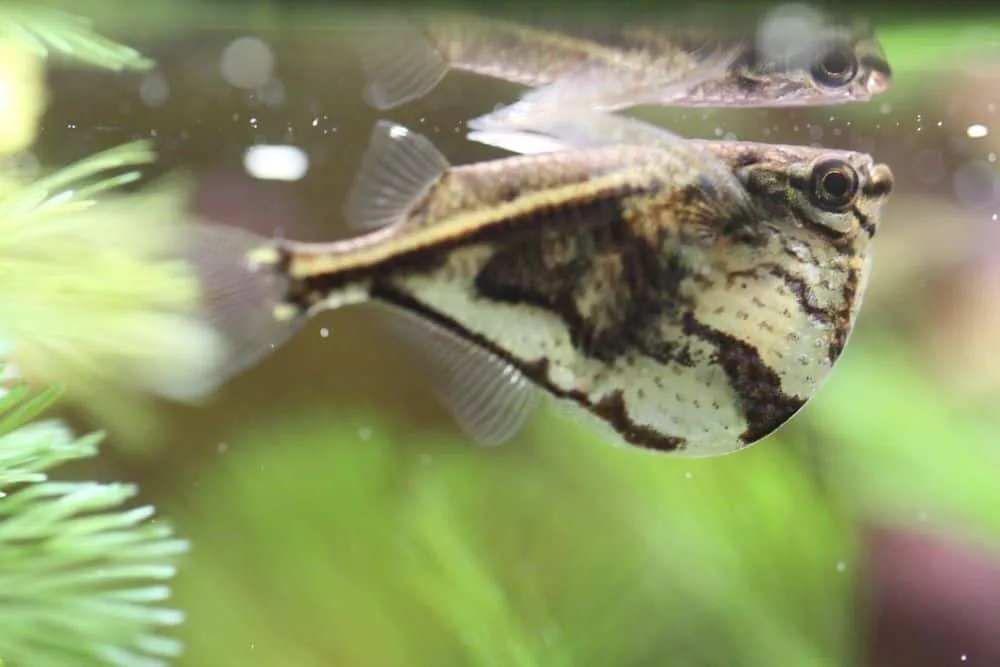
Image source: Web (Bing) / pinterest.com (Web image (fair-use with source credit))
Horn Shark Tank Requirements at a Glance
Horn sharks aren't a beginner species. They need at least 180 gallons. Cold water, strong filtration, and a protein-heavy diet keep them healthy.
Their dorsal spine can snag nets and injure them. Handle them carefully, if at all.
For Cooks: Choosing H-Fish by Visual Cues
Buying better seafood starts with knowing what fresh looks like. These checks work on any of the H-fish.
Freshness Indicators (Gills, Eyes, Skin)
Start with the gills. They should be bright red to pink. Brown or gray gills mean old fish.
Eyes should be clear and bright, not cloudy or sunken. The skin should be shiny with a tight scale pattern.
Press the flesh with a finger. It should spring back when fresh. If it stays indented, the fish is past its prime.
Smell the fillet. Fresh fish smells like seawater, not fishy.
Fillet Texture and Color by Species
Haddock fillets are bright white and flake apart easily. Hake is also white but slightly firmer. Halibut fillets are thick, snow-white, and hold together in steaks.
Hogfish is white with a slight pink tint. Herring flesh is darker, naturally oily, and never marketed as white fish.
Quick ID Cards: One-Sentence Visual Summary
Here's the shortest possible version for last-second checks.
The "If You See This, It's…" Section
- Flat body, both eyes up, over 50 pounds: Halibut
- Black lateral line, small chin whisker: Haddock
- No whisker, longer body, up to 15 pounds: Hoki
- Small silver fish with blue-green back: Herring
- Long snout, reddish bronze body: Hogfish
- Deep body, upward mouth, 2 inches long: Hatchetfish
FAQs About H-Fish Identification
Is Hake Just a Baby Haddock?
No. Hake and haddock are entirely different species. Hake belongs to the Merlucciidae family.
Haddock is a member of the cod family, Gadidae. They share some visual traits, but the lateral line and breeding behavior differ completely. Hake reaches its full size at 5 to 8 pounds.
Haddock maxes out around 3 to 5 pounds in most fisheries.
Do All Flatfish Start as Roundfish?
Yes. Every flatfish begins life swimming upright, with one eye on each side. During metamorphosis, one eye migrates to the other side of the skull.
The fish then settles onto the seafloor on its blind side. This process takes a few weeks and is controlled by thyroid hormones.
How Can I Tell Herring from Sardines?
Herring are larger, typically reaching 9 to 12 inches. Sardines stay under 8 inches. Herring has a darker blue-green back.
Sardines carry a more silver-green tone. Both are oily fish, but herring is smoked or pickled more often. Sardines get canned in oil or tomato sauce.
Final Visual Reference: Your Takeaway Checklist
You've got the full guide now. Here's a ten-second flow that covers any H-fish in front of you.
Ten-Second ID Flow for Any H-Fish
First, check the body shape. Flat means flatfish, and you're looking at halibut, flounder, or sole. Upright means roundfish.
Now check the lateral line for haddock or hake. Look for the snout length to spot hogfish. Small silver fish with blue backs are herring.
Aquarium species present deep bodies and upward mouths.
That's it. You're ready to identify fish that start with h, whether you're at a market, on the water, or setting up your next tank.
For Anglers: H-Fish ID in the Field
If you're fishing for these species, identification happens before the fish hits the cooler. Get it wrong and you could face fines.
Bag Limits and Size Minimums by Species
| Species | Typical Limit | Size Minimum | Region |
|---|---|---|---|
| Hogfish | 2 per person/day | 12 inches FL | Florida Gulf/Atlantic |
| Halibut | 1-2 per day | 26-40 inches | Alaska/California |
| Haddock | 15 per day | 19 inches | Federal waters |
Check current regs every season. Limits change based on stock assessments. NOAA publishes updated rules annually.
Handling and Photographing for Confirmation
When you catch a fish you can't identify instantly, photograph it before cleaning. Capture the lateral line, the head, and the tail. These three features let a fisheries biologist confirm the species.
Don't rely on memory. Take a photo and check it against a field guide that same day.
For Aquarium Keepers: Visual Care Guide
Aquarium fish identification matters less for legal reasons and more for water requirements. Each H-species has different tolerance and tank needs.
Hatchetfish and Halfbeak ID Traits
Hatchetfish have that unmistakable deep, compressed body. The pectoral fins sit high. The mouth points upward.
They're built for surface feeding and quick jumps. Halfbeaks have the extended lower jaw that gives them their name. They're surface dwellers too, but they need river and brackish setups depending on the species.
Image source: Web (Bing) / pinterest.com (Web image (fair-use with source credit))
Horn Shark Tank Requirements at a Glance
Horn sharks aren't a beginner species. They need at least 180 gallons. Cold water, strong filtration, and a protein-heavy diet keep them healthy.
Their dorsal spine can snag nets and injure them.
For Cooks: Choosing H-Fish by Visual Cues
Buying better seafood starts with knowing what fresh looks like. These checks work on any of the H-fish.
Freshness Indicators (Gills, Eyes, Skin)
Start with the gills. They should be bright red to pink. Brown or gray gills mean old fish.
Eyes should be clear and bright, not cloudy or sunken. The skin should be shiny with a tight scale pattern. Press the flesh with a finger.
It should spring back when fresh.
Fillet Texture and Color by Species
Haddock fillets are bright white and flake apart easily. Hake is also white but slightly firmer. Halibut fillets are thick, snow-white, and hold together in steaks.
Hogfish is white with a slight pink tint. Herring flesh is darker, naturally oily, and never marketed as white fish.
Quick ID Cards: One-Sentence Visual Summary
Here's the shortest possible version for last-second checks.
The "If You See This, It's…" Section
- Flat body, both eyes up, over 50 pounds: Halibut
- Black lateral line, small chin whisker: Haddock
- No whisker, longer body, up to 15 pounds: Hoki
- Small silver fish with blue-green back: Herring
- Long snout, reddish bronze body: Hogfish
- Deep body, upward mouth, 2 inches long: Hatchetfish
FAQs About H-Fish Identification
Is Hake Just a Baby Haddock?
No. Hake and haddock are entirely different species. Hake belongs to the Merlucciidae family.
Haddock is a member of the cod family, Gadidae. They share some visual traits, but the lateral line and breeding behavior differ completely.
Do All Flatfish Start as Roundfish?
Yes. Every flatfish begins life swimming upright, with one eye on each side. During metamorphosis, one eye migrates to the other side of the skull.
The fish then settles onto the seafloor on its blind side.
How Can I Tell Herring from Sardines?
Herring are larger, typically reaching 9 to 12 inches. Sardines stay under 8 inches. Herring has a darker blue-green back.
Sardines carry a more silver-green tone. Both are oily fish, but herring is smoked or pickled more often.
Final Visual Reference: Your Takeaway Checklist
You've got the full guide now. Here's a ten-second flow that covers any H-fish in front of you.
Ten-Second ID Flow for Any H-Fish
First, check the body shape. Flat means flatfish, and you're looking at halibut, flounder, or sole. Upright means roundfish.
Now check the lateral line for haddock or hake. Look for the snout length to spot hogfish. Small silver fish with blue backs are herring.
Aquarium species present deep bodies and upward mouths.
That's it. You're ready to identify fish that start with h, whether you're at a market, on the water, or setting up your next tank.
Safety and Sustainability: A Note on Overfished Stocks
Before you buy, check the source. Atlantic halibut remains heavily overfished, and NOAA lists it as a species of concern. Pacific halibut is better managed.
Haddock stocks in the North Atlantic have rebounded, but regional quotas shift yearly.
Choose MSC-certified hoki when you can. Herring supports a strong sustainable fishery in Alaska and Norway. When a species is overfished, skip it.
There are plenty of other H-fish on this list.
Regional Market Variations
The same name means different things in different regions. In New Zealand, hoki is a premium export. In the US, it's the white fish inside frozen breaded sticks.
European markets sell hake fresh, while US buyers see it mostly frozen.
Herring appears cured in Scandinavia, pickled in Germany, and fresh in Asian markets. Hogfish is a Florida specialty, rarely seen elsewhere. Know your regional standards before you buy.
Ask where the fish was caught, and verify it makes sense for the season.
Troubleshooting Common Identification Errors
If a fillet looks white and mild, that doesn't tell you the species. You need structure. Haddock fillets run thin and taper sharply at the tail.
Hake fillets are thicker and more uniform. Hoki fillets are the longest and most consistent in width.
For flatfish, check the fillet count. Four matching fillets mean flatfish. Two free-form fillets mean roundfish.
When a market sells "halibut" as four skinny fillets from a small fish, you're likely looking at flounder.
Seasonal Availability Calendar
- Haddock: Best fall through spring. Spawning peaks in spring.
- Halibut: Pacific season opens March through November. Atlantic is scarce year-round.
- Herring: Peak winter catches in Norway and Iceland.
- Hogfish: Year-round in Florida, but best summer through fall.
- Hoki: Year-round from New Zealand deep-water fisheries.
Timing matters for quality and price. Out-of-season fish costs more and tastes less fresh. Check local harvest calendars before you shop.
Final Tips for Confident Identification
You don't need a biology degree to get this right. Stick to the core visual anchors. Check the lateral line.
Study the body shape. Look at the snout and the fins. Those four checks eliminate most of the guesswork.
Keep a field guide on your phone. Compare your fish against trusted reference photos before you clean it. If you're still unsure, ask the fishmonger or your local fisheries office.
Every expert started as a beginner who asked questions.
H-Fish in Popular Culture and Cuisine
These fish turn up in dishes worldwide. Haddock stars in British fish and chips. Herring anchors Scandinavian smorgasbord tables.
Hake is the backbone of Portuguese bacalhau alternatives. Hogfish appears on high-end Florida menus.
Each fish carries regional pride. If you're traveling, try the local preparation. You'll taste the difference that freshness makes.
How to Photograph Fish for Accurate ID
Good photos make identification easier. Lay the fish flat on a clean surface. Include the whole body in frame.
Shoot the lateral line and head close-ups separately.
Natural light works best. Avoid filters. Keep the fish wet so colors stay accurate.
Then match your photo against a trusted field guide or fisheries database.
Where H-Fish Fit in the Seafood Market
Haddock and hake hold steady demand in Europe and North America. Herring fluctuates with bait and food markets. Hoki supplies the frozen white fish sector.
Hogfish stays a niche luxury item.
Prices follow supply, season, and region. Expect to pay more for halibut and hogfish. Hake and hoki remain budget-friendly alternatives that cook just as well.
The Bottom Line on H-Fish
You don't need to memorize every species. Learn the core visual anchors. Body shape, lateral line, snout, and fin placement.
Those four checks separate the deep-sea flatfish from the round cod-likes.
Use this guide next time you shop, fish, or set up a tank. The more you look, the easier it gets. And if you're ever unsure, ask the buyer or check the regulations.
That's what experienced anglers and cooks do.
Your Next Steps
Bookmark this page for quick reference. Share it with your fishing buddies. Next time you're at the market, test yourself on the fillets.
You'll be surprised how fast the patterns stick.