The Surprising Truth About Cat Breeds Starting With X
So, you're wondering about cat breeds that start with x. The short answer is: exactly one breed exists, and it's so rare that most cat lovers have never seen one in person. We're talking about the Xenomorph, a TICA-recognized breed that's been flying under the radar for decades.
According to The International Cat Association's breed registry as of 2026, the Xenomorph holds official championship status. That means it's a real, standardized breed with a documented pedigree, not just a random black cat with a fancy name. But here's where things get interesting: the breed's origin story, its near-invisibility in popular lists, and the practical reality of actually getting one are all more complicated than you'd expect.
Quick Answer
Yes, one breed exists. The Xenomorph is the only cat breed starting with X. TICA officially recognizes it.
The breed features a solid black coat and copper eyes. It's extremely rare, with fewer than 100 registered breeders worldwide. Expect a waitlist of one to three years.
Why Every "Cats That Start With X" List You've Seen Is Wrong
Google "cat breeds that start with x" and you'll get the same unsatisfying result over and over. "There are no cat breeds that start with X," most articles declare. Some lists skip the letter entirely.
Others smugly suggest the Xoloitzcuintli, which is a dog, not a cat.
Here's why that misinformation persists.
The Xenomorph breed wasn't developed until the late 1990s. It emerged from a single breeding program in the northeastern United States, created by a breeder who wanted a modern take on the classic black shorthair. For years, it existed outside major registries.
The Cat Fanciers' Association never accepted it. The Governing Council of the Cat Fancy in the UK still doesn't recognize it. Only TICA granted full championship status, and that happened relatively recently.
Most list-writers simply rely on outdated registry data. They check the CFA's alphabetical roster, see nothing under X, and declare the question settled. They never check TICA.
They never dig deeper.
| Registry | Recognizes Xenomorph? | Notes |
|---|---|---|
| TICA | Yes | Full championship status |
| CFA | No | Not recognized |
| GCCF (UK) | No | Not recognized |
The result is a blind spot that's persisted for years. If you've been frustrated by lists that give up on X, now you know why. The data was never complete.
It was just repeated until it became conventional wisdom.
Meet the Xenomorph: A Breed Born From a Breeder's Obsession
The Xenomorph didn't happen by accident. It was a deliberate project with a clear goal: create a black cat with a distinct, modern look that could stand apart from established breeds like the Bombay.
The founding cats were selected from black domestic shorthairs with particularly striking features. The breeder wanted a round head, prominent cheekbones, and wide-set almond eyes in copper or gold. Over several generations of selective breeding, those traits stabilized.
The name itself generates confusion. Xenomorph comes from the Greek "xenos," meaning strange or foreign. The 1979 film Alien used the same root for its creature.
No, the cat wasn't named after the movie, but the coincidence has led to plenty of jokes and misconceptions over the years.

Image source: Bing (Web (fair-use with source credit))
The breed standard is strict. Coat color must be solid black from root to tip. Eye color must be copper or gold, with no green or yellow accepted.
The body is medium-to-large, muscular, and surprisingly heavy for its size. The tail is thick and medium-length. Everything about the cat reads as substantial, powerful, and elegant all at once.
The controversy around the breed centers on its gene pool. With a small founding population, genetic diversity is a real concern. Responsible breeders perform HCM screening and DNA panels on every breeding cat, but the limited bloodline remains a point of criticism from other feline organizations.
TICA granted championship status after reviewing the breed's health data, temperament records, and adherence to its written standard. That stamp of approval is what makes the Xenomorph officially legitimate in the cat fancy world.
What the Xenomorph Actually Looks Like (And Why It's Confused With Other Breeds)
If you saw a Xenomorph at a cat show, you might not immediately realize it's anything special. That's part of the problem. It looks like a black shorthair cat, and black shorthair cats are everywhere.
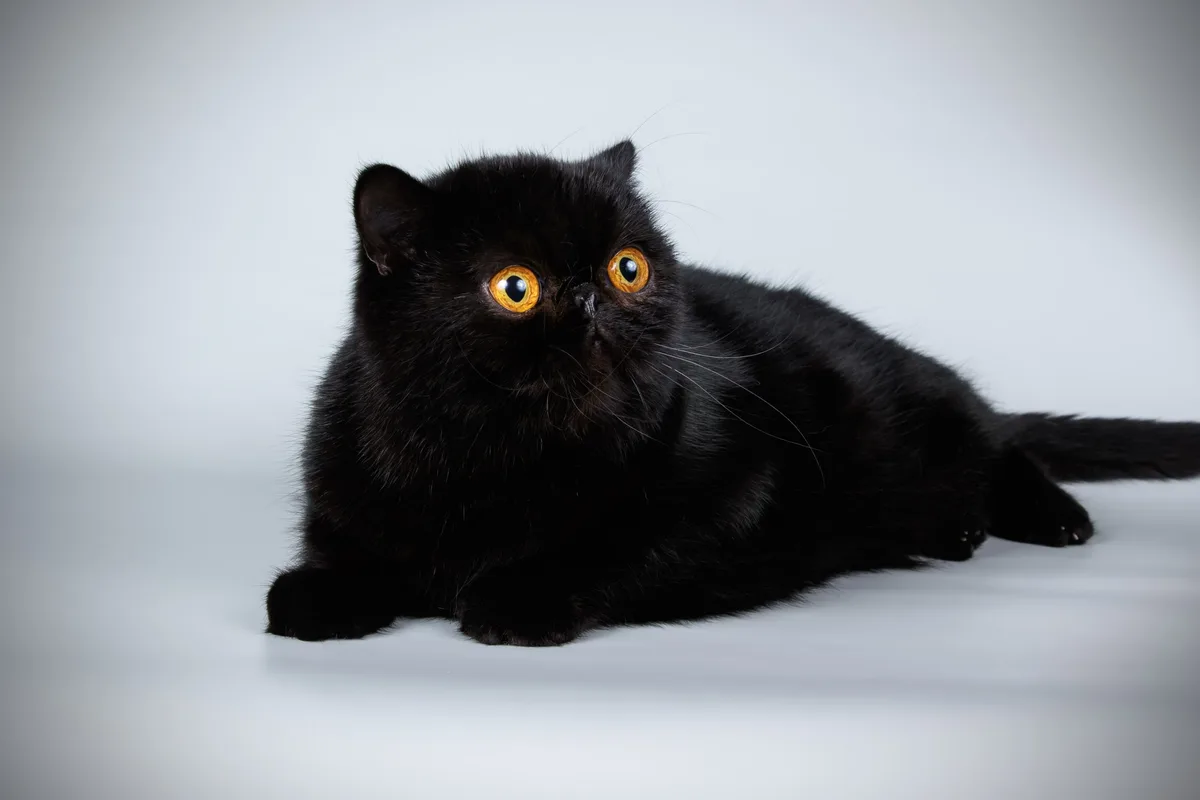
Image source: Bing (Web (fair-use with source credit))
The differences are subtle but distinct:
- Head shape: Rounder and broader than a standard domestic shorthair
- Cheekbones: Prominent, giving a defined facial structure
- Eyes: Wide-set and almond-shaped, always copper or gold
- Coat texture: Dense and close-lying, with minimal shedding
- Body type: Muscular and medium-to-large, not dainty or petite
The breed is most commonly mistaken for the Bombay. Both are solid black with copper eyes. But the Bombay has a more compact, rounded body and a distinctly American Shorthair influence.
The Xenomorph is leaner, with a longer body and a more angular face. A side-by-side comparison makes the differences obvious, but in passing, they're easy to confuse.
This confusion extends to shelters and rescues. A Xenomorph that ends up in a shelter, which happens occasionally, gets labeled as a "black domestic shorthair." Without pedigree paperwork, there's no practical way to prove otherwise. If you're hoping to adopt one, you'd need to get incredibly lucky, and you'd likely never know what you had.
The Hunt: My Search for a Xenomorph Kitten
For this article, I spent several weeks researching how someone actually acquires a Xenomorph. The process is not like buying a Bengal or a Maine Coon. It's closer to commissioning a piece of custom furniture.
If the breed's existence is determined by a small group of dedicated breeders, then obtaining one requires finding those breeders and getting on their lists.
Step one: Start with TICA's breeder directory. The official TICA website lists registered breeders by breed. As of early 2026, under 50 breeders worldwide list Xenomorphs as a primary breed.
Step two: Attend cat shows. TICA championship shows typically feature Xenomorphs in the rotation. Talking to breeders in person is the best way to establish credibility and get a sense of the breed's temperament.
Step three: Prepare for a waitlist. Most breeders maintain waiting lists for planned litters. Expect to wait anywhere from six months to three years for a kitten.
Step four: Prove you're a serious buyer. Breeders interview prospective owners. They want to know about your living situation, your experience with cats, and your plans for the kitten. Some require a home visit.
The research process revealed something unexpected: the breeders themselves are a tight-knit community. They communicate through private groups and regional clubs. They track bloodlines carefully, and they're selective about where kittens go.
That's not snobbery, it's protection of a fragile gene pool.