Reptiles That Start With S: A Full Guide
If you're hunting for reptiles that start with S, you're probably not looking for a single answer. Skinks, snakes, softshell turtles, sliders, spiny lizards… the list spans a huge chunk of the reptile world. The challenge isn't finding them.
It's telling them apart without a field guide in your hand.
Most people assume every long, legless reptile is a snake. That's wrong. Slow worms and many skinks are lizards.
As of 2026, herpetologists recognize more than 1,500 skink species alone, making this the largest lizard family on Earth. That's exactly why visual cues matter more than memorizing names.

Image source: Web (Bing) / wall.alphacoders.com (Web image (fair-use with source credit))
Quick Answer
Reptiles starting with S include skinks, snakes, softshell turtles, and sideneck turtles. Snakes and legless lizards are easiest to confuse. Skinks, slow worms, and sand lizards have eyelids.
True snakes do not. Look for ear openings.
Use this guide as a visual ID tool, not a trivia list. Start with the blue-tongued skink above. It's a lizard, even though its body plan looks snake-like at first glance.
Then scan the table below and test yourself on the common mistakes. If you enjoy this format, our B-named animals page covers similar visual mix-ups.
The Full List: Reptiles That Start with S, A to Z
Here's a working cheat sheet. These are the S reptiles you're most likely to spot in field guides, zoos, and backyards. As of 2026, the IUCN Red List tracks conservation status for most of them, and a few are protected.
| Reptile | Type | Native Range | One-Point ID |
|---|---|---|---|
| Blue-tongued skink | Lizard | Australia | Blue tongue, sturdy body |
| Common snapping turtle | Turtle | North America | Oversized head, ridged shell |
| Red-eared slider | Turtle | Southern US and invasive elsewhere | Red patch behind the eye |
| Sidewinder | Snake | Southwestern US, Mexico | Horn-like scales above the eyes |
| Slow worm | Legless lizard | Europe and western Asia | Visible eyelids, ear openings |
| Smooth snake | Snake | Europe | Sleek, uniform brownish scales |
| Softshell turtle | Turtle | Africa, Asia, North America | Flat, leathery shell |
| Spectacled caiman | Crocodilian | Central and South America | Bony ridge between the eyes |
| Spiny-tailed iguana | Lizard | Mexico, Central America | Spiny ringed tail |
| Spotted turtle | Turtle | Eastern US | Small yellow spots on the shell |
| Stiletto snake | Snake | Sub-Saharan Africa | Short head, curved fangs |
| Sungazer | Lizard | South Africa | Spiked tail, heavily armored body |
These are not all of them. There are more skinks, snakes, and turtles with S names around the world. But this list gives you the core group that keeps showing up.
If you want another alphabetical breakdown, our A-listed species guide covers agamas and anacondas.
Snake or Not? Scale Patterns and Body Shape Cues
Before you name a species, decide if it's a snake at all. The fastest test is the head, not the body. The anatomy image below shows what a snake skull looks like, but the field marks you can actually see from a distance are simpler.

Image source: Web (Bing) / ar.inspiredpencil.com (Web image (fair-use with source credit))
The image above comes from a colubrid skull. Colubrids are the family behind corn snakes, rat snakes, and king snakes. Their jaw bones are loosely connected.
That's what lets them swallow prey wider than their head.
Now use these four checks:
- Eyelids. Lizards have movable eyelids. Snakes have a clear scale over the eye, called a spectacle. No blinking.
- Ear openings. Lizards have small external ear holes. Snakes don't.
- Belly scales. Snakes have one broad row of belly scales. Many legless lizards share this, so don't rely on it alone.
- Head shape. Snakes have a blunt, rounded head. Legless lizards tend to have a more pointed snout and a slight neck.
If you see eyelids and ear openings, it's a lizard. If you see neither, it's a snake. This simple decision tree resolves most slow worm and skink confusions.
Other groups, like caimans and chameleons, have their own visual clues. The C-named reptiles guide walks through those.
Turtle ID Tricks: Softshells, Sideneck, Snapping, and Sliders
Turtles are easier than snakes once you focus on two features. Look at the shell, then look at how the neck folds.

Image source: Bing (Web (fair-use with source credit))
The photo above shows the clearest contrast. A softshell turtle's shell is flat and leathery, with flexible edges. A snapping turtle's shell is hard, rigid, and often ridged.
A slider's shell is also hard but smoother.
Neck retraction is the other major clue. Sliders, softshells, and snapping turtles pull their heads straight back. Sideneck turtles fold their heads sideways into a space under the shell rim.
If you're looking at a photo, check the angle of the neck.
Here's the quick ID rundown:
- Softshell turtle: flat leathery shell, long snout, webbed feet
- Snapping turtle: massive head, small plastron, rough shell
- Slider turtle: hard shell, red or yellow stripes behind the eye
- Sideneck turtle: long neck folded sideways, oval shell
Softshell turtles can move fast on land and bite defensively. Give them space. The red-eared slider is one of the world's most invasive reptiles, and many countries regulate its trade under CITES.
If you're curious about related alphabet groups, our D-named reptiles guide covers dwarf geckos and dragon lizards.
The 6 Most Common "S" Reptile Lookalike Mistakes
Most identification errors happen because people rely on body shape alone. The slow worm below is a classic example. It looks like a snake, but it has eyelids and ear openings.
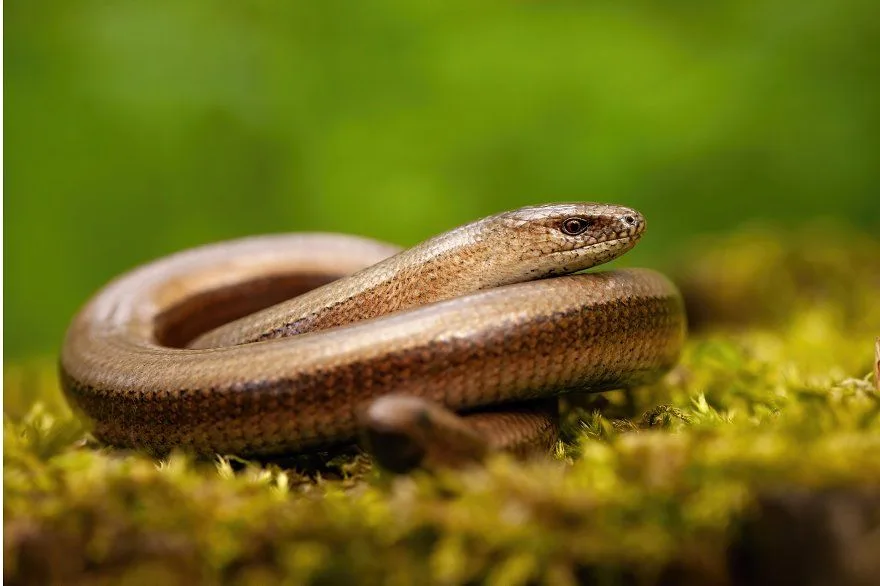
Image source: Web (Bing) / artofit.org (Web image (fair-use with source credit))
Here are the six mix-ups that send people to reptile forums and field guides.
1. Slow worm vs. smooth snake. Both live in Europe. Check the head.
A slow worm has visible eyelids and a small ear opening. A smooth snake has neither. If you see a blink, it's a lizard.
2. Scarlet snake vs. coral snake. Scarlet snakes are harmless. Coral snakes are venomous.
The safest field clue is snout color. Scarlet snakes have a pale or cream snout. Coral snakes have a black snout that extends behind the eye.
If you're not sure, back away.
3. Skink vs. snake. Blue-tongued skinks have visible limbs. But some skinks have tiny or absent legs.
Use eyelids and ear openings again. The blue-tongued skink also has a wide, blunt head and a bright blue tongue.
4. Softshell turtle vs. snapping turtle. Softshells look flat, like a pancake with legs. Snappers have a heavy head, a small lower shell, and a spiky tail.
Shell texture separates them best.
5. Stiletto snake vs. shield-tailed snake. Stiletto snakes are venomous and have short, thick heads. They can strike backward with specialized fangs.
Shield-tailed snakes are harmless, with blunt heads and a pointed tail tip. Never grab a stiletto by the neck.
6. Spiny lizard vs. spiny-tailed iguana. Spiny lizards from the genus Sceloporus are small and live across North America. Spiny-tailed iguanas from Ctenosaura are much larger and hang out in Mexico and Central America.
Size and habitat are your first clues.
The same ID logic works with mammals, too. The S-named mammals guide shows seals and shrews side by side. When in doubt, take a photo first and identify later.
Your eyes will thank you.