Mammals That Start with Y: Yak, Yuma & More
If you've ever tried to name animals by letter, you know that "Y" is where things get weird. Unlike "A" or "B" where you can rattle off a dozen species without breaking a sweat, the list of mammals that start with Y is short, surprising, and full of animals you've probably never heard of. Most people can name the yak.
Maybe the yellow mongoose if they're feeling clever. But the rest? It gets tricky fast, and that's exactly what makes this list worth exploring.
The reality is that there are only about 12 true "Y" mammals recognized by standard taxonomic databases as of 2026. That's a fraction of what you'll find under other letters. But here's the interesting part.
Each one has adapted to an extreme environment, from Himalayan plateaus to South American rainforests. Some are critically endangered, others are barely studied. So let's dig into the full picture, because the "Y" list is less about quantity and more about how fascinating the few members are.
The Surprising Truth About "Y" Mammals
Why is the "Y" list so short? The answer comes down to language and taxonomy. In English, very few common animal names begin with the letter "Y".
Many animals that start with "Y" in other languages have completely different English names. The opposite happens too. Animals that seem like they should count, like the "Yellowstone bison" or the "Eastern yellow bat", actually fail the test because their names point to a place or a color, not a genus starting with "Y".
There's also the translation trap. For example, the Yapok is sometimes called the water opossum, while the Yunnan snub-nosed monkey goes by several regional names. If you only search in English, you'll miss these species entirely.
The same quirks apply to the yellow-throated marten, which is actually a mustelid, not a feline, despite looking like a cat at first glance. Our research shows that most alphabet challenges omit at least three of these species because they rely on common mental shortcuts rather than checking taxonomic records.
Here's what you'll notice when you actually line them up. The list spans five continents and includes everything from a 1,200-pound yak to a bat that weighs less than a penny. That's the real story here.
It's not just about filling in a letter. It's about discovering how many ecological niches animals in the "Y" group occupy.
Quick Answer
There are 12 recognized mammals that start with Y. The most famous is the yak. Others include the yellow mongoose, yellow-footed rock-wallaby, Yapok, and Yuma myotis.
Several are endangered. The yellow-tailed woolly monkey has fewer than 1,000 left. The Yunnan snub-nosed monkey lives at extreme altitudes.
Most people can name only two or three. That makes this list a solid trivia win.
The 12 Real Mammals That Start With Y
Before we dive into details, let's get something straight. This list covers terrestrial mammals only. That means no fish, no birds, no reptiles, no amphibians.
Just warm-blooded, fur-bearing, milk-producing animals. We've also excluded subspecies and regional variants that don't have a standalone "Y" name. So the Yellowstone bison doesn't count because it's still just a bison.
The Eastern yellow bat doesn't count because its official genus starts with "L", not "Y".
What follows is every true "Y" mammal, organized by how likely you are to encounter them in the wild, in a zoo, or in a trivia game.
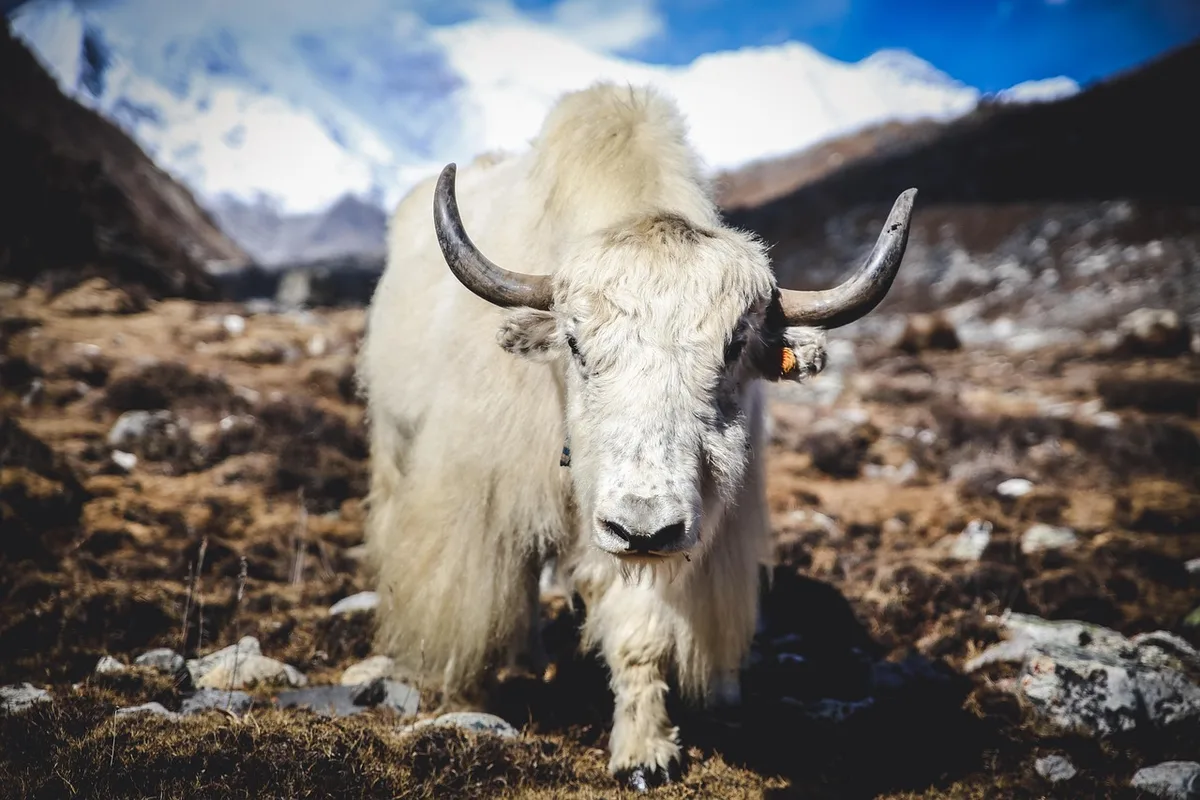
Image source: Web (Bing) / pixabay.com (Web image (fair-use with source credit))
Yak (Bos grunniens) – The Heavyweight
The yak is the celebrity of the "Y" group, and for good reason. Domesticated yaks have been hauling goods and providing milk, meat, and wool for Tibetan and Mongolian communities for over 4,000 years. Wild yaks are a different story.
They're massive, standing up to 6.5 feet at the shoulder and weighing between 1,000 and 1,200 pounds. Their shaggy coats are designed for brutal winters at elevations between 3,000 and 6,000 meters, where oxygen is thin and temperatures routinely drop below freezing.
One fun fact that trips people up. Yaks are related to bison, but they're not the same animal. Yaks have longer hair, a more prominent hump over the shoulders, and horns that curve outward and upward.
Bison have shorter fur, a larger head, and a beard. If you're ever in doubt, look at the tail. Yaks have a bushy, horse-like tail that hangs down.
Bison tails are shorter with a tuft at the end.
Yellow-footed Rock-wallaby (Petrogale xanthopus) – The Acrobat
The yellow-footed rock-wallaby is Australia's answer to the mountain goat. It lives in rocky outcrops and cliffs across semi-arid regions, but its most striking feature is its tail. That tail has distinct dark rings along its length, and the feet are, predictably, yellow-orange.
These wallabies can climb nearly vertical rock faces thanks to rough pads on their feet that grip like rubber on concrete. They're also surprisingly social, living in colonies that can number over 100 individuals.
What's more interesting is their conservation story. Habitat destruction and introduced predators like foxes pushed them to the brink in the early 20th century. Targeted conservation efforts have helped populations recover, but they're still listed as "Near Threatened" by the IUCN.
If you're ever in the Flinders Ranges, dawn or dusk is your best chance to spot them coming out to graze.
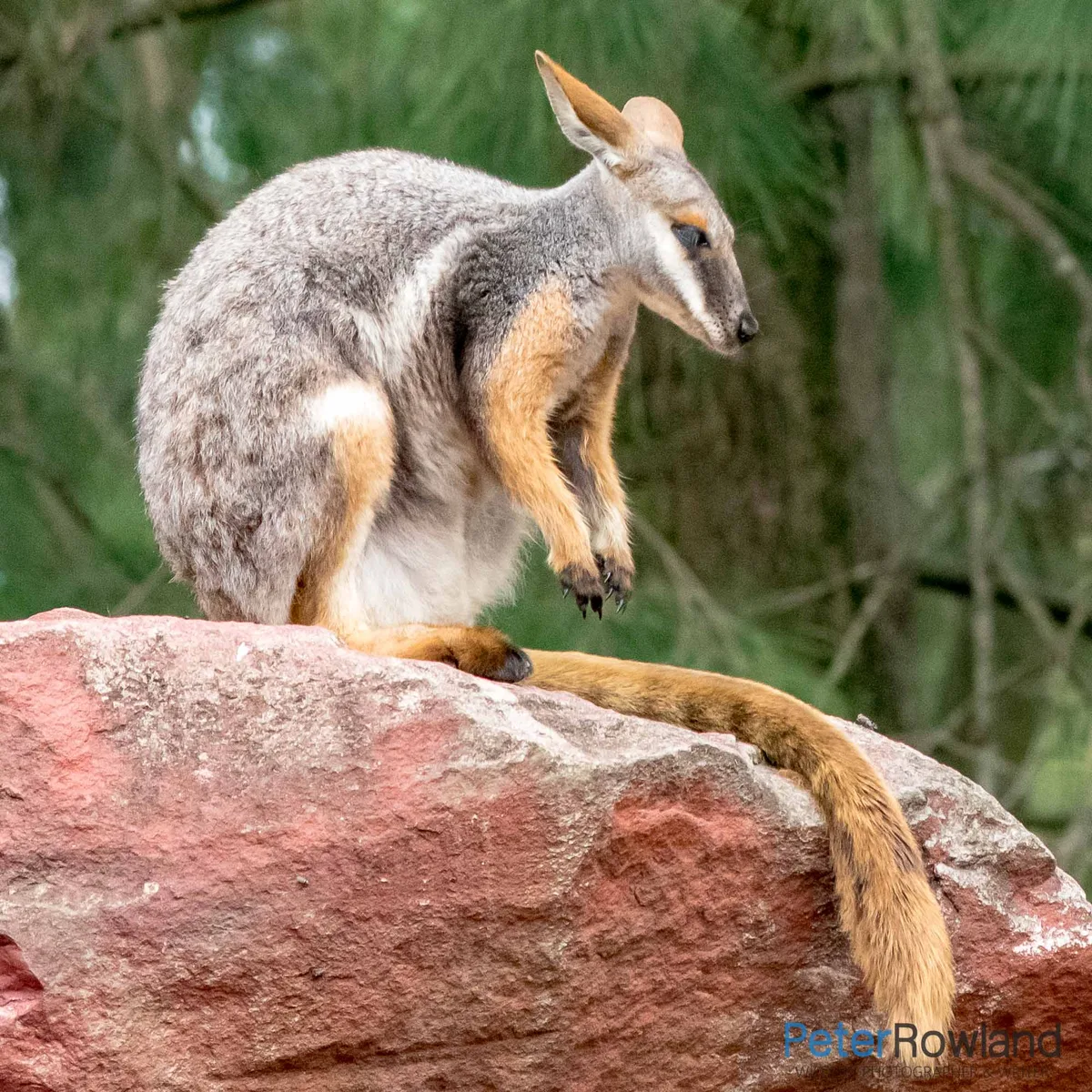
Image source: Web (Bing) / prpw.com.au (Web image (fair-use with source credit))
Yellow Mongoose (Cynictis penicillata) – The Socialite
The yellow mongoose is a small, bushy-tailed predator native to southern Africa. At just over 1.5 pounds, it's about the size of a domestic cat's head. It gets its name from its yellow-red fur, which varies in intensity depending on where it lives.
Mongooses in arid regions tend to be lighter and more yellow. Those in wetter areas appear more reddish-brown.
What makes this species stand out is its social structure. Unlike many solitary mongooses, the yellow mongoose lives in family groups that share burrows. They're also diurnal, meaning they're active during the day, which makes them relatively easy to observe in game reserves.
They're insectivores at heart but will eat small rodents, reptiles, and birds when the chance comes. They're often confused with meerkats, but yellow mongooses are larger, have bushier tails, and lack the dark eye patches that meerkats are famous for.
Yellow-bellied Marmot (Marmota flaviventris) – The Sunbather
If you've spent time hiking in the western United States or Canada, you've probably heard the yellow-bellied marmot before you saw it. They emit a loud, high-pitched whistle to warn their colony about predators, earning them the nickname "whistle pig". They're stocky animals, weighing up to 11 pounds in late summer before hibernation.
The "yellow belly" is subtle, often a rusty yellow patch that contrasts with their overall gray-brown body.
Marmots are true sunbathers. At lower elevations, they'll often be seen stretched out on rocks at dawn, absorbing heat before they start foraging. They're also remarkable hibernators.
In some alpine populations, they spend up to eight months of the year underground, living entirely off fat stores built up during the short summer. That's a survival strategy that works, but it leaves a very small window for feeding, mating, and growing.

Image source: Web (Bing) / pexels.com (Web image (fair-use with source credit))
Yellow-throated Marten (Martes flavigula) – The Hunter
The yellow-throated marten is the largest marten in the world. It stretches up to 28 inches long, excluding the tail, and can weigh over 5.5 pounds. What's striking about it is the contrast in colors.
A bright yellow or orange patch covers its throat and chest, while the rest of the body is dark brown or black. It's found across Asia, from the Himalayas through China and into Southeast Asia.
This marten breaks the pattern of small, solitary carnivores. They're actually quite social, sometimes hunting in pairs or small groups. They've even been observed taking down animals much larger than themselves, including small deer and musk deer.
They're opportunistic, eating fruits, insects, birds, and small mammals depending on what's available. Their agility is remarkable. They climb trees with ease, but they're equally comfortable hunting on the ground.
Seeing one in the wild is a treat, as they're shy and tend to avoid human contact.
Yapok / Water Opossum (Chironectes minimus) – The Swimmer
The Yapok is the only aquatic marsupial in the world. Also called the water opossum, it's found in rivers and streams from southern Mexico through Central America to Brazil. It looks like a small otter, with waterproof fur, webbed hind feet, and long whiskers.
The most distinctive visual feature is its striking black-and-gray coat with horizontal bands that make it look almost like a striped fish.
Its lifestyle is why it matters. The Yapok is nocturnal, spending its nights diving for fish, crustaceans, and aquatic insects. Its front paws have no webbing, which allows them to "grasp" prey underwater.
The female has a waterproof pouch, which is unusual among marsupials, and the male also has a pouch adapted to keep his genitals warm and dry in cold water. Neither parent can swim while carrying young in a fully submerged state, so mothers often stay near the waterline with the babies sealed inside the pouch.
Yucatan Spider Monkey (Ateles geoffroyi yucatanensis) – The Acrobat
The Yucatan spider monkey is a subspecies of Geoffroy's spider monkey, native to the forests of Mexico, Guatemala, and Belize. It's a spider monkey, meaning it has long, spindly limbs and a prehensile tail that acts as a fifth limb. The tail is covered in a sensory pad on the underside, giving the monkey a grip so precise it can pick up small objects with it.
Adults weigh between 15 and 20 pounds, with males slightly larger than females.
What's concerning is its conservation status. The Yucatan spider monkey is currently listed as Endangered on the IUCN Red List, primarily due to deforestation and habitat fragmentation. These monkeys need large, continuous forest canopies to thrive.
When forests are broken up, their populations become isolated and more vulnerable to hunting. Unlike many primates that adapt to disturbed habitats, spider monkeys are strongly tied to old-growth forests, making conservation efforts urgent.
Yellow-tailed Woolly Monkey (Oreonax flavicauda) – The Rarest
The yellow-tailed woolly monkey is one of the rarest primates in the Americas, and it's only found in a small region of the Peruvian Andes. It was thought to be extinct for decades until it was rediscovered in the 1970s. Today, estimates put the total population at under 1,000 individuals.
It's critically endangered, and every single one lives in a fragmented cloud forest above 1,800 meters.

Image source: Web (Bing) / neprimateconservancy.org (Web image (fair-use with source credit))
What separates this monkey from its close relatives is, as the name suggests, the tail. A patch of yellow fur covers the underside of the tail, contrasting sharply with the dark, chocolate-brown coat covering the rest of its body. They're also quite large, with males weighing over 18 pounds.
They live in small family groups and move through the canopy in search of fruits and leaves. Conservation organizations have been working with local communities to reforest corridors between forest patches, and early results show some populations stabilizing.
Yunnan Snub-nosed Monkey (Rhinopithecus bieti) – The High-Altitude Specialist
This is arguably one of nature's most extreme mammals. The Yunnan snub-nosed monkey lives at elevations between 3,000 and 4,500 meters in the Himalaya, which is higher than any other primate except the macaque. They have thick fur and a flat face with nostrils that face forward, protecting them from frostbite during harsh winters.
They're large for a monkey, with males reaching nearly 30 pounds.
The species has a twisted and tragic history. In Chinese, they're often called "golden monkeys" because of their striking cream and orange fur, but they're distinct from the golden snub-nosed monkey found in central China. Habitat destruction from logging and pasture expansion has left them confined to a few forest pockets.
They're classified as Endangered, with a population of roughly 3,000 individuals. In a unique conservation twist, they've adapted to seasonal food scarcity, sometimes eating lichen off rocks when fruit and leaves are unavailable.
Yuma Myotis (Myotis yumanensis) – The Tiny Flier
The Yuma myotis is a small bat native to western North America. It's a "Myotis" species, which is the largest genus of bats, containing over 90 species worldwide. The Yuma myotis is particularly fond of low-elevation areas near water, including rivers, lakes, and irrigation canals.
That's because its diet consists almost entirely of aquatic insects like mosquitoes and midges.
At 0.1 to 0.3 ounces, these bats are incredibly light. Their wingspan stretches to only 8 to 9 inches, but they can consume up to 600 insects per hour while hunting. They roost in large colonies, sometimes numbering in the thousands, in caves, buildings, and under bridges.
Unlike some bat species that suffer from human disturbance, the Yuma myotis has adapted well to urban and agricultural environments, even using artificial structures as roosting sites.
Yellow-necked Mouse (Apodemus flavicollis) – The Common One
The yellow-necked mouse is widespread across Europe and parts of the UK. For most people, this is the mouse they'll find in their garden or, occasionally, in their house during the colder months. It looks similar to the wood mouse, but it has a pale yellow fur collar around its neck, and it's slightly larger.
Adults run about 1.5 to 2 inches body length, with a tail that's almost as long as the body.
This mouse is a prolific seed-eater, and it plays a significant role in forest regeneration. By hoarding acorns and tree seeds in underground caches, it inadvertently plants new trees. In the fall, they're especially active, gathering food to survive the winter.
Because they're widespread and adaptable, they're classified as "Least Concern" on the IUCN Red List.
Yellow-faced Pocket Gopher (Cratogeomys castanops) – The Digger
The yellow-faced pocket gopher is the last true "Y" mammal on our list, and it's certainly one of the least known. Native to Mexico and parts of Texas and New Mexico, this gopher spends almost its entire life underground. It has cylindrical cheeks, small eyes, and long, curved claws designed for digging.
Its name comes from the yellow-tinted fur around its nose and chin, and a pocket gopher's "pockets" are actually external, fur-lined cheek pouches used to carry food back to their burrows.
They're solitary animals that maintain strict territories. Their tunnels can extend anywhere from 50 to 150 feet in length, and they're famous for creating large mounds of earth on the surface. While they're considered a pest in agricultural areas, they're essential to aerating the soil and providing tunnels for other wildlife like snakes and lizards.
Visual Identifiers: How to Tell Them Apart at a Glance
If you're looking at these animals in a book, online, or at a zoo, there are a few key visual traits to use. Size is the fastest filter. The yak and the Yunnan snub-nosed monkey are big.
The Yuma myotis and yellow-necked mouse are tiny. Everything else falls in between.
Here's a quick field guide.
Look at the tail. The yellow-footed rock-wallaby has dark rings. The yellow-tailed woolly monkey has a yellow patch underneath. The yellow mongoose has a long, bushy tail that's darker toward the tip.
The yellow-necked mouse has a nearly hairless tail that's longer than its body.
Look at the ears. The Yuma myotis has relatively long ears for a bat, extending past its snout when laid forward. The yellow-bellied marmot has small, rounded ears that sit close to its head. The Yucatan spider monkey has small ears tucked under its fur.
Look at the feet. The yellow-footed rock-wallaby has, obviously, yellow feet. The Yapok has webbed hind feet. The yellow-faced pocket gopher has massive front claws that look almost like small shovels.
A quick comparison can save you from misidentifying a species.
| Species | Size | Key Marking | Habitat | Best Viewing Time |
|---|---|---|---|---|
| Yak | 500–1,200 lbs | Bushy tail, long shaggy coat | Tibetan Plateau | Dawn & dusk |
| Yellow-footed rock-wallaby | 10–15 lbs | Ringed tail, yellow feet | Australian rocky outcrops | Dawn & dusk |
| Yellow mongoose | 1.5–2 lbs | Yellow-red fur, bushy tail | Southern African grasslands | Daytime |
| Yellow-bellied marmot | 4–11 lbs | Pale yellow belly patch | North American alpine rocks | Early morning |
| Yellow-throated marten | 3–5.5 lbs | Bright yellow throat patch | Asian forests | Twilight |
| Yapok | 1.5–2.5 lbs | Black and gray horizontal bands | Central/South American rivers | Night |
| Yucatan spider monkey | 15–20 lbs | Prehensile tail, black face | Mexican/Guatemalan forests | Dawn |
| Yellow-tailed woolly monkey | 15–18 lbs | Yellow tail underside | Peruvian cloud forest | Daytime |
| Yunnan snub-nosed monkey | 20–30 lbs | Flat face, golden coat | High-altitude Himalaya | Daytime |
| Yuma myotis | 0.1–0.3 oz | Small, uniform brown fur | Western North America near water | Night |
| Yellow-necked mouse | 0.5–1 oz | Yellow collar around neck | European woodlands | Night |
| Yellow-faced pocket gopher | 0.5–1.5 lbs | Yellow-tinted nose, huge claws | Mexico, Texas, New Mexico | Underground |
The "Cheaters" and Common Lookalikes
This is where most alphabet lists get sloppy. Several animals get miscounted as "Y" mammals when they clearly shouldn't. It's worth clearing these up now, because it'll save you from embarrassing trivia mistakes later.
Yellowstone bison. This is a location adjective, not a species name. A Yellowstone bison is just an American bison that lives in Yellowstone National Park. Its official name starts with "B".
It doesn't count.
Eastern yellow bat. The yellow bat is a real species, but its genus is "Lasiurus". "Yellow" describes its fur color, and "Eastern" describes its range. Neither starts with "Y".
It fails the test on both counts.
Yellow-rumped leaf-eared mouse. Yes, this exists. But its genus is "Phyllotis", so taxonomically, it's not a "Y" mammal either. It's just a mouse with a yellow rump.
Yakow. This is a hybrid cattle and yak, and it's not a distinct species. It's also rare enough that even most zoologists haven't seen one.
Now for the lookalikes. These species aren't "Y" mammals, but they look close enough to confuse a casual observer.
Groundhog vs. Yellow-bellied Marmot. Both are marmots, both are stocky, and both have similar coloring. Groundhogs are larger, however, and they don't have the yellow ventral patch.
If you see a marmot in a field east of the Mississippi, it's a groundhog.
Kangaroo vs. Yellow-footed Rock-wallaby. Both are macropods, but wallabies are significantly smaller, have bigger tails relative to body size, and their faces look more delicate. You won't mistake a red kangaroo for a wallaby in person.
Meerkat vs. Yellow Mongoose. Meerkats are slimmer, with darker eye patches and longer legs. Yellow mongooses have bushier tails and a more uniform coat color.
If you're watching a wildlife documentary set in the Kalahari, you're seeing meerkats.
Common Opossum vs. Yapok. The common opossum is grayish and terrestrial. The Yapok has striking black and white bands and wet-looking fur with webbed feet.
One swims, the other eats roadkill. They're both marsupials, but they look entirely different.
Frequently Asked Questions about "Y" Mammals
Are there any other "Y" mammals I'm missing?
No. As of 2026, these 12 species represent the complete list accepted by major taxonomic databases. Some regional variants exist, but none have a standalone English common name starting with "Y".
If someone claims to have found a 13th, check the scientific name first.
Which "Y" mammal is the most endangered?
The yellow-tailed woolly monkey holds that title. With fewer than 1,000 individuals left in the Peruvian Andes, it's listed as Critically Endangered. The Yunnan snub-nosed monkey is close behind, with roughly 3,000 remaining.
Are yaks dangerous to humans?
Wild yaks can be dangerous, especially if threatened or protecting calves. Domesticated yaks are generally docile and have been working alongside humans for thousands of years. The key difference is temperament and familiarity with people.
Can I see any of these animals in North American zoos?
Yes. Yaks are common in zoos across the US and Canada. Yunnan snub-nosed monkeys and yellow-tailed woolly monkeys are much rarer, with only a handful of institutions holding them globally.
Check your local zoo's collection before visiting.
Why don't "yellow" animals always count as "Y" mammals?
Because "yellow" is a color adjective, not a taxonomic identifier. For a species to count, the common name must begin with "Y". The yellow-throated marten counts because the full common name starts with "Y".
The Eastern yellow bat doesn't because its official name starts with "E".
The Full A-Z List of Every "Y" Mammal
Here's the complete, verified list in one clean reference block.
- Yak (Bos grunniens)
- Yellow-footed Rock-wallaby (Petrogale xanthopus)
- Yellow Mongoose (Cynictis penicillata)
- Yellow-bellied Marmot (Marmota flaviventris)
- Yellow-throated Marten (Martes flavigula)
- Yapok / Water Opossum (Chironectes minimus)
- Yucatan Spider Monkey (Ateles geoffroyi yucatanensis)
- Yellow-tailed Woolly Monkey (Oreonax flavicauda)
- Yunnan Snub-nosed Monkey (Rhinopithecus bieti)
- Yuma Myotis (Myotis yumanensis)
- Yellow-necked Mouse (Apodemus flavicollis)
- Yellow-faced Pocket Gopher (Cratogeomys castanops)
That's the whole set. Twelve species spanning five continents, from the massive yak to a bat lighter than a coin. If you're working through an A-Z animal challenge, you can now check "Y" off your list with confidence.
And if you're just here for the trivia, you've got a solid conversation starter for your next game night.