
Insects That Start with D: Dragonflies, Damselflies & More
If you've ever found yourself staring at a pond and wondering whether that flash of blue was a dragonfly or something else entirely, you're not alone. The insects that start with d include some of the most eye-catching, misunderstood, and ecologically important creatures you'll meet in your backyard. From the ferocious-looking dobsonfly to the industrious dung beetle, this group spans a wild range of shapes, sizes, and behaviors.
The challenge is identification. Most of these insects share overlapping habitats, similar body colors, and a knack for appearing exactly when you're not ready to study them. As of 2026, entomologists have described over 350,000 beetle species alone, which means visual ID skills matter more than ever.
Let's break down the key features that separate these D-named insects, starting with the ones you're most likely to encounter.
Quick Answer
The main insects that start with d are dragonflies, damselflies, dung beetles, darkling beetles, dobsonflies, and dog-day cicadas. Dragonflies and damselflies have long bodies and two pairs of wings. Beetles have hardened wing covers called elytra.
Dobsonflies are large with impressive mandibles. Dog-day cicadas are loud, stout-bodied insects that emerge in late summer. Each group has distinct visual features once you know what to look for.
Why Visual ID Matters (and Why Text Descriptions Fall Short)
Here's the reality: written descriptions alone will only get you so far. Two insects can share nearly identical color patterns, yet belong to completely different orders. A drone fly mimics a honeybee so convincingly that most people panic before noticing the fly's single pair of wings instead of two.
The reason visual ID matters is straightforward. Getting it right affects everything from pest control decisions to whether you reach for a flashlight or an insect repellent. Misidentification isn't just embarrassing; it can lead to unnecessary chemical treatments or missed opportunities to protect beneficial species in your garden.
Text descriptions fail because they can't capture the subtle wing angles, eye spacing, and body posture that separate lookalikes. That's why this guide pairs every key feature with a photograph and explains what to look for in real-time. When you're at the pond edge or checking basement corners, you need quick visual anchors, not paragraphs of prose.
Per the USDA Forest Service guidelines on beneficial insects, accurate field identification is the first step in any integrated pest management approach. So let's build those skills properly.
The Quick Answer: Your "D" Insect Cheat Sheet
Before we dive deep, here's your fast-reference table. Bookmark this if you're heading outside, and revisit it when you spot something unfamiliar.
| Insect | Key Visual Feature | Where to Look | Season |
|---|---|---|---|
| Dragonfly | Wings held flat, perpendicular to body | Ponds, lakes, streams | Spring to fall |
| Damselfly | Wings folded along slender body | Dense vegetation near water | Spring to fall |
| Dung Beetle | Rounded body, strong legs, often shiny | Pastures, grassy fields | Warm months |
| Darkling Beetle | Matte black, hardened elytra, long antennae | Arid regions, desert floors | Year-round |
| Dobsonfly | Massive mandibles on males | Near flowing rivers, streams | Late spring to summer |
| Diving Beetle | Streamlined oval body, paddle-like legs | Still ponds, slow creeks | Spring to fall |
| Deathwatch Beetle | Small, brownish, tiny antennae | Old timber, aged structures | Indoors year-round |
| Dermestid Beetle | Small, oval, mottled scales | Carpets, wool, stored goods | Indoors year-round |
| Drone Fly | Bee-like, single pair of wings | Gardens, wildflower patches | Spring to fall |
| Dog-Day Cicada | Stout body, clear veined wings | Trees in late summer | July to September |
The fastest differentiator is always wing position. If the insect rests with wings held straight out, it's a dragonfly. If the wings fold close to the body, you're looking at a damselfly.
For beetles, check for the hard shell and the way the antennae curve.
This cheat sheet covers the most common D-insects you'll encounter, but each group deserves a closer look. That's exactly what the next sections deliver.
How to Look: The Visual Cues That Actually Matter
Identifying insects in the field comes down to four visual cues. Master these, and you'll handle most identification challenges without a field guide.
Wing position and shape. This is your first filter. Dragonflies hold their wings flat and perpendicular to their body. Damselflies fold theirs neatly along their abdomen.
Beetles hide their flight wings under hardened covers. This single observation eliminates entire groups instantly.
Eye placement and size. Dragonflies and damselflies have enormous compound eyes that take up most of their head. The eyes of a dragonfly often touch at the top; damselfly eyes remain separated. Beetles have comparatively small eyes, positioned on the sides of their heads.
Cicadas have wide-set eyes on a broad, blunt head.
Body proportions. Note whether the body is thick or needle thin. Dragonflies have robust, muscular thoraxes and tapering abdomens. Damselflies look almost fragile by comparison.
Beetles carry a chunky, oval profile, while dobsonflies have elongated bodies with prominent mandibles.
Antennae type. This separates flies from wasps and beetles. Drone flies have short, stubby antennae. Wasps and bees have longer, elbowed ones.
Beetles show segmented antennae that often end in a club shape. Cicadas have tiny bristle-like antennae tucked near their eyes.

Image source: Bing (Web (fair-use with source credit))
One more trick: watch behavior. Diving beetles swim with a distinctive, frantic leg motion. Dragonflies hunt on the wing with sudden darting bursts.
Dung beetles climb onto dung pats and roll them into balls. Behavior often confirms what morphology suggests. You'll rarely need more than two cues to land the right identification.
The Dragonflies and Damselflies: Odonata Deep Dive
The order Odonata includes both dragonflies and damselflies, and it's where most people start their D-insect journey. These are ancient insects; fossils date back over 300 million years, predating dinosaurs entirely. Today they're celebrated predators that keep mosquito populations in check.
Dragonflies (Anisoptera). The name literally means "unequal wings," because their hindwings are broader than their forewings. At rest, they spread all four wings horizontally. Their eyes meet at the top of the head in most species, giving them that characteristic helmet look.
They're powerful fliers, reaching speeds of 30 miles per hour or more during hunting flights.
Damselflies (Zygoptera). These look like delicate versions of dragonflies, but the differences go deeper than refinement. Their forewings and hindwings match in shape, hence "equal wings." At rest, they fold their wings together over their bodies. Their eyes sit on the sides of the head, separated by more than an eye's width.
They flutter rather than dart, and they're far less aggressive flyers.
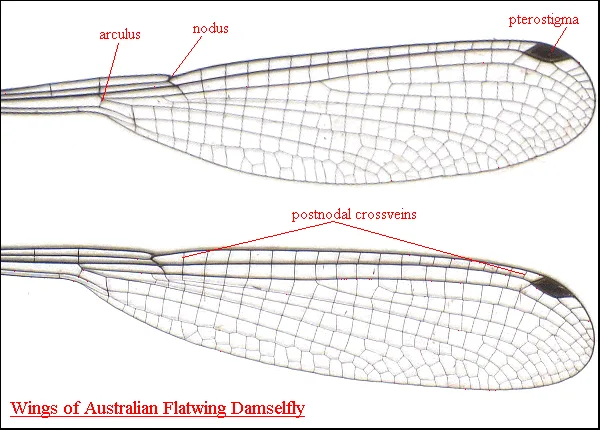
Image source: Web (Bing) / brisbaneinsects.com (Web image (fair-use with source credit))
| Feature | Dragonfly | Damselfly |
|---|---|---|
| Wing shape | Hindwing broader | Fore and hind match |
| Wing position at rest | Flat, perpendicular | Folded along body |
| Eye spacing | Touching or nearly touching | Separated by a gap |
| Body build | Robust, muscular | Slender, delicate |
| Flight style | Fast, darting | Fluttering, slower |
Both spend their juvenile years as aquatic naiads breathing through gills underwater. They emerge as adults, shed their exoskeletons, and take to the air. Finding those molted skins near pond edges is a reliable sign that odonates are breeding nearby.
If you're hoping to spot both, check the same pond but different microhabitats. Dragonflies patrol open water. Damselflies prefer perches among emergent vegetation and reeds.
Watching both in a single afternoon is one of the most rewarding parts of insect observation. And yes, they're voracious mosquito predators, so encouraging them near your home pays dividends. If you enjoy learning about creatures that share their names with reptiles, our article on reptiles starting with d covers a totally different branch of the animal kingdom.
The Beetles: Darkling, Dung, Diving, and More
The beetles under the D banner represent some of the most ecologically important insects on the planet. They're also some of the easiest to confuse with one another. Here's how to keep them straight.
Darkling beetles (Tenebrionidae). These are the desert staples, the ones you see shuffling across dry ground or gathering near livestock feed. They're matte black or dark brown, with a teardrop shape and hard elytra that meet evenly down the back. Many species can't fly at all because their wing covers have fused together.
Their antennae are thread-like and segmented, rarely reaching more than half the body length. They're primarily scavengers, feeding on decaying plant matter.
Dung beetles (Scarabaeidae). Rounder than darkling beetles, often glossy, and equipped with strong legs for digging and rolling. The famous ball-rolling behavior is unique to certain species; others tunnel directly beneath dung pats. There are over 7,000 described species globally as of 2026 research.
They vary in size from about the width of a pencil eraser to nearly two inches. Their antennae end in fan-like plates, which they use to detect dung from remarkable distances.
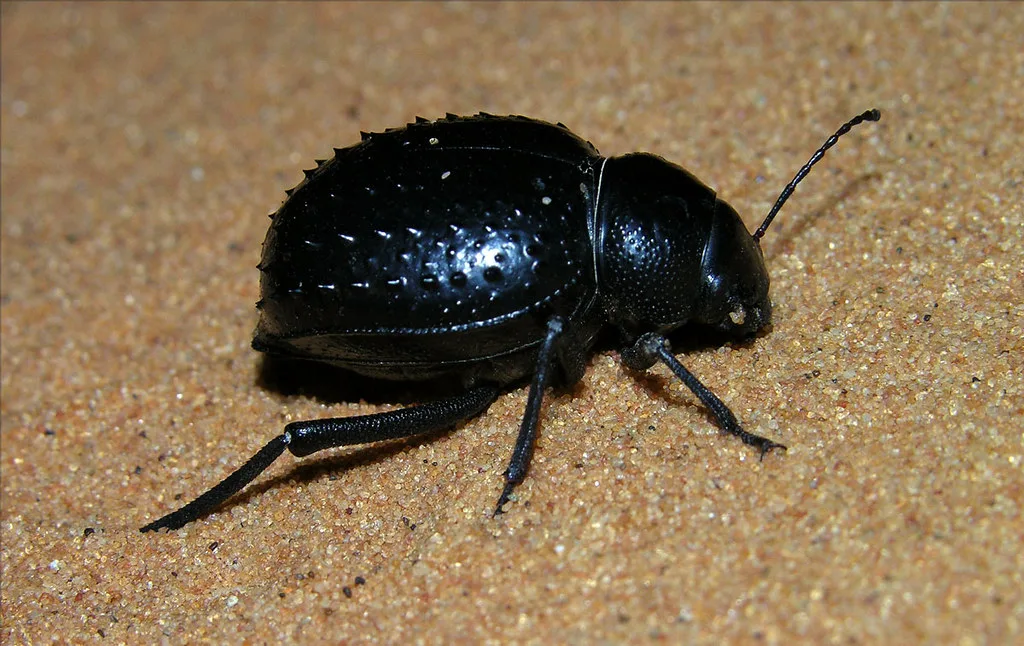
Image source: Web (Bing) / flickriver.com (Web image (fair-use with source credit))
Diving beetles (Dytiscidae). These are aquatic predators with streamlined, oval bodies built for underwater speed. Their hind legs are flattened and fringed with hairs, functioning like oars. They come to the surface to trap air under their wings, then dive again.
The larvae, called water tigers, are equally fierce and hunt small fish and tadpoles. They bite if handled, though the bite is harmless to humans.
Dermestid beetles. Small, oval, and often fuzzy-looking due to scales on their wing covers. You'll find them in homes where they feed on wool, silk, dried meat, and museum specimens. Some species are used in forensic entomology to clean skeletons for research.
They're small, rarely exceeding a quarter inch, and their damage is often noticed before the insects themselves. The key ID feature is the distinct body shape, which feels almost like lattice work under magnification.
| Beetle | Body Shape | Habitat | Diet |
|---|---|---|---|
| Darkling | Teardrop, matte | Arid soil | Decaying plants |
| Dung | Round, glossy | Pastures | Dung |
| Diving | Oval, streamlined | Ponds | Aquatic prey |
| Dermestid | Small, oval, scaled | Homes, stored goods | Dry organic matter |
Deathwatch beetles. These are the wood borers you'll hear before you see. They infest old oak and hardwood timber, producing a ticking sound that gave them their name. The larvae tunnel through wood for two to five years before emerging.
Small round exit holes, about an eighth of an inch, are the classic sign of an infestation. Unlike termites, they prefer older, often damp timber, and they don't consume the wood for nutrition; they live on fungi growing within it.
Each of these beetles plays a specific role in its ecosystem. Dung beetles aerate soil and recycle nutrients. Diving beetles control mosquito larvae in stagnant water.
Dermestids clean carcasses and stored organic matter. Even darkling beetles, often considered pests in grain storage, break down decaying material in natural settings.