Animals That Start with B: Surprising List with Fun Facts
You're hunting for animals that start with b. Maybe it's for a school alphabet chart, a quiz, or a curious kid who keeps asking. Either way, you want a clean list, not a jumble of obscure Latin names.
You want the recognizable ones, organized so they actually stick.
We built this guide around exactly that. As of 2026, researchers have cataloged roughly 1.2 million animal species worldwide, but only a small slice starts with b. Most people search for the same few dozen, so we grouped those by animal class and added identifying details that make each one memorable.
Here's your complete visual reference.
Quick Answer
Animals that start with b span every major class. Mammals include bear, beaver, bison, and bobcat. Birds include the bald eagle, barn owl, and blue jay.
Fish and reptiles include barracuda, bass, and boa constrictor. The full list covers everything from blue whales to butterflies.
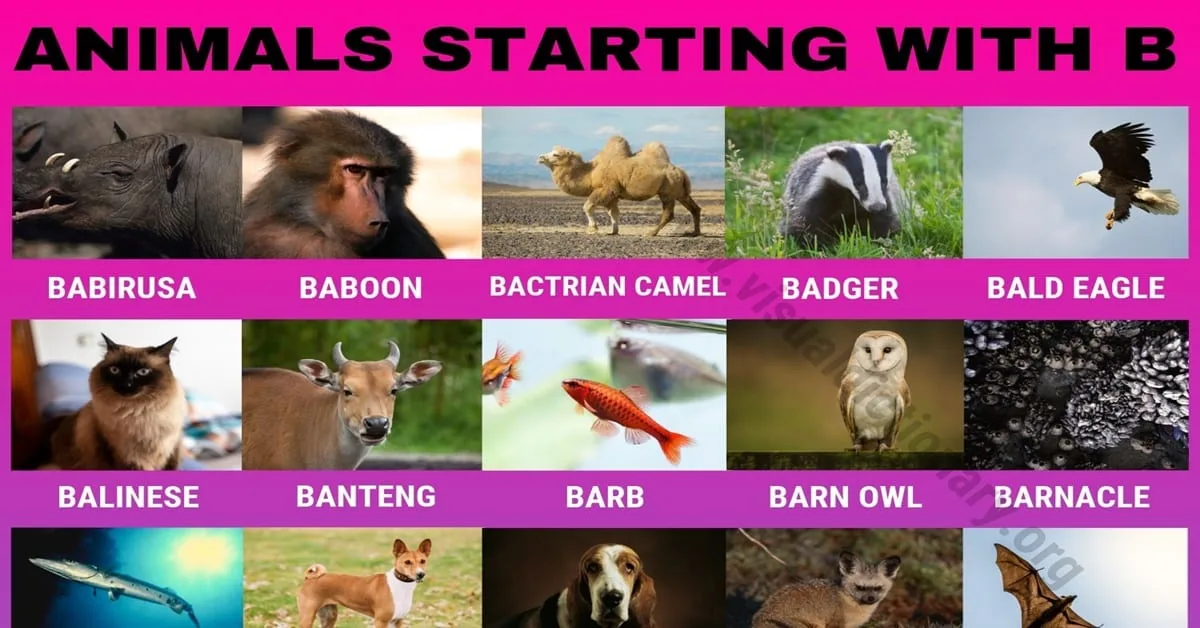
Image source: Bing (Web (fair-use with source credit))
The Quick List: 30+ Animals That Start With B
Here's the full lineup at a glance. Scan the table, then read on for a deeper breakdown of each group.
| Animal | Class | Quick Identifier |
|---|---|---|
| Babirusa | Mammal | Curved tusks growing up through the snout |
| Baboon | Mammal | Long snout, loud social troops |
| Badger | Mammal | Black-and-white striped face |
| Bald eagle | Bird | White head, massive wingspan |
| Barn owl | Bird | Heart-shaped face, near-silent flight |
| Barracuda | Fish | Torpedo body, razor-sharp teeth |
| Bass | Fish | Freshwater favorite, two main families |
| Bat | Mammal | The only true flying mammal |
| Bear | Mammal | Heavy build, flat-footed walk |
| Beaver | Mammal | Flat tail, dam-building habits |
| Beluga whale | Mammal | White whale with a bulging forehead |
| Bengal tiger | Mammal | Orange coat with black stripes |
| Betta fish | Fish | Long flowing fins, often kept alone |
| Bighorn sheep | Mammal | Massive curled horns |
| Bison | Mammal | Humped shoulders, shaggy mane |
| Black bear | Mammal | Smaller and shyer than grizzlies |
| Black widow | Arachnid | Glossy black with a red hourglass mark |
| Blue jay | Bird | Crested, bright blue with a white chest |
| Blue whale | Mammal | The largest animal in Earth's history |
| Boa constrictor | Reptile | Heavy-bodied constrictor snake |
| Bobcat | Mammal | Tufted ears, short bobbed tail |
| Bonobo | Mammal | Great ape, our closest living relative |
| Boxer | Mammal | Energetic, muscular dog breed |
| Budgerigar | Bird | Small parakeet, popular pet |
| Buffalo | Mammal | Water buffalo and Cape buffalo species |
| Bull shark | Fish | Can survive in fresh and salt water |
| Bullfrog | Amphibian | Deep croak, robust green body |
| Bunny | Mammal | Common informal name for rabbit |
| Bushbaby | Mammal | Tiny African primate with huge eyes |
| Butterfly | Insect | Four colorful wings, metamorphic life |
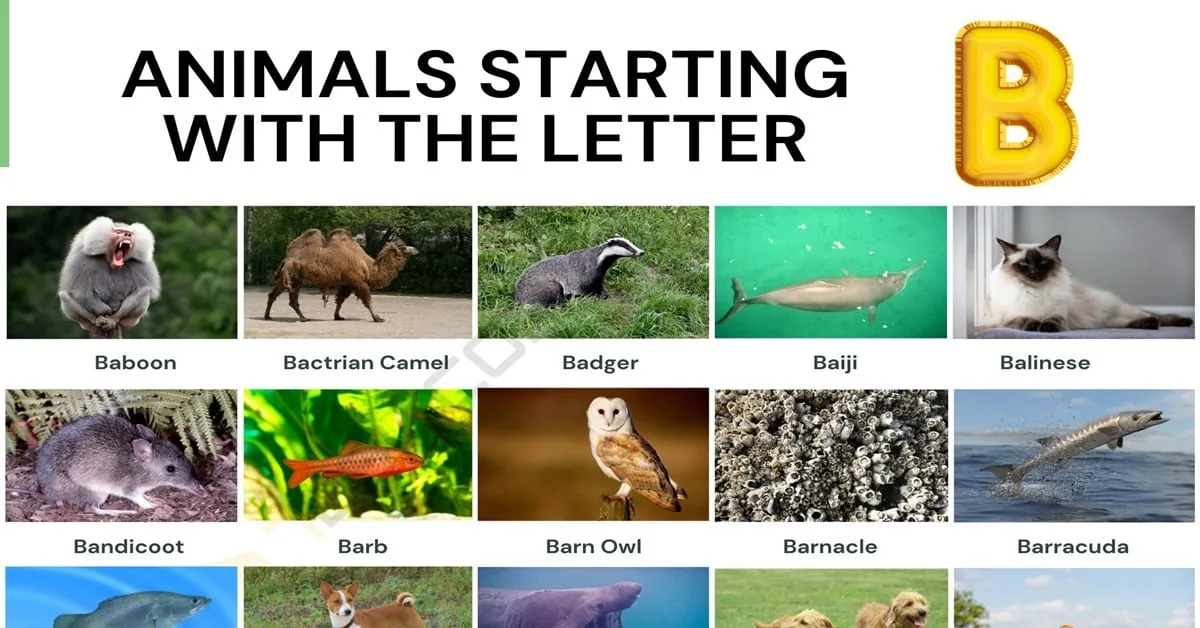
Image source: Bing (Web (fair-use with source credit))
A quick note before we continue. Bison and buffalo are separate animals. People often use the names interchangeably, but they're different species with different home ranges.
We'll unpack that in the look-alike section later.
Why Visuals Are the Secret to Learning These Names
Human memory works best when it pairs a label with a picture. That's why flashcard systems always use images, and it's why bird field guides are photo-heavy rather than text-only.
Think about how you learned birds as a kid. You probably didn't memorize "Cyanocitta cristata." You saw a flash of blue feathers at the feeder, someone said "blue jay," and the pair locked in. Visual recognition bypasses slow, effortful memorization and goes straight to pattern matching.
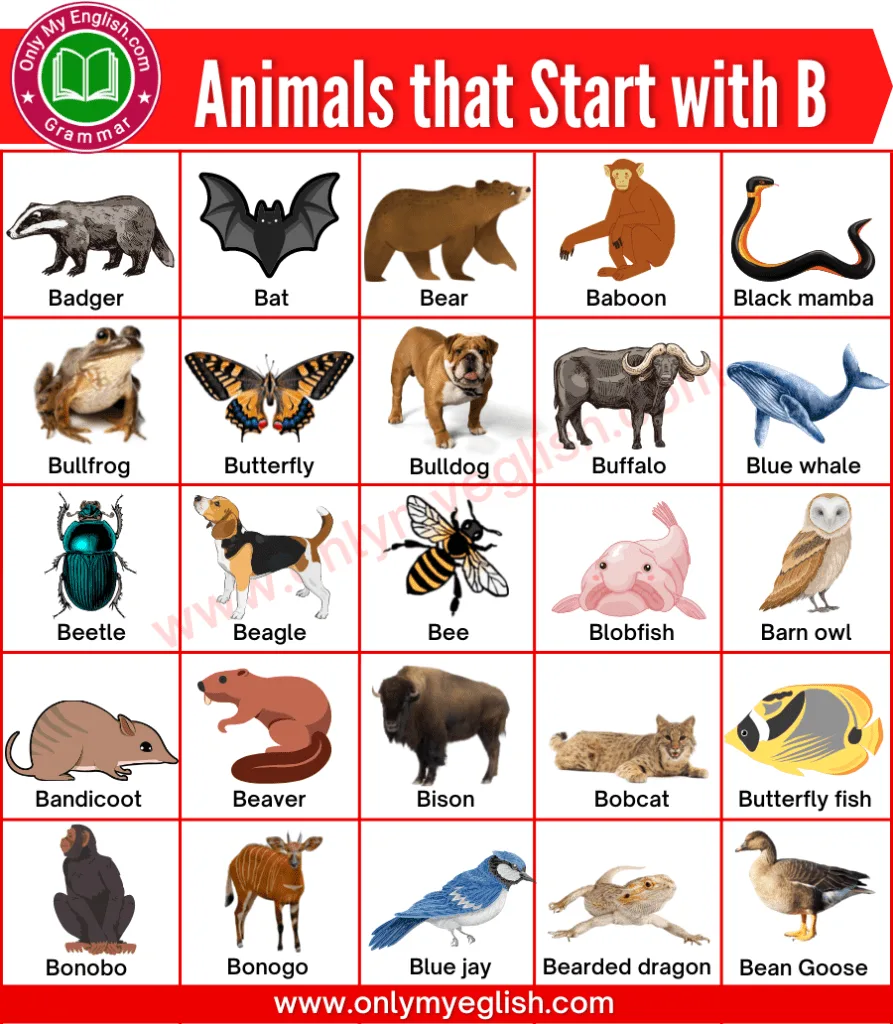
Image source: Bing (Web (fair-use with source credit))
The same logic applies across the whole b-list. When you picture a beaver's paddle-shaped tail, you won't confuse it with a muskrat. When you see a bighorn sheep's curled horns, you won't mistake it for a domestic goat.
Every distinguishing trait we describe here is chosen to anchor the name in your mind's eye.
For more alphabet-based learning resources, check out our animal reference collection for every letter of the alphabet.
Mammals That Start With B: Spots, Stripes, and Snouts
Mammals dominate the b-list, and they're the most recognizable names for most readers. Let's break them into groups so the details stay sharp.
Big Cats and Bears
- Bengal tiger: The largest cat species on Earth. Its striped coat works as camouflage in tall grass. Found mainly in India.
- Bobcat: A medium-sized wild cat with tufted ears and a stubby tail. It roams forests across North America.
- Black bear: The most common bear in North America. Lighter than a grizzly and far better at climbing trees.
- Brown bear: A broad category that includes grizzlies. They range across northern North America, Europe, and Asia.
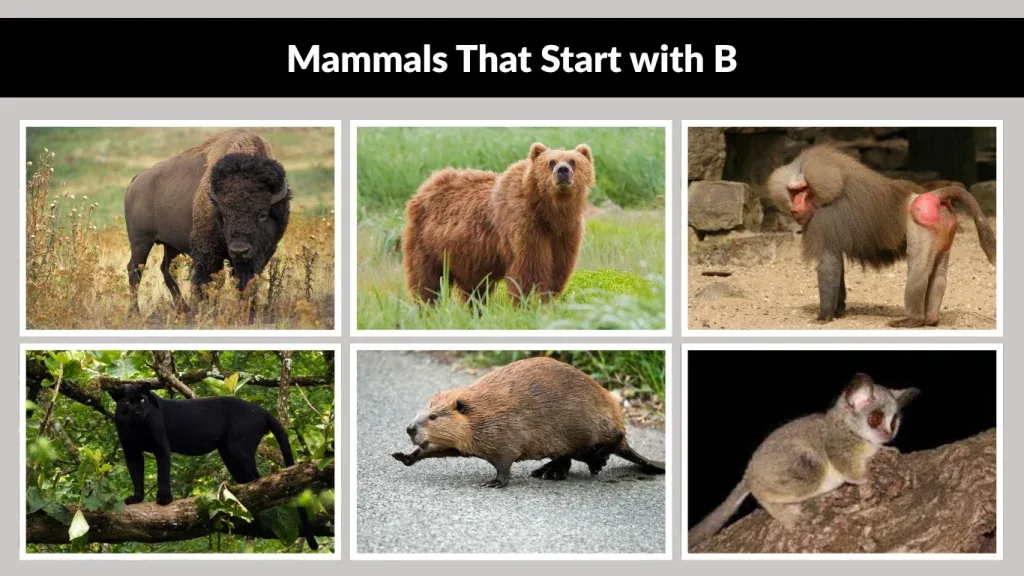
Image source: Bing (Web (fair-use with source credit))
Hoofed Animals and Herd Species
- Bison: North America's largest land mammal. They roam grasslands in protected herds.
- Buffalo: True buffalo live in Africa and Asia. The Cape buffalo and the water buffalo are the two main types.
- Bighorn sheep: Known for curled horns that can weigh 30 pounds. They live on steep mountain terrain.
- Bongo: A large, striped antelope that stays deep in African rainforests, rarely seen in the open.
Small Mammals With Big Personality
- Beaver: The dam-building rodent with a flat tail and orange front teeth.
- Binturong: Often called a bearcat, though it's neither. Its fur smells like buttered popcorn.
- Bushbaby: A palm-sized African primate with enormous eyes built for night vision.
- Badger: A stocky digger with facial stripes and powerful forelimbs.
Remember that large wild mammals deserve real respect. Our wildlife viewing disclaimer covers safe distances and general precautions.
Birds That Start With B: Beaks, Wings, and Feathers
Birds give the b-list some of its most iconic entries. Here's the mix you're most likely to encounter.
Raptors and Owls
- Bald eagle: The national bird of the United States. Adults develop the white head and tail after their fourth year.
- Barn owl: A pale, ghost-like owl with a heart-shaped face. Soft-edged wing feathers make its flight nearly silent.
Songbirds and Backyard Favorites
- Blue jay: A bold, crested songbird with a noisy, far-carrying call. Common across eastern North America.
- Bluebird: A small thrush with a bright blue back and rusty chest. Often seen perched on fence lines and open fields.
- Budgerigar: The small parakeet native to Australia. Wild budgies are green and yellow. Domesticated ones come in many colors.
Seabirds and Waders
- Booby: A seabird famous for clumsy landings. Several species have vivid blue feet. They nest on tropical islands.
For authoritative bird identification and vocalization guides, the Cornell Lab of Ornithology is the gold standard reference.
Sea Creatures, Reptiles, and Bugs That Start With B
The b-list doesn't stop on land. Some of the most impressive entries live in water or crawl through the undergrowth.
Fish and Ocean Giants
- Blue whale: The largest animal ever known. An adult can weigh up to 200 tons. Its heart alone is roughly the size of a small car.
- Beluga whale: A white whale with a rounded forehead. It lives in Arctic and sub-Arctic waters.
- Barracuda: A fast predator with a spear-shaped body and jagged teeth. Common in warm coastal waters.
- Bass: A broad family that includes both freshwater and saltwater species. The largemouth bass is the most famous.
- Bull shark: A tough shark that can move between salt water and fresh water. It has been found as far up the Mississippi as Illinois.
Snakes, Frogs, and More
- Boa constrictor: A heavy-bodied snake that squeezes its prey. Native to Central and South America.
- Bullfrog: North America's largest frog. Its call sounds like a deep, low "jug-o-rum" bellow.
Insects and Arachnids
- Butterfly: Around 17,500 known species worldwide. They follow a four-stage lifecycle from egg to caterpillar to chrysalis to adult.
- Black widow spider: A glossy black spider with a red hourglass mark. Its venom is more potent by volume than a rattlesnake's, though bites are rarely fatal and prompt treatment carries a very low fatality rate.
If we missed your favorite b-animal, drop us a line and we'll add it to the list. For species conservation data and current threat levels, the IUCN Red List is the most reliable global resource.
All images in this guide are credited per our copyright and attribution policy.
Don't Confuse These Look-Alike B-Animals
Several b-animals have twins that trip people up constantly. Let's sort out the five most common mix-ups.
Bison vs Buffalo
Bison live in North America and Europe. True buffalo live in Africa and Asia. Bison have a large hump, a shaggy beard, and a massive head.
Buffalo have longer horns and no hump.
Bobcat vs Lynx
Bobcats are smaller, with shorter ear tufts and a more spotted coat. Lynx have huge, padded snowshoe feet and solid gray-brown fur. Their ranges overlap in the north, but size and ear tuft length settle it.
Bonobo vs Chimpanzee
Both are great apes that share nearly 99% of their DNA with humans. Bonobos are leaner, with longer legs, pink lips, and a center-parted hairstyle. Chimpanzees are more robust and have a more aggressive social structure.
Basset Hound vs Beagle
Both are scent hounds, so they share floppy ears and a strong nose. Basset hounds are short and heavy with long ears and droopy eyes. Beagles are smaller, more compact, and built for stamina.
If the ears touch the nose, it's probably a basset.
Butterfly vs Moth
Butterflies hold their wings upright when resting. Moths flatten theirs out to the sides. Butterflies have thin antennae with a club at the tip.
Moth antennae are feathery or pointed.
Common Visual Mistakes People Make When Identifying B-Animals
Even experienced wildlife watchers get fooled by recurring errors. These are the ones we see most often.
Color vs Shape: What to Look For First
People memorize color first, and that's a trap. Color changes with age, season, and lighting. Shape is stable.
A bald eagle's white head is reliable, but young bald eagles are brown. Focus on silhouettes, not paint jobs.
Size and Silhouette Traps
Blue jays and bluebirds are both blue, but their shapes are totally different. The jay is husky with a crest. The bluebird is slim with a short beak.
If you read the shape, you identify the family before you even see a color.
Habitat Clues That Save You
Where you see an animal narrows the list in seconds. A beaver means water and timber. A baboon means open savanna or rock outcrop.
A bighorn sheep means slopes. Habitat is the fastest filter you have.
Matching B-Animals to Their Habitats
Here's a quick map of where these b-animals actually live.
| Habitat | B-Animals You'll Find |
|---|---|
| North American forests and plains | bison, black bear, bobcat, blue jay, beaver |
| African savannas and wetlands | baboon, bongo, buffalo, bushbaby |
| Ocean and freshwater environments | blue whale, beluga, barracuda, bass, bull shark, bullfrog |
| Australian and island species | bilby, budgerigar, booby, butterfly |
North American Forests and Plains
The bison is the largest land mammal here. Black bears roam wooded areas across the continent. Bobcats prefer rocky, rough terrain.
Blue jays and beavers are backyard regulars in the eastern half.
African Savannas and Wetlands
The baboon is the classic savanna primate. The bongo hides in dense forest patches. Cape buffalo gather in huge herds across open grasslands.
Bushbabies come out at night in wooded areas.
Ocean and Freshwater Environments
Blue whales and belugas stay in salt water. Barracuda patrol warm reefs. Bass and bullfrogs live in lakes and rivers.
Bull sharks are the rare shark that can handle both fresh and salt water.
Australian and Island Species
The bilby is a desert-dwelling marsupial. Budgerigars fly in massive flocks across Australia's interior. Boobies nest on remote tropical islands.
Thousands of butterfly species scatter across the region.
Fun Fact Beats: Tiny Details That Make Names Stick
These are the facts that make people smile and never forget the animal.
The Binturong Smells Like Popcorn
The binturong's scent glands produce a compound that smells like buttered popcorn. No one is sure why, but it likely helps mark territory. The smell is strong enough to notice near zoo habitats.
A Blue Whale's Heart Is the Size of a Car
A blue whale's heart weighs about 400 pounds. Its major arteries are wide enough for a small adult to swim through. The entire animal can reach 100 feet and weigh up to 200 tons.
Babirusa Tusks Grow Upward Through the Snout
The babirusa is an Indonesian wild pig. Its upper canines grow through the skin of its snout and curve backward toward its forehead. If they never stop growing, they can eventually touch or even pierce the skull.
Using This List for Alphabet Lessons and Flashcards
This b-list works beautifully for teaching. The strong visuals and memorable facts make the names stick fast.
How to Build a B-Animal Flashcard Deck
Print one animal per card. Put the name on the front and three facts on the back. Include a photo or colored illustration.
Sort the deck by class so a child can group mammals, birds, and fish on their own. If you're making sheets for a class, keep our site terms handy for fair-use guidance.
Weekly B-Animal Feature: A Simple Plan
Pick one b-animal each Monday. Spend five minutes reading one fact a day. End the week by drawing the animal from memory.
This works especially well for distinctive species like the binturong or the babirusa.
Zoo or Aquarium Scavenger Hunt Ideas
Make a checklist of ten b-animals before you visit. Mark off each one you spot. Snap a photo of each animal's name sign so you can match them after.
Natural history museums work too, since models and skeletons count just as much as live animals.
FAQs About Animals That Start With B
Are There Any Dinosaurs That Start With B?
Yes. Brachiosaurus, baryonyx, and brontosaurus are the most famous. Brachiosaurus was a massive long-necked sauropod.
Baryonyx was a fish-eating theropod with a crocodile-like snout. Brontosaurus is known for its towering neck and thunderous name.
What Is the Rarest B-Animal?
The Bali myna is one of the rarest. Fewer than 100 remain in the wild. The species is critically endangered on the IUCN Red List.
The bonobo and Bengal tiger are also seriously threatened, but the Bali myna has the smallest remaining population.
Which B-Animals Are Domesticated?
Several. The beagle, basset hound, and boxer are dog breeds. The budgerigar is a domesticated parakeet.
The betta fish is a common aquarium pet. Farmers raise water buffalo for milk and labor across Asia.
Are There B-Animals That Start With Other Letters in Other Languages?
Yes. Common names vary by language. In Spanish, a bear is "oso." In French, a butterfly is "papillon." Scientific names like Bison bison stay consistent worldwide, which is why researchers rely on them.
Final Recommendation: Your Quick Visual Reference Guide
Start with the animals you're most likely to see. Blue jays, bats, and butterflies appear in backyards everywhere. Beaver dams are easy to spot near waterways.
Black bears roam forests across North America.
If you're teaching a child, don't try to cover all 30 at once. Pick five species, study their photos, and learn one fun fact per animal. Add five more the next week.
Our best advice? Get outside. Visit a zoo, a wildlife refuge, or a local pond.
Watching an animal move in person beats any photograph, and it locks the name into memory faster than flashcards ever will.