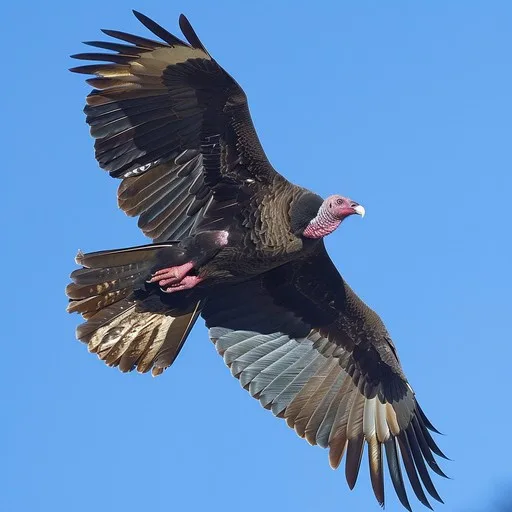
Fascinating Mammals That Start With the Letter E
Here's the article opening and first five sections:
If you've ever tried to rattle off mammals that start with E, you probably got stuck after elephant and elk. That's the trap. The letter E looks easy until you're actually put on the spot.
It's not that the animals are rare. It's that most people only know two or three of them.
The full list spans nearly every mammal order, from egg-laying echidnas to 4,000-kilogram elephant seals. As of 2026, there are roughly 60 to 70 recognized mammal species that start with E, depending on which taxonomic split you follow. Here's the complete breakdown, with the visual cues you need to actually tell them apart.
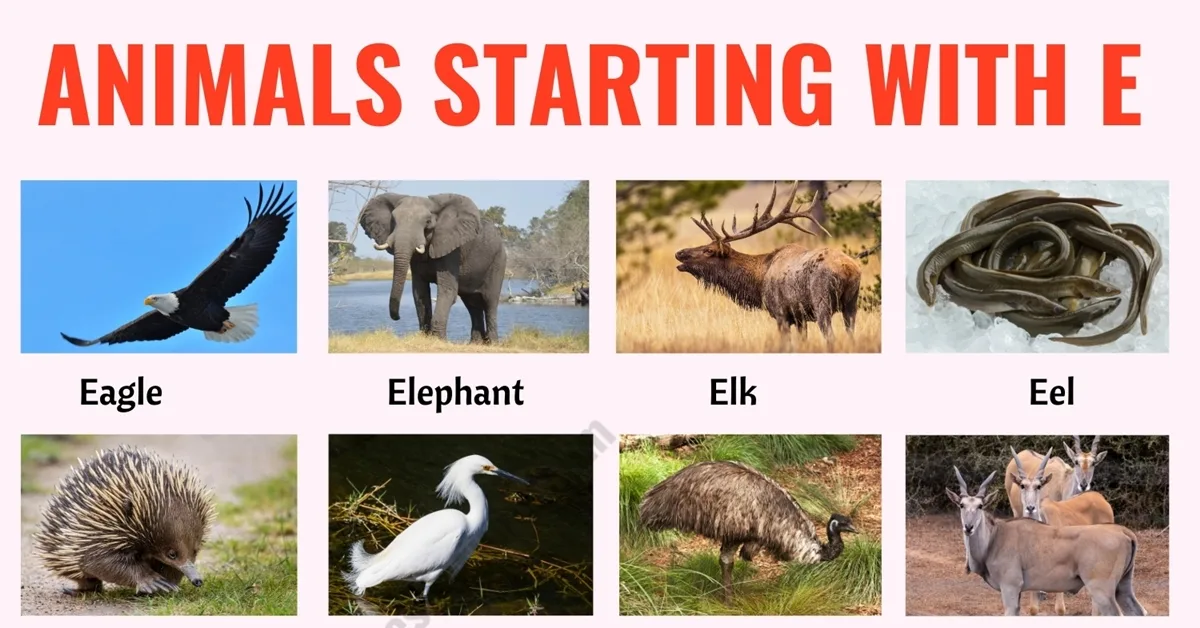
Image source: Web (Bing) / eslforums.com (Web image (fair-use with source credit))
Quick Answer
The mammals that start with E include the elephant, elk, echidna, ermine, eland, elephant seal, European hedgehog, eastern grey kangaroo, and several others. The full list covers about 60 species. Most fit into a few recognizable groups: elephants, deer-family herbivores, spiny insect-eaters, and weasel relatives.
Each has distinct visual markers that make identification straightforward.
Why "E" Is Tougher Than It Looks
The letter E spans more mammal orders than almost any other alphabet letter. That's the real reason these lists get confusing. You're not just remembering animals.
You're remembering animals from completely different branches of the mammal family tree.
Consider what groups together under E:
- Proboscidea, elephants, the only surviving members of this order
- Artiodactyla, elk and eland, both even-toed ungulates
- Monotremata, echidnas, egg-laying mammals
- Carnivora, ermine, European badger, European otter
- Eulipotyphla, hedgehogs, moles, and shrews
- Diprotodontia, marsupials like the eastern grey kangaroo
- Pinnipedia, elephant seals and eared seals
The variety is staggering. But it also means each animal needs its own set of identification cues. You can't rely on size alone, because the Etruscan shrew weighs about 1.8 grams while a bull elephant hits 6,600 kilograms.
That's a size difference of roughly 3.6 million times.
The other challenge is geography. These animals live on every continent except Antarctica. A list of E-mammals is essentially a world tour, and confusing a European hedgehog with an Australian echidna is easier than you'd think when you're just reading names.
The Heavyweights: Elephants
Elephants are the most famous mammals that start with E, and they're also the most misunderstood. There are three living species, and they look different once you know what to check.
The African bush elephant is the largest land animal on Earth. Males reach about 3.2 meters at the shoulder and weigh up to 6,600 kilograms. The African forest elephant is smaller, around 2.4 meters tall, with straighter, thinner tusks.
The Asian elephant sits in between, reaching about 2.8 meters, and has distinctly smaller ears.
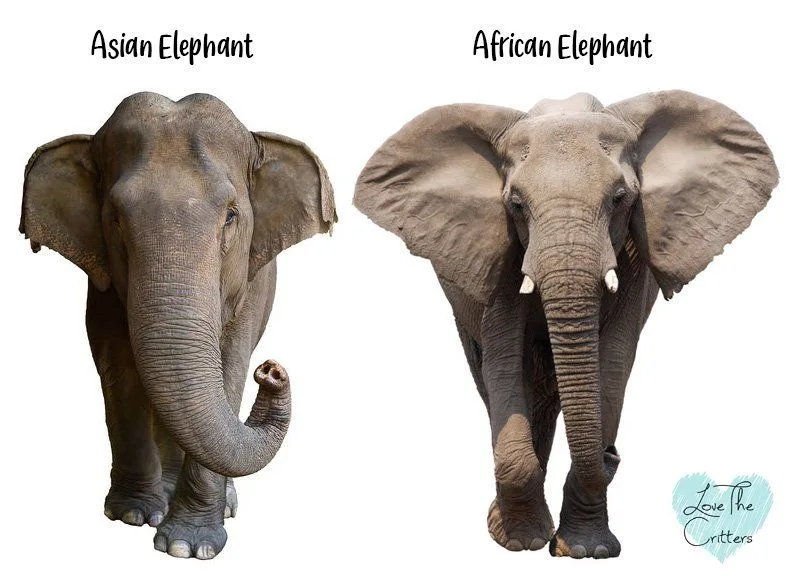
Image source: Web (Bing) / jovannytelamb.blogspot.com (Web image (fair-use with source credit))
The fastest way to tell them apart is the ears. African elephants have large ears shaped roughly like the African continent. Asian elephants have smaller, rounded ears that don't extend above the neck line.
The back shape matters too. African elephants have a concave dip in their spine, while Asian elephants have a smooth hump.
Tusks are another clue. Both male and female African elephants grow tusks. Only some male Asian elephants do.
If you see a female elephant without tusks in Asia, she's likely an Asian elephant. If you see a tuskless female in Africa, she's an exception, not the rule.
One more detail worth knowing: the trunk tip. African elephants have two "fingers" at the tip, which let them grasp objects with precision. Asian elephants have only one.
It's a small difference, but it's a reliable species marker that naturalists use in the field.
Conservation status matters here too. The IUCN lists African bush elephants as endangered and African forest elephants as critically endangered. Poaching and habitat loss have cut populations dramatically.
Asian elephants are also endangered, with an estimated 40,000 to 50,000 remaining in the wild. If you want to see these animals in person, wildlife tourism that follows ethical viewing guidelines is the responsible way to go.
The Spiny Ones: Echidnas, Hedgehogs, and Lookalikes
This is where most people hit the confusion wall. Echidnas and hedgehogs both have spines. They both roll into defensive positions.
They both eat insects. But they're not closely related at all.
The short-beaked echidna is a monotreme, meaning it lays eggs. It's native to Australia and New Guinea. The European hedgehog is a placental mammal in the order Eulipotyphla, and it gives birth to live young.
These two animals diverged evolutionarily around 160 million years ago.
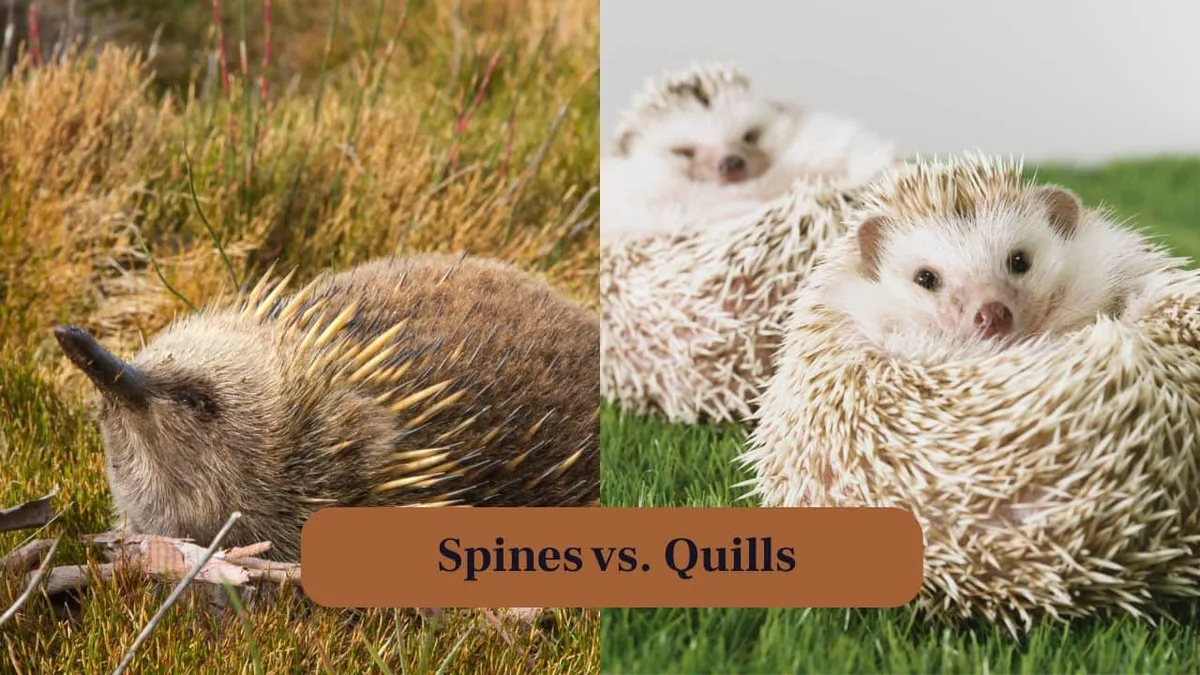
Image source: Web (Bing) / moneycontrol.com (Web image (fair-use with source credit))
Here's how to tell them apart at a glance:
| Feature | Echidna | Hedgehog |
|---|---|---|
| Snout | Long, tubular, toothless | Short, pointed, with teeth |
| Spines | Mixed with fur | Dense, uniform |
| Feet | Strong claws for digging | Short legs, shuffling walk |
| Tongue | Long, sticky, extends far | Short, used for chewing |
| Reproduction | Lays eggs | Gives live birth |
| Range | Australia, New Guinea | Europe, Asia, Africa |
The echidna also has electroreceptors in its snout, a trait it shares with the platypus. These tiny sensors detect electrical signals from insect prey underground. No placental mammal has this ability.
There's a third spiny animal that complicates things further: the porcupine. But porcupines are rodents, and they start with P, not E. Still, their spines are longer and sharper than both echidna and hedgehog quills, and they can detach them defensively.
Neither echidnas nor hedgehogs can shoot their spines, despite the old myth.
If you're teaching this to kids, the fastest lesson is the snout. A long, tubular snout means echidna. A short, round face means hedgehog.
Everything else follows from there. And if you want to explore other alphabet letters, our guide to animals starting with C covers plenty of spiny and non-spiny options.
The Ermine: A Shape-Shifter in the Weasel Family
The ermine, also called the stoat or short-tailed weasel, is one of the most visually striking animals on this list. And it changes its entire appearance twice a year.
In summer, the ermine has a brown back, white belly, and a black tip on its tail. It blends into forests and fields across North America, Europe, and northern Asia. In winter, in the northern parts of its range, it molts into a pure white coat.
The black tail tip stays dark all year.
That black tail tip is the single best identifier for this species. It's the only weasel in most regions with a consistently black-tipped tail, regardless of season.
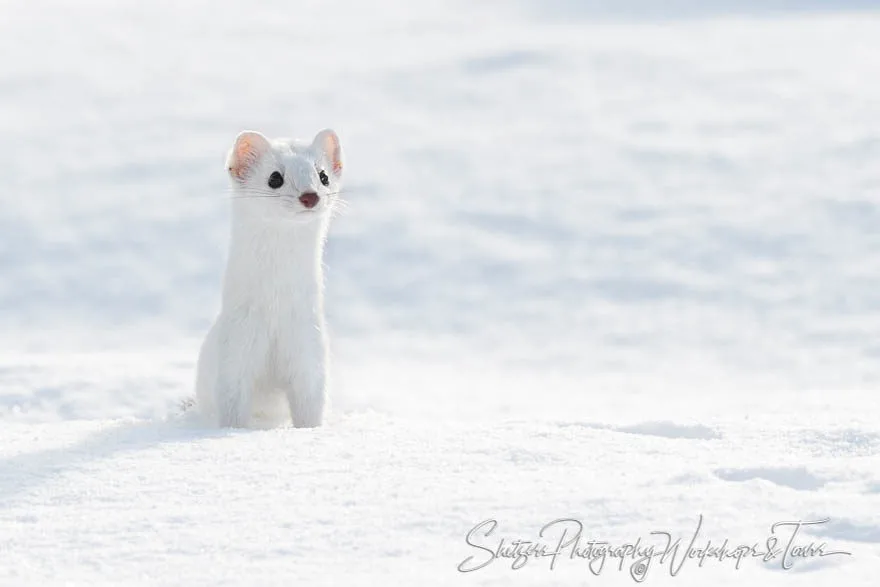
Image source: Web (Bing) / shetzers.com (Web image (fair-use with source credit))
The ermine's winter camouflage isn't just decorative. It's functional. The white coat helps it hunt voles and mice in snow-covered terrain, while the black tail tip serves as a distraction.
Predators like hawks and foxes often strike at the moving black tip, missing the ermine's body entirely.
Size is another helpful marker. Ermines are small, typically 17 to 32 centimeters long including the tail. They're smaller than long-tailed weasels, which can reach 55 centimeters, and considerably smaller than ferrets or minks.
There's some naming confusion worth clearing up. In North America, "ermine" refers specifically to the short-tailed weasel in its white winter coat. In Europe, "stoat" is the common name year-round.
The word "ermine" also historically referred to the white fur with black tips used in royal robes, which came from these animals.
If you're trying to spot one in the wild, look for quick, serpentine movement along fence lines or through tall grass. Ermines are relentless hunters, often covering several kilometers in a single day. They'll readily climb trees and swim across streams to pursue prey.
The Herd Animals: Elk and Eland
Two large herbivores share the letter E, but they live worlds apart. The elk (also called wapiti) roams North America and parts of East Asia. The eland is Africa's largest antelope.
Both are even-toed ungulates, yet they look nothing alike.
The elk is a member of the deer family, Cervidae. Bulls grow massive antlers that can span up to 1.2 meters across. These antlers are shed every spring and regrow through summer, making them the fastest-growing bone tissue in the animal kingdom.
The rump patch is a pale yellow-white, a reliable marker even at a distance.
The eland belongs to the Bovidae family, alongside cattle and antelope. Both sexes carry spiral horns, and the males use them for dominance displays. A distinctive dewlap hangs from the throat, thicker in males, and a fatty hump sits above the shoulders.
Adult males can weigh up to 940 kilograms, rivaling a small car.
| Feature | Elk | Eland |
|---|---|---|
| Location | North America, East Asia | Sub-Saharan Africa |
| Family | Cervidae (deer) | Bovidae (bovids) |
| Headgear | Antlers (males only) | Spiral horns (both sexes) |
| Key marker | Pale rump patch | Throat dewlap, shoulder hump |
| Max weight | ~450 kg | ~940 kg |
Geographic separation makes confusion unlikely in the wild. If you're in the Rocky Mountains, it's an elk. If you're on a safari in Kenya, it's an eland.
For those interested in exploring other animal groups alphabetically, our guide to animals starting with B offers plenty of African species to compare.
The Rest of the List Worth Knowing
Beyond the big names, several other E-mammals deserve recognition. They may not headline alphabet lists, but they're fascinating in their own right.
Elephant seals are the largest pinnipeds outside of walruses. Northern elephant seals breed along the California coast, while southern elephant seals dominate sub-Antarctic beaches. Males can reach 4,000 kilograms, and their massive proboscis amplifies their roar.
The northern population was nearly hunted to extinction but has rebounded to over 150,000 animals per the NOAA Fisheries monitoring.
Eastern grey kangaroos are Australia's most widespread macropod. They can hop at 64 kilometers per hour and cover 9 meters in a single bound. Females carry joeys in their pouch for roughly nine months, a classic marsupial trait.
European otters are semi-aquatic mustelids found across Europe and Asia. They have counter-shaded fur, dark on top and light underneath, which helps camouflage them in water. They're excellent indicators of healthy waterways.
European badgers are stocky, black-and-white-faced burrowers. They live in social groups called clans, defending territories that can span several square kilometers.
European moles are rarely seen due to their subterranean lifestyle. Their shovel-like forepaws are adapted for digging up to 20 meters of tunnel daily.
The Etruscan shrew holds a world record. At 1.8 grams, it's the smallest mammal by mass on the planet, beating out several bat species for the title.
The Egyptian mongoose is a small carnivore native to North Africa. It's famous for hunting snakes, relying on speed and agility rather than resistance to venom.
The "E" Animal That Isn't a Mammal
Every alphabet list has its trap, and for the letter E, it's the emu. This large flightless bird is a staple of children's animal charts. It starts with E, and it's relatively well-known.
But it's not a mammal.
Emus belong to the bird class, Aves. They're ratites, closely related to ostriches and cassowaries. They lay eggs, have feathers, and lack the defining mammalian traits like fur and mammary glands.
This distinction matters more than it seems. Many students and even adults assemble animal lists mixing birds and mammals without realizing. The confusion also extends to other E-animals.
Eagles are birds, eels are fish, and earthworms are invertebrates. None belong on a mammals list.
When teaching this topic, the emu serves as a useful test case. If you can spot the emu and exclude it, you're paying attention to the actual classification, not just the spelling.
Quick Visual Reference Table
A single glance at this table should settle most identification questions. Print it, save it, or keep it handy for quizzes and nature walks.
| Animal | Size | Key Feature | Habitat |
|---|---|---|---|
| African bush elephant | 3.2m shoulder | Large ears, concave back | Sub-Saharan Africa |
| Asian elephant | 2.8m shoulder | Small ears, humped back | Southeast Asia |
| Elk | 1.5m shoulder | Antlers, pale rump | North America, East Asia |
| Eland | 1.8m shoulder | Spiral horns, dewlap | Africa |
| Echidna | 50cm body | Tubular snout, spines | Australia, New Guinea |
| European hedgehog | 30cm body | Short snout, uniform spines | Europe, Asia |
| Ermine | 32cm total | Black tail tip year-round | Northern Hemisphere |
| Elephant seal | 4m male | Massive proboscis | Pacific coasts, sub-Antarctic |
| Eastern grey kangaroo | 2m body | Powerful hind legs | Eastern Australia |
| Etruscan shrew | 4cm body | Smallest mammal by mass | Southern Europe, North Africa |
Size measurements refer to maximum adult values in captivity or the wild. Body length for some species excludes the tail. Use the habitat column as your first filter, then confirm with key features.
How to Explain This to Kids
Science communicators, teachers, and parents often ask how to make this material stick. The answer is to group animals by simple categories instead of memorizing names. Kids naturally grasp the idea of pouches, eggs, and placentas.
Start with the echidna. Explain that it's one of only two egg-laying mammals in existence, the other being the platypus. That fact alone makes it unforgettable.
Then move to the eastern grey kangaroo and explain that its young grows in a pouch. Finally, contrast these with elephants and elk, where babies develop fully inside the mother.
Memory tricks help with the trickier names. For the ermine, remind kids that it "wears ermine" in winter, turning white like a royal robe. For the eland, associate the spiral horns with a spiral notebook.
For the elephant seal, imagine a seal with a trunk, even though it's really just a big nose.
Hands-on activities reinforce the visual cues. Showing a photo of an echidna next to a hedgehog and asking kids to spot the snout difference works better than any verbal description. For deeper alphabet exploration, our guide to animals starting with A offers another letter to practice with.
Common Mistakes and How to Avoid Them
The most frequent error is confusing echidnas with hedgehogs. Remember the snout rule. Echidnas have long, tubular snouts; hedgehogs have short, round faces.
If the animal is in Australia, it's an echidna. If it's in Europe, it's a hedgehog.
Mixing up elk and moose is another classic blunder. Moose have broad, palmate antlers that look like open hands. Elk have branching, pointed antlers that sweep backward.
Moose also have a drooping bell of skin under the chin, which elk lack. If it's massive with flat antlers, it's a moose, and it doesn't start with E anyway.
Assuming every African antelope is an eland. Elands are the largest, with spiral horns and a dewlap. A kudu has spiral horns too, but it's slimmer and lacks the shoulder hump.
A wildebeest has a heavy front body and curved horns, nothing like an eland's smooth profile.
Forgetting seasonal changes in ermine. A white ermine in winter looks nothing like its summer brown form. If you're identifying from a photo, check the season and location first.
That white weasel in your garden in February is almost certainly an ermine.
FAQs About E-Mammals
Are echidnas related to hedgehogs?
No. Echidnas are monotremes, egg-laying mammals in the order Monotremata. Hedgehogs are placental mammals in Eulipotyphla.
They share spines and insect-based diets, but they evolved on separate continents and diverged around 160 million years ago. Their similarities are convergent evolution, not shared ancestry.
Do all elephants have tusks?
No. African elephants of both sexes grow tusks. Among Asian elephants, only some males do, and even those are smaller.
Tusks are modified incisor teeth that continue growing throughout the elephant's life. The ivory trade has driven severe poaching, which is why tuskless elephants are becoming more common in some African populations.
Where do elephant seals actually live?
Northern elephant seals breed on offshore islands and remote beaches along the California and Baja California coasts. Southern elephant seals live on sub-Antarctic islands and the Antarctic continent itself. They spend most of the year at sea, diving to depths over 1,000 meters to hunt squid and fish.
Is an elk the same as a European red deer?
They're related but distinct species. The elk of North America is classified as Cervus canadensis. The European red deer is Cervus elaphus.
They were once considered the same species, but genetic analysis in 2004 confirmed they diverged thousands of years ago. They differ in size, coat color, and antler structure.
Why Learning These Animals Matters
These mammals aren't just trivia. Elephants are keystone species, shaping entire ecosystems by clearing trees and digging water holes. Their presence supports hundreds of other species.
European hedgehogs consume thousands of insects, slugs, and grubs each year, naturally regulating garden pests.
The conservation stakes are real. African forest elephants are critically endangered, with populations falling by over 80 percent in recent decades. Knowing these animals, recognizing them in photos, and understanding their habitats builds awareness.
That awareness drives support for protected areas, anti-poaching efforts, and responsible tourism.
The diversity of E-mammals also tells an evolutionary story. Egg-laying echidnas represent one of the oldest mammal lineages on Earth. Marsupial kangaroos branched off separately.
Placental elephants, elk, and ermine each took their own path. Once you can identify them all, you're not just memorizing names. You're mapping the mammal family tree.