Surprising Animals That Start with O You Need to Know
You've probably been stuck on an alphabet animal list before. Maybe your kid asks you for an animal with the letter O, and your mind draws a blank after "ostrich." Or you're prepping a classroom activity and need solid examples. The letter O actually covers some of the most fascinating creatures on Earth, from deep-ocean masters of disguise to lightning-fast birds that tower over humans.
What makes this letter special is the range. You get the octopus with its three hearts, the okapi that looks like a zebra but isn't, and the ocelot that's basically a tiny jungle leopard. As of 2026, researchers have documented over 300 known octopus species alone.
In our research, we've pulled together the complete list of animals that start with O, organized by habitat so you can find what you need fast.

Image source: Bing (Web (fair-use with source credit))
Quick Answer
The most well-known animals that start with O include the octopus, ostrich, otter, owl, ocelot, orangutan, orca, and okapi. Other notable examples include the opossum, oryx, osprey, oriole, and onager. This list spans oceans, forests, deserts, and your own backyard.
Each species brings something unique to the table, whether it's the octopus's camouflage abilities or the ostrich's record-breaking speed.
The Different O Animals and Where They Live
When you look at animals starting with O, they're not grouped in one corner of the globe. They span every continent except Antarctica and every major habitat type. That's actually what makes them such a great teaching example for kids and adults alike.
Here's a quick breakdown of where the major O-animals call home:
| Animal | Primary Habitat | Geographic Region |
|---|---|---|
| Octopus | Ocean reefs and deep sea | Worldwide |
| Ostrich | Grasslands and savannas | Africa |
| Otter | Rivers, lakes, coastlines | North America, Europe, Asia |
| Owl | Forests, grasslands, tundra | Worldwide |
| Ocelot | Rainforests, scrublands | South and Central America |
| Orangutan | Tropical rainforests | Borneo, Sumatra |
| Orca | Oceans | Worldwide |
| Okapi | Dense rainforest | Democratic Republic of Congo |
| Opossum | Forests, urban areas | North and South America |
The real takeaway? This letter covers animals that fly, swim, run, climb, and everything in between. You'll find them in your city park and in some of the most remote rainforests on the planet.
Octopus, Orca, and Oyster: The Ocean O-Animals
The ocean has some of the easiest-to-remember O-animals. Three stand out as true icons.
Octopus. The octopus has eight arms lined with roughly 2,240 suction cups. It has three hearts and blue blood. Two hearts pump blood to the gills, while the third pumps it to the rest of the body.
The blue color comes from copper-based hemocyanin, which helps them survive in cold, low-oxygen water. Some species can change color and texture in under a second, matching every rock, coral, and patch of sand they touch.
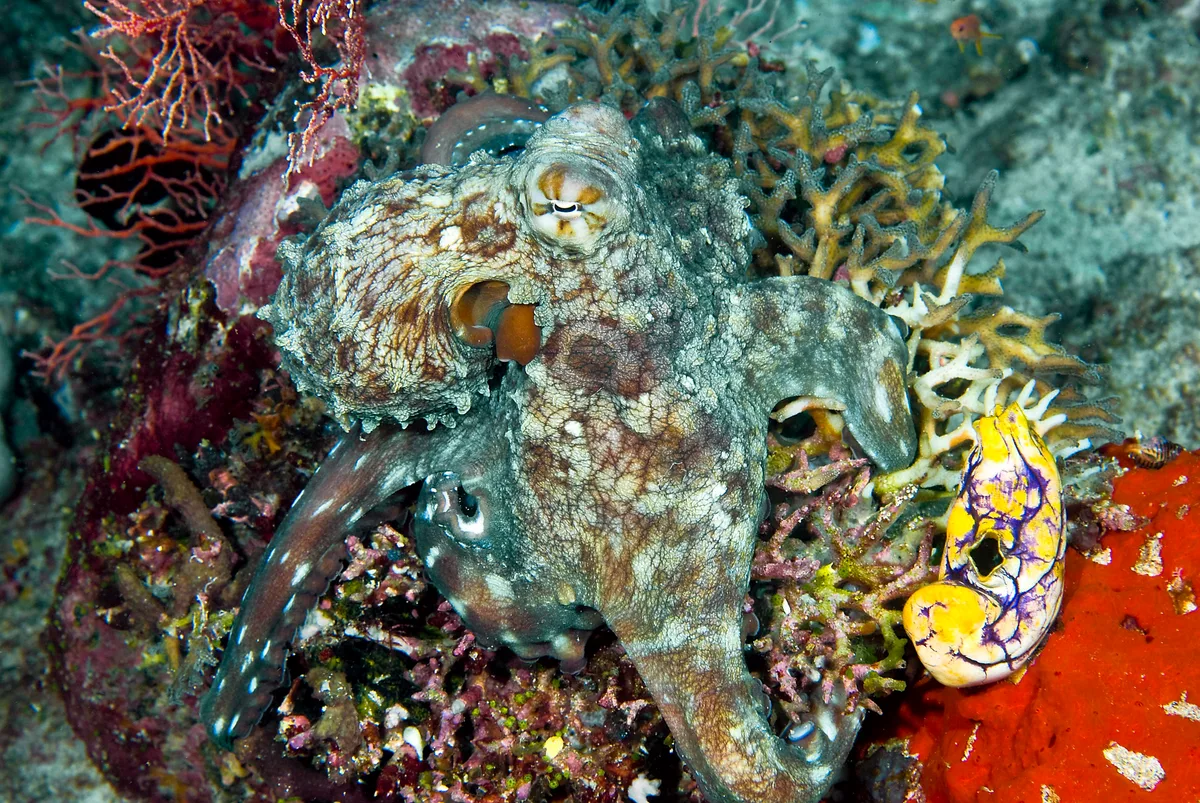
Image source: Web (Bing) / thoughtco.com
The giant Pacific octopus can weigh over 100 pounds and stretch 14 feet across. That's bigger than most adult humans. And they're remarkably intelligent.
Orca. People call them killer whales, but orcas are actually dolphins. They're the largest members of the Delphinidae family. Males can reach 32 feet and weigh up to 10 tons.
That's about the size of a school bus.
Orcas hunt in coordinated family pods with distinct dialects. Different pods specialize in different prey, from fish to seals to even other whales. They're found in every ocean on Earth, making them one of the most widely distributed mammals.
Oyster. Oysters might seem boring compared to the octopus and orca. But they're ecosystem powerhouses. A single adult oyster filters up to 50 gallons of water per day.
That keeps coastal water clean and supports entire food chains. Oyster reefs also provide habitat for hundreds of other marine species. Their pearl production, while rare, represents one of nature's most fascinating defense mechanisms.
For more marine life examples, you might enjoy our list of animals starting with B, which includes barracudas and blowfish.
Birds That Start With O: Ostrich, Owl, Osprey, and Oriole
Birds are well represented in the O-animal family. Four species stand out for different reasons.
Ostrich. The ostrich is the largest bird alive today. Males can reach 9 feet tall and weigh over 300 pounds. They can't fly, but they don't need to.
Ostriches can sprint at 43 mph and maintain a steady 30 mph for long distances. Their eyes are bigger than their brains, which is one of those facts people never forget.
Contrary to the old myth, ostriches don't bury their heads in sand. They lower their heads to swallow sand and pebbles for digestion, and they press their necks flat against the ground to hide from predators. The confusion comes from watching them at a distance.
Owl. Owls are precision hunters. Their feathers have serrated edges that break up airflow, making flight nearly silent. A barn owl can hear a mouse under a foot of snow.
Their eyes are fixed in their sockets, so they rotate their heads up to 270 degrees. That's not a full 360, but it's close.
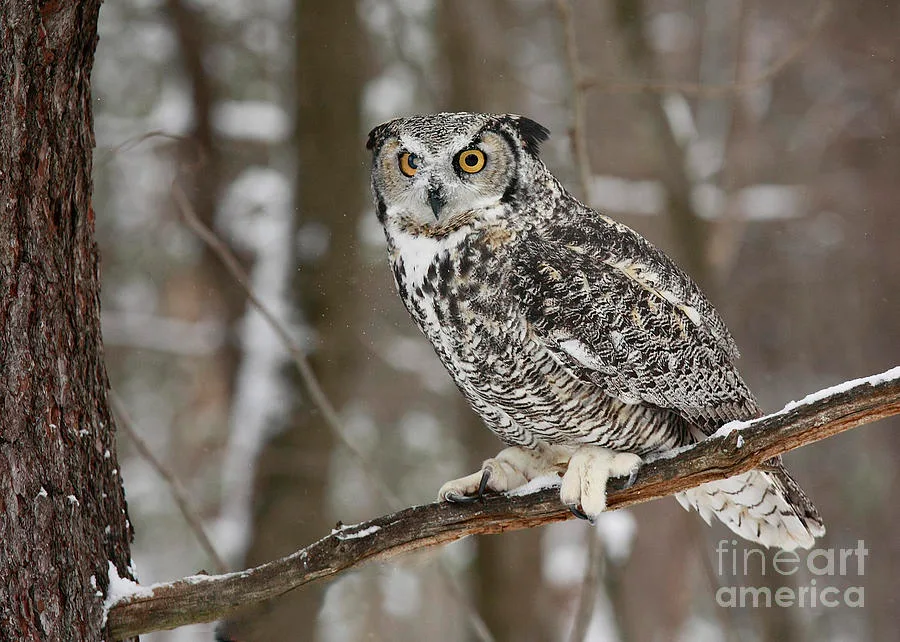
Image source: Bing (Web)
The great horned owl has a wingspan of about 5 feet and can take down prey larger than itself. Great gray owls can weigh up to 4 pounds, making them the largest owls in North America by length.
Osprey. The osprey is the only bird of prey that eats almost exclusively fish. Its reversible outer toe lets it grip slippery fish with two toes forward and two back. They hover over water, spot prey from 100 feet up, then dive talons-first.
They close their nostrils when diving to keep water out.
Oriole. Baltimore orioles are backyard favorites across the eastern United States. Males flash brilliant orange and black. They build hanging pouch nests that dangle from tree branches, which keeps eggs safe from most predators.
Orioles migrate south for winter, covering hundreds of miles.
For more winged wonders, check out our animals starting with C list, which covers cardinals and crows.
Land Mammals Starting With O: Otter, Ocelot, Orangutan, and More
Land animals starting with O range from playful river swimmers to intelligent tool-users. Here's what you need to know.
Otter. River otters are built for speed and play. They have webbed feet, dense fur, and can hold their breath for up to 8 minutes. Sea otters float on their backs and use rocks to crack open shellfish.
They also wrap themselves in kelp to anchor while sleeping. Otters are famously social, sliding down muddy banks and wrestling with each other just for fun.
Ocelot. This wild cat looks like a miniature leopard. They weigh 18 to 35 pounds and measure about 3 feet long. Their spots, called rosettes, break up their outline in dappled jungle light.
Ocelots are mostly nocturnal and territorial. They're found in South America, Central America, and parts of southern Texas. CITES protections have helped stabilize populations, but habitat loss remains a threat.
Orangutan. Orangutans share about 97 percent of their DNA with humans. They're the largest tree-dwelling animals on Earth. Males can weigh up to 200 pounds and have an arm span of 7 to 8 feet.
They build new nests every night, weaving branches and leaves into platforms high in the canopy. Orangutans use tools in the wild, cracking nuts with rocks and using leaves as umbrellas. Both species are critically endangered due to palm oil deforestation.
Opossum. North America's only marsupial gets a bad rap. Opossums eat thousands of ticks each season, making them valuable to disease control. They're also largely immune to snake venom.
When threatened, they play dead so convincingly that scientists call it tonic immobility. Their body temperature drops, and they release a foul-smelling fluid. It's an involuntary response, not a trick.
Oryx. These antelopes live in some of the harshest deserts on Earth. The Arabian oryx was extinct in the wild by 1972 but has been successfully reintroduced through captive breeding programs. The scimitar oryx in the Sahara can raise its body temperature to reduce water loss.
Their horns can reach 3 feet long.
Onager. This wild donkey relative once roamed across Asia and the Middle East. Only about 600 survive in the wild today, mostly in Iran. They can run 40 mph and survive on desert vegetation that would starve most livestock.
If you're looking for even more animal alphabet options, our comprehensive list of animals starting with A covers everything from aardvarks to axolotls.
The Okapi: The Animal People Mistake for a Zebra
The okapi stumps people more than any other O-animal. It has zebra stripes on its legs and rear, but it's actually the closest living relative of the giraffe. They share the same long neck structure, though the okapi's is much shorter.
Both have unique coat patterns and the same type of walking gait.
Okapis live only in the dense rainforests of the Democratic Republic of Congo. They were unknown to Western science until 1901. Even today, they're incredibly shy and difficult to spot in the wild.
They communicate using infrasonic sounds, below the range of human hearing.
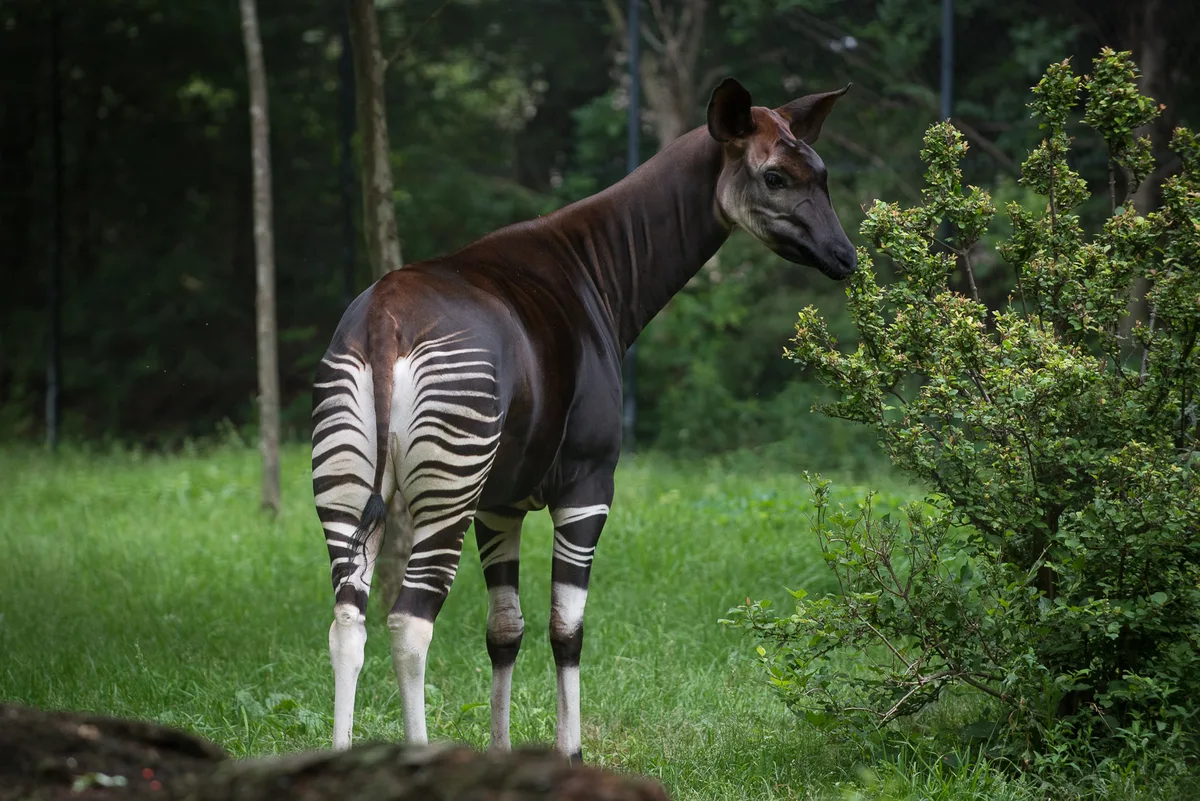
Image source: Web (Bing) / columbuszoo.org
The IUCN Red List classifies okapis as endangered. Their population is estimated at around 10,000 to 35,000, but numbers are declining due to habitat loss and hunting. The Okapi Wildlife Reserve in Congo protects about one-fifth of the remaining population.
It's a UNESCO World Heritage Site and covers roughly 5,400 square miles.
In our research, what surprises most people is how gentle okapis are. They live alone or in mother-calf pairs. They browse on leaves, fruits, and grasses, using their long, grasping tongues to pull foliage into their mouths.
Their tongue is long enough to lick their own eyes and ears.
Okapis share their habitat with forest elephants, chimpanzees, and a dizzying array of birds. But they are among the most elusive of all the animals that start with O.