Mammals That Start with B: A Complete List
Alright, let’s get into it. You’ve got a blank page, a trivia night coming up, or maybe just a curious kid asking you a question you thought you knew the answer to. The question is simple: what mammals start with the letter "B"?
It sounds easy, then you realize there are actually a lot of them. Some are massive, some are weird, and a couple will genuinely surprise you.
That’s exactly what we’re diving into here. We’ve pulled together the full list of notable mammals that start with the letter "B", from the famous ones you’ve seen in documentaries to the obscure critters that will win you points at your next quiz night. By the time you finish reading, you’ll have a working knowledge of over a dozen species, including their habitats, their quirks, and the things most people get wrong about them.
Why the Letter "B" Is a Zoological Goldmine
The letter "B" punches way above its weight in the animal kingdom. It’s not just one or two well-known creatures. The list spans the largest animal to ever live, a mammal that smells like movie theater popcorn, and a species that shares nearly 99% of our DNA.
That's the kind of variety that makes the letter "B" a treasure chest for nature lovers.
Our research shows that most people can name maybe five or six off the top of their heads. The usual suspects are bears, bison, and bats. But once you start digging, the list expands quickly.
As of 2026, the IUCN Red List tracks over 6,000 mammal species globally, and a solid chunk of them begin with the letter "B". That's a lot of territory to cover.
Here’s the thing about these mammals: they live on nearly every continent and in every type of habitat. You’ve got arctic species like the beluga whale, desert dwellers like the Bactrian camel, and forest animals like the bongo. Understanding them isn’t just about memorizing names.
It’s about seeing how different environments shape completely different survival strategies.
Quick Answer
Plenty of mammals start with "B". The most well-known are bears, bison, baboons, beavers, and blue whales. Others include the binturong, bonobo, bongo, bandicoot, and beluga whale.
Many live in Africa or North America. Some live in the ocean. The letter "B" covers a huge range of species.
The Heavyweights: Bears, Bison, and Baboons
If you ask someone to name a mammal that starts with "B", they’ll almost certainly start here. These are the icons of the animal world. They’re big, they’re recognizable, and they show up in national parks, documentaries, and cultural stories across the globe.
Bear Basics: From Sun Bears to Polar Bears
Bears are the quintessential "B" mammals. There are eight living species, and they span an enormous range of sizes and habitats. The smallest is the sun bear, which maxes out around 150 pounds and lives in the tropical forests of Southeast Asia.
The largest is the polar bear, a marine mammal that can weigh over 1,700 pounds and relies on sea ice to hunt seals.
One of the most common misconceptions about bears is that they hibernate. Technically, they don't. They enter a state called torpor.
Unlike true hibernation, torpor allows them to wake up quickly if they feel threatened. Their heart rate drops from around 40 beats per minute to as low as 8, but their body temperature only drops a few degrees. It’s a lighter sleep that still conserves massive amounts of energy.
Our research indicates that bears are also surprisingly intelligent. Studies on captive bears show they can solve complex puzzles, navigate mazes, and even use tools in some cases. That combination of raw power and cognitive ability makes them one of the most formidable land animals on the planet.
They are the definition of a keystone predator in many ecosystems.
Bison vs. Buffalo: Settling the Debate
Let’s clear this up right now. A bison is not a buffalo, and a buffalo is not a bison. They are entirely different animals from different parts of the world.
The confusion is understandable, but it's a distinction that matters for accuracy.
Bison are native to North America and Europe. The American bison has a large hump on its shoulders, a thick beard, and a massive head that sits low to the ground. Buffalo, on the other hand, are native to Africa and Asia.
The African buffalo has no hump, a smoother back, and a distinct set of curved horns that form a heavy base shield called a boss.
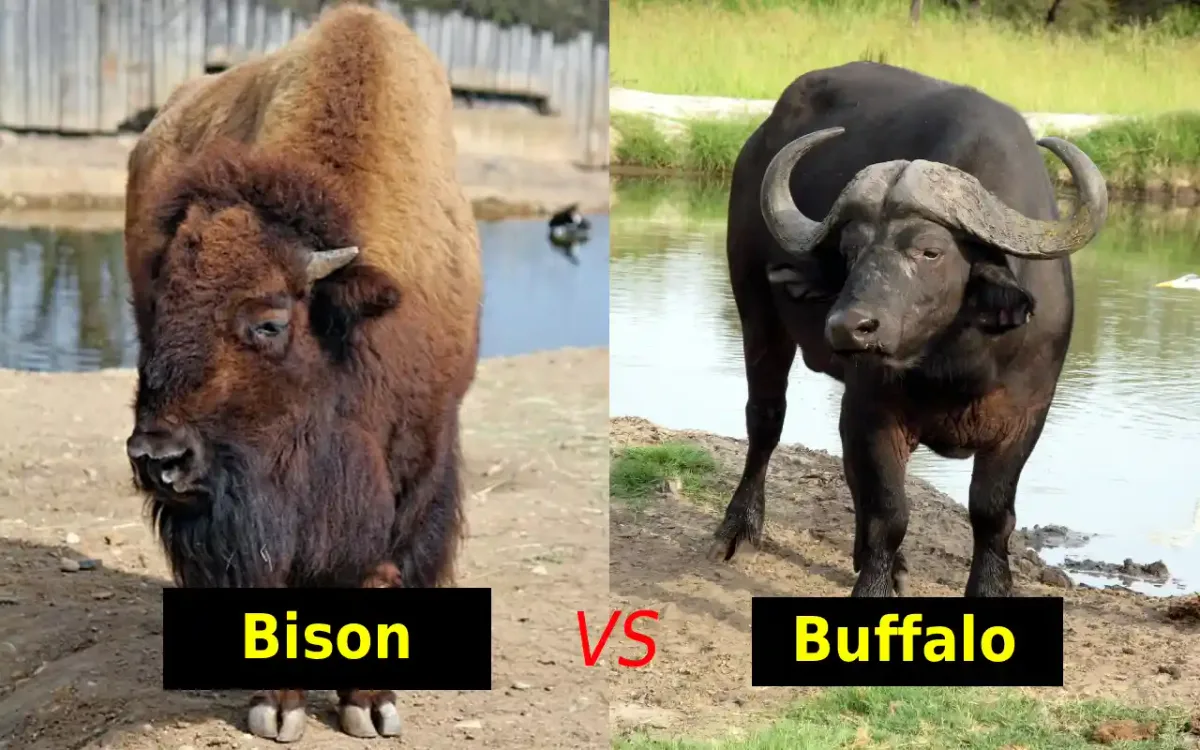
Image source: Web (Bing) / farm.ws (Web image (fair-use with source credit))
Here’s a quick breakdown of the key differences:
| Feature | American Bison | Water Buffalo |
|---|---|---|
| Native Range | North America | Asia, Africa |
| Shoulder Hump | Prominent | Absent |
| Horn Shape | Short, curved | Long, sweeping |
| Body Hair | Thick, shaggy coat | Thin, sparse coat |
| Domestic Status | Wild (mostly) | Domesticated |
The bison is also faster than you might think. Despite weighing up to 2,000 pounds, they can sprint at 35 miles per hour. That’s faster than an Olympic sprinter.
If you ever find yourself near a bison in a national park, remember that distance is your friend. They are not the docile animals they appear to be from a car window.
Baboons: The Drama Kings of the Savanna
Baboons are the most recognizable monkeys in Africa. They have dog-like muzzles, powerful jaws, and a social structure that rivals any reality TV show. Troops can range from 10 to over 200 individuals, and they are organized by a strict hierarchy.
What makes baboons fascinating is their adaptability. They live in savannas, woodlands, and even semi-arid deserts. They’ll eat almost anything, including fruit, insects, small mammals, and the occasional bird egg.
This dietary flexibility is why they’ve managed to thrive across such a wide geographic range.
One physical trait that surprises people is their "sit pads", technically called ischial callosities. These are tough, hairless patches of skin on their rear ends. They’re not just for sitting.
They also signal reproductive status and help babies grip their mothers when they’re riding along. It’s a small detail, but it shows how every part of an animal’s body serves a specific purpose.
Ocean Giants and Semiaquatic Oddballs
Not all "B" mammals walk on land. Some spend their entire lives in the water, and others split their time between riverbanks and the deep woods. These species push the definition of what a mammal can do.
The Blue Whale: Biggest Animal Ever
Let’s start with the record holder. The blue whale is the largest animal to have ever existed on Earth. We’re not just talking about today.
We’re talking about bigger than any dinosaur that ever walked the planet. An adult blue whale can reach 100 feet in length and weigh up to 150 tons. That’s the weight of about 25 adult elephants.
To put that in perspective, a blue whale’s heart alone weighs around 400 pounds. Its tongue weighs as much as an elephant. A human could theoretically swim through its major arteries, though that’s not a recommended activity.
These animals are literally on a different scale entirely.
Blue whales are also loud. Their vocalizations can reach 188 decibels, which is louder than a jet engine at takeoff. Underwater, those calls can travel for hundreds of miles.
They use these sounds to communicate with each other across vast stretches of open ocean, maintaining contact in a habitat where sight is almost useless.

Image source: Web (Bing) / qaqooking.wiki (Web image (fair-use with source credit))
These giants feed almost exclusively on krill, a tiny shrimp-like creature. During peak feeding season, a single blue whale can consume up to 4 tons of krill per day. They use a system of baleen plates to filter the water and trap their food.
It’s an incredibly efficient method of eating that supports their massive size.
Beluga Whales: The Canaries of the Sea
The beluga whale is instantly recognizable. It’s completely white, lacks a dorsal fin, and has a rounded head that looks almost alien. They live primarily in Arctic and sub-Arctic waters, where they navigate through sea ice and hunt for fish, crustaceans, and worms.
They earned the nickname "canaries of the sea" because of their vocal nature. Belugas are among the most talkative whales, producing a wide range of clicks, whistles, and chirps. They use these sounds for echolocation and communication with other members of their pod.
One of the most interesting physical features of the beluga is its flexible neck. Unlike most whales, the bones in a beluga’s neck are not fused together. This allows the animal to turn its head from side to side and nod up and down.
Combined with a highly mobile melon organ on its forehead, belugas can create an astonishing range of facial expressions. It’s one of the reasons they’re so popular in aquariums and marine parks.
Beavers: Nature's Engineers
Beavers are the construction workers of the animal kingdom. They’re semiaquatic, meaning they spend a significant amount of time in the water. They’re also the second-largest rodent in the world, after the capybara.
Their impact on the environment is so profound that they’re often called a keystone species.
Here’s what makes them unique: they build dams. Beavers use trees, mud, and stones to construct structures that can span entire rivers. These dams create ponds that provide protection from predators and easy access to food during winter.
Some beaver dams are massive. The largest known beaver dam, located in Wood Buffalo National Park in Canada, is over 2,700 feet long. That’s visible from space.
Beavers have several adaptations that make this engineering possible. Their front incisors never stop growing, so constant chewing keeps them filed down. They have transparent eyelids that act like goggles, allowing them to see underwater.
They can also close their ears and nose to keep water out. A single beaver can cut down hundreds of trees in a year, and they work primarily at night.
The Weird and Wonderful: Binturongs, Bonobos, and Bandicoots
This is where the list gets fun. These are the "B" mammals that stump people at trivia nights. They’re not as famous as bears or whales, but they’re arguably more interesting because of their unique quirks.
The Binturong: Smells Like Popcorn, Looks Like a Bear (But Isn't)
The binturong is a guaranteed conversation starter. It’s also known as the "bearcat", which is incredibly misleading because it’s neither a bear nor a cat. The binturong is actually a viverrid, which puts it in the same family as civets and genets.
They are native to the dense rainforests of Southeast Asia.

Image source: Web (Bing) / wallpapers.com (Web image (fair-use with source credit))
Here’s the wild part: binturongs smell like buttered popcorn. It’s true. They produce a compound in their urine called 2-acetyl-1-pyrroline, which is the exact same chemical that gives popcorn its distinctive aroma.
They use this scent to mark their territory, but to us, it just smells like movie theater snacks.
Binturongs are also one of only two carnivores in the world with a prehensile tail. That means their tail is strong and flexible enough to grasp branches, acting like a fifth limb. They use it to stabilize themselves as they move slowly through the treetops.
They have a low, deliberate stride that makes them look almost like they’re dancing.
Bonobos: The Peaceful Hippie Cousins
If you’ve ever seen a chimpanzee, you’ve got a rough idea of what a bonobo looks like. The two species share about 98.7% of their DNA with humans, and they’re both members of the great ape family. But bonobos are distinctly different in their social behavior and physical proportions.
Bonobos have longer legs, narrower shoulders, and a more upright posture than chimpanzees. Their faces are darker, and they typically have a center hair part. They are found exclusively in the Democratic Republic of Congo, living south of the Congo River.
That’s their only natural habitat on Earth.
Here’s what makes them truly remarkable: their society is matriarchal and peaceful. Female bonobos form strong bonds with each other, and those alliances keep the peace within the group. They resolve conflicts through grooming, play, and sexual behavior, rather than aggression.
In our research, we found that studies of bonobos show they exhibit high levels of empathy, cooperativeness, and sensitivity to others’ emotions. They will comfort a distressed peer, and they often share food voluntarily. It’s a stark contrast to the more aggressive, male-dominated chimpanzee society.
Bandicoots: Tiny Ecosystem Engineers
Bandicoots are small marsupials native to Australia and New Guinea. If you’ve ever played the video game Crash Bandicoot, you’ve seen a stylized version of one. The real animals are about the size of a rabbit, with pointy snouts, rounded backs, and powerful hind legs.
Bandicoots are often mistaken for rats, but they’re completely unrelated. They’re marsupials, which means they carry their young in a pouch. However, their pouch opens backwards.
This is an adaptation that allows them to dig without getting dirt in the pouch. It’s a brilliant evolutionary solution.
They’re also incredibly beneficial to their ecosystems. Bandicoots are natural diggers. They create small conical holes in the soil as they search for insects, grubs, and fungi.
These holes help aerate the soil, improve water infiltration, and promote seed germination. In short, they are tiny ecosystem engineers. A single bandicoot can turn over tons of soil in a single year.
B-Mammals Ranked by "Wow Factor"
Now that we’ve covered the heavyweights and the weirdos, let’s rank the top "B" mammals by sheer impressiveness. This isn’t a scientific ranking. It’s a playful look at which species make people stop and say, "Wait, really?"
| Rank | Mammal | Why It Makes the List |
|---|---|---|
| 1 | Blue Whale | It’s the largest animal to ever exist. Nothing else comes close. |
| 2 | Binturong | It smells like popcorn and has a prehensile tail. That’s a double win. |
| 3 | Bonobo | Our closest peaceful relative, with a matriarchal society. |
| 4 | Bison | A 2,000-pound animal that can outrun a human. |
| 5 | Belgian Hare | The racehorse of the rabbit world, built for speed and elegance. |
Let’s talk about the Belgian Hare for a second because it rarely gets the spotlight. This breed was developed in Belgium in the 19th century and was originally bred for meat. But its sleek, athletic build made it a show favorite.
It has a long, arched back, slender legs, and a coat that shimmers like polished mahogany. It’s sometimes called "the poor man's racehorse." They were so popular in Victorian England that they sparked a wave of rabbit breeding that eventually led to the founding of the National Rabbit Club.
These rankings show that "wow factor" isn’t just about size. It’s about uniqueness, behavior, and the ability to surprise us. A blue whale is objectively incredible, but a binturong that smells like a movie theater is memorable in a completely different way.