Discover 10 Fascinating Fish That Start With Z
Let's be honest, the alphabet is pretty stingy with the letter "Z." When someone asks about fish that start with z, you're not getting a sprawling list like you would with "S" or "C." But the ones that do exist are genuinely fascinating, and a few of them are absolute icons in the aquarium and sport fishing worlds.
In our research, we found fewer than ten widely recognized species (plus a few rare deep-sea oddballs) that carry a "Z" name. Out of those, exactly one, the Zebra Danio, is a mainstream pet store staple. Most of the others are specialized, expensive, or live in environments you'd need scuba gear to explore.
As of 2026, that's still true. So let's look at the full cast, from the fish you can buy for a few bucks to one that costs nearly as much as a used car.

Image source: Bing (Web (fair-use with source credit))
Quick Answer
The fish that start with z are Zebra Danio, Zebra Pleco, Zebra Loach, Zebra Moray, Zander, Zebra Tilapia, and several other "Zebra" species named for their stripe patterns. The Zander is a freshwater game fish found across Europe. Zebra Danios are common beginner aquarium fish.
Zebra Plecos are rare, expensive catfish from Brazil. No saltwater "Z" fish are common in home aquariums.
Why the Letter "Z" Is a Zoological Oddity
The reason this list is so short comes down to taxonomy and common naming conventions. Most fish species are named for their physical location, their discoverer, or a distinctive feature. In English, "Zebra" became the go-to descriptor for any striped fish, giving us legions of "Z" names.
But here's the catch. Many of these are not true species. They are color variants or regional populations.
For example, the Zebra Tilapia is the same species as the more common Nile Tilapia. It just has a different pattern. And some fish we call "Zebra" something are actually closer to other, more well-known groups.
The naming makes for a fun trivia question, but it can also lead to serious confusion at the fish store.
This is where visual identification becomes critical. If you're looking for a specific "Z" species, you need to know more than just the name.
The Freshwater Starters: Zebra Danio, Zebra Loach, and Zebra Tilapia
Zebra Danio — The Ubiquitous Beginner Fish
The Zebra Danio (Danio rerio) is the poke bowl of the fish world. It's everywhere, it's cheap, and it's surprisingly good for you. In the aquarium trade, this is the fish millions of people start with.
Why is it so popular? Three reasons.
- Hardiness: They tolerate water temperatures from 64°F to 75°F. They'll survive pH swings that would kill more delicate species.
- Size: They max out at about 2.5 inches. That makes them perfect for 10-gallon tanks.
- Activity: They are constant swimmers. A school of six Danios brings a tank to life.
The horizontal stripes run from the gills to the tail. That's the defining trait. Many people confuse them with Tiger Barbs, but Barbs have vertical stripes and a completely different attitude.
Danios are peaceful community fish. Tiger Barbs are fin nippers.
Zebra Loach — The Striped Bottom-Dweller
Also called the Candystripe Loach (Botia striata), this is a peaceful bottom feeder that stays under 4 inches. It's a great choice for a community tank because it does well with other small fish.
The loach has a very different body shape from the Danio. It's deeper-bodied and has a downturned mouth designed for sifting through substrate. They need a soft sand bottom.
Feeding them is straightforward. They will eat sinking pellets, frozen bloodworms, and even small snails.
Zebra Tilapia — The Aggressive African Cichlid
Now for the one that causes problems. The Zebra Tilapia (Tilapia buttikoferi) is stunning. It has bold, dark vertical bands on a cream-colored body.
But this fish is not a beginner pet.
It grows rapidly to over a foot long. In a tank, that size equals aggression. They are fiercely territorial and will bully tank mates to death.
If you want a Zebra Tilapia, plan for a 75-gallon tank as the absolute minimum. And plan for it to be the only fish in that tank.
The Collector's Dream: Zebra Pleco (L046)
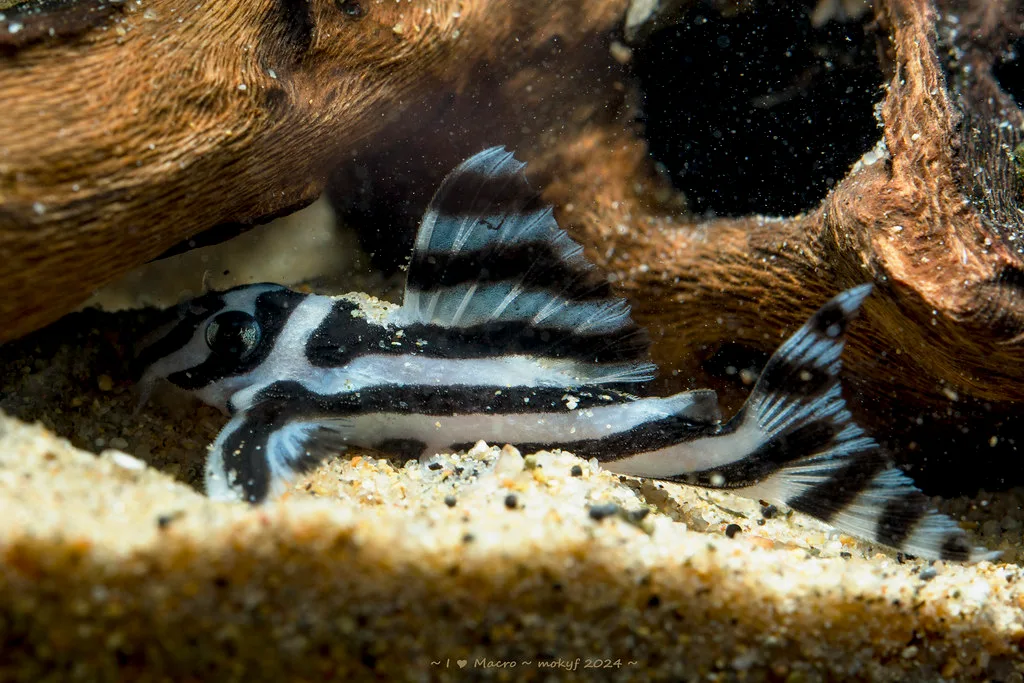
Image source: Web (Bing) / flickr.com (Web image (fair-use with source credit))
If you've been in the aquarium hobby for a while, you've heard about the Zebra Pleco. It's the crown jewel of the catfish world.
This fish comes from a single river system in Brazil. For that reason, it was heavily exported until regulations kicked in. Today, most Zebra Plecos are captive-bred, but the price hasn't dropped much.
What makes it look special? The white and black stripes curve across the body in a diagonal pattern. Unlike the Danio's horizontal stripes, these are bold and abrupt. It looks like a piece of porcelain.
How to Spot a True Zebra Pleco vs. Lookalikes
There's a "False Zebra Pleco" (L098) that looks very similar. The difference is subtle. The true Zebra Pleco has white lines that curve down around the nose.
The L098 lacks that facial pattern and has slightly different fin ratios.
You also need to recognize their nutritional needs. These are mostly carnivorous fish.
They need high-protein foods like frozen brine shrimp and specialized pleco wafers. They won't thrive on algae alone.
Why It Commands Such a High Price
Prices for juvenile Zebra Plecos sit between $150 and $300. Adult proven breeding pairs can go for much, much more.
Why the markup? Slow reproduction. A female lays a small number of eggs relative to other catfish.
They also take 2 to 3 years to reach breeding size. That combination keeps supply low and demand high.
The Big-Game Angle: Zander

Image source: Web (Bing) / anglingtimes.co.uk (Web image (fair-use with source credit))
The Zander (Sander lucioperca) is the only true game fish on this list. It's a perch, not a catfish. It's native to freshwater systems across Europe and parts of Asia.
This is a predator. An adult Zander routinely reaches 2 to 3 feet in length. Weights of 10 to 20 pounds are common in larger rivers.
Anglers target them for their aggressive strikes and strong fights. They hunt mostly at dawn and dusk. During the day, they hold tight to deep structure.
Zander vs. Walleye — How to Tell Them Apart
This is the most common point of confusion. In North America, the Walleye is a close cousin. The Zander is the European version.
Visually, they're nearly identical. Both have elongated amber bodies and spiny dorsal fins. The easiest way to tell them apart is location.
If you caught it in the Danube, it's a Zander. If you caught it in the Mississippi, it's a Walleye.
There is one physical difference if you look closely. The Zander has a slightly larger mouth and smaller scales. But in a live fish, it's very hard to tell.