Mammals That Start with V: Vole, Vervet, Vaquita, Vicuña
Ask someone to name mammals that start with v and you'll probably get one answer: vampire bat. Maybe a vole, if you're lucky. But the V list actually holds a wild mix of the famous, the endangered, and the truly bizarre.
Most people miss half of them.
In our research, we confirmed 9 distinct species that make the cut, from a critically endangered porpoise with fewer than 15 individuals alive as of 2026 to an Andean camelid whose fleece, at roughly 12 microns thick, is finer than cashmere. Their stories range from bloody survival tricks to luxury textile empires. Let's meet them one by one.

Image source: Bing (Web (fair-use with source credit))
The V-Mammal Problem: Why This List Is Harder Than It Looks
Why is this such a mental blank? Part of the blame goes to the letter itself. English has very few common animal names that begin with "v," and the ones that do tend to live far from most readers.
The confusion gets worse because people instinctively reach for animals like wolverines, weasels, or wallabies. They start with "w," not "v," and our brains blur them together. Others reach for Latin names, like Vulpes for foxes, which don't count here.
Even zoologists trip up on this list. Some "v" names describe a whole group, like voles, while others name a single species on the edge of extinction. There's no shared trait, no visual pattern, and no reason any one person would know them all.
That's why this guide exists. We dug through the taxonomy, the conservation databases, and the field guides so you don't have to.
Compare that to the letter A. Between aardvarks, alpacas, and axolotls, the list is overflowing. We already covered the full aardvark-to-axolotl list, and the letter B collection runs just as deep.
Quick Answer: The Complete V-Mammal Roster
The mammals that start with v number nine confirmed species. You've got vampire bats, vicuñas, vervet monkeys, and voles. Plus vaquitas, Visayan warty pigs, volcano rabbits, Vaal rheboks, and Vancouver Island marmots.
They span four continents and nearly every climate on Earth. Here's the complete roster.
| Species | Scientific Name | Region | Conservation Status |
|---|---|---|---|
| Vampire bat | Desmodus rotundus | Mexico to Argentina | Least Concern |
| Vicuña | Vicugna vicugna | Andes Mountains, South America | Least Concern |
| Vervet monkey | Chlorocebus pygerythrus | Sub-Saharan Africa | Least Concern |
| Vole | Microtus species | North America, Europe, Asia | Least Concern |
| Vaquita | Phocoena sinus | Gulf of California, Mexico | Critically Endangered |
| Visayan warty pig | Sus cebifrons | Panay and Negros, Philippines | Critically Endangered |
| Volcano rabbit | Romerolagus diazi | Central Mexico | Endangered |
| Vaal rhebok | Pelea capreolus | South Africa | Least Concern |
| Vancouver Island marmot | Marmota vancouverensis | Vancouver Island, Canada | Critically Endangered |
The Flying Feeders: Vampire Bats Up Close
The only mammal that lives exclusively on blood? That's the vampire bat. Desmodus rotundus, to use the proper taxonomy. And it's nowhere near the monster movies make it out to be.
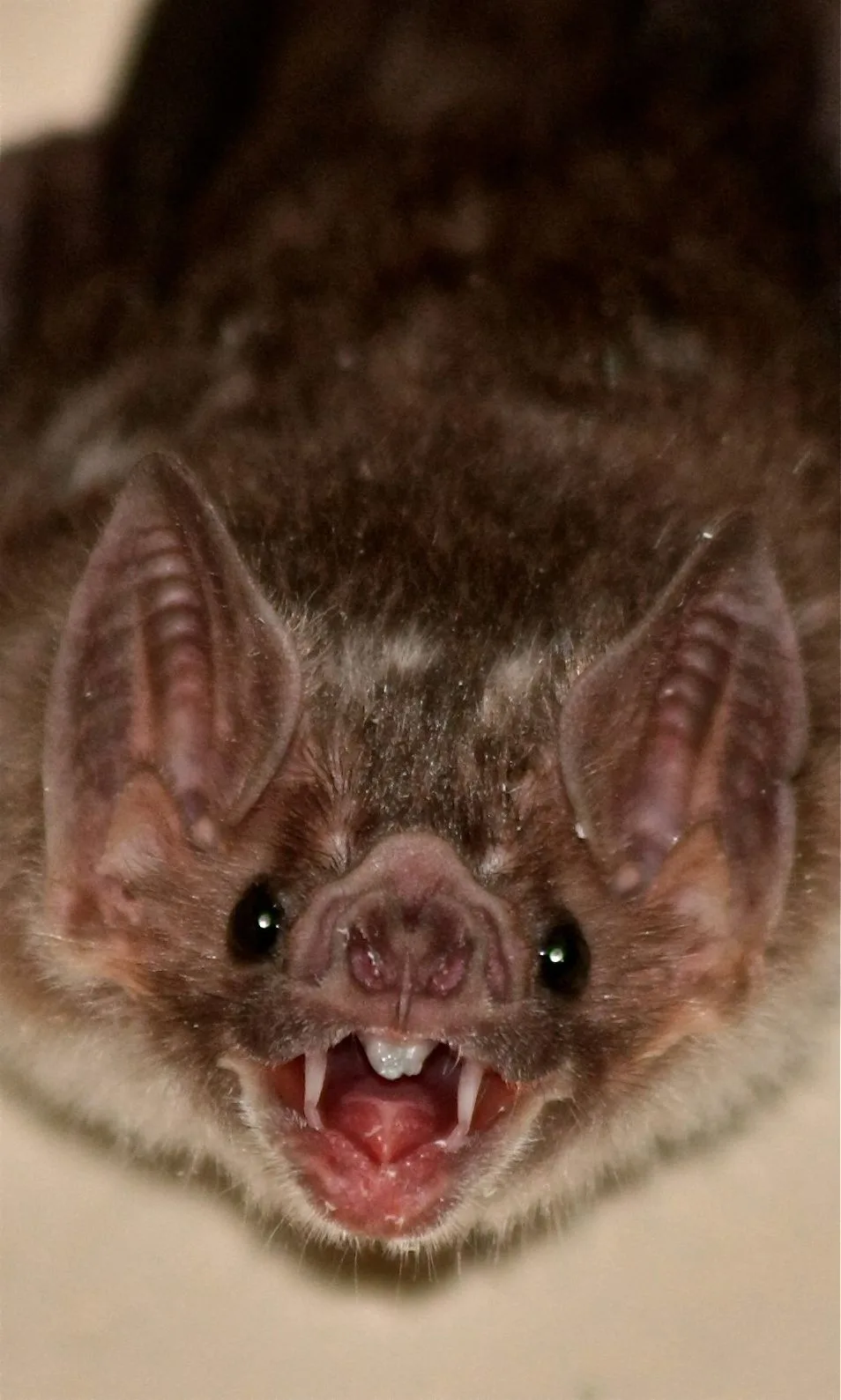
Image source: Web (Bing) / za.pinterest.com (Web image (fair-use with source credit))
Vampire bats are small. Their wingspan tops out around 8 inches, and their bodies fit in the palm of your hand. You'll find them across Central and South America, from Mexico down to Argentina.
The feeding routine sounds like sci-fi. Heat-sensing pits on their noses locate a warm spot on a sleeping animal. Then they make a tiny, razor-thin cut with incisors sharp enough to barely wake the victim.
Their saliva releases an anticoagulant called Draculin, which keeps the blood flowing.
That saliva has caught researchers' attention for decades. Draculin's blood-thinning properties could one day improve stroke treatment and heart medications. But cattle ranchers see a darker side.
Vampire bats can transmit rabies to livestock, and handling them without proper protective gear carries real risk. The IUCN lists the species as Least Concern, but local culls happen regularly.
The Andean Elite: Vicuña and Their Legendary Wool
If you've heard of vicuñas at all, it was probably about the wool. And for good reason. A vicuña's fleece measures around 12 to 15 microns thick.
Human hair is about 70 microns. Cashmere runs 15 to 19 microns. This is the finest natural textile fiber on Earth.

Image source: Web (Bing) / animalresearcher.com (Web image (fair-use with source credit))
It's also impossibly rare. Vicuñas were hunted nearly to extinction in the 1960s for their fleece, which led to a CITES Appendix I listing and a total trade ban.
The recovery story is genuinely impressive. Thanks to coordinated conservation across Peru, Bolivia, Chile, and Argentina, vicuña numbers have rebounded from around 10,000 in the 1970s to roughly 400,000 today.
The secret to that success is a tradition called chaku. Local communities round up wild vicuñas, shear them alive, and release them back into the wild. The animals aren't harmed, the fiber is harvested legally, and the profits go back to the communities that protect the herds.
The price tag reflects all of that scarcity and effort. A single vicuña produces about 200 grams of fiber per year. That's enough for one scarf, and luxury scarves routinely sell for several thousand dollars.
The Social Climbers: Vervet Monkeys in the Wild
These are the monkeys you've seen in a hundred wildlife documentaries. Chlorocebus pygerythrus is everywhere in sub-Saharan Africa, which makes them one of the easiest V-mammals to actually see in the wild.
They're also one of the most studied primates on the planet. The reason comes down to their alarm calls. Vervet monkeys have distinct warning signals for specific predators.
One call means leopard. Another means eagle. A third means snake.
Infants have to learn which call goes with which danger, which makes them a perfect model for understanding how communication evolves.
Their social structure gets just as much attention from researchers. Troops are matrilineal, meaning females stay in their birth group while males migrate to new ones. Ranks are inherited, and grooming is the glue that holds alliances together.
Size-wise, adults land somewhere between 3.5 and 12 pounds, with males at the top. Their home range typically spans 10 to 50 acres. Black faces, white collars, and blue scrotums on males make them easy to spot.
If you're heading to East Africa, a vervet troop is almost guaranteed. Just don't feed them. These monkeys have learned that tourists mean snacks, and their boldness can turn into biting incidents.