Mammals That Start with H: From Hedgehogs to Hippos
If you've ever tried to rattle off mammals that start with h, you know it gets tricky fast. Hamster, horse, hippo, then what? Hedgehog, hyena, maybe a howler monkey if you're sharp.
The list runs deeper than most people expect, and a few entries catch even wildlife enthusiasts off guard.
A quick scan of the IUCN Red List as of 2026 shows roughly four dozen mammal species with common English names starting with the letter H. That includes everything from the 1,500-kilogram hippopotamus to the 30-gram harvest mouse. Some are household pets, others are apex predators, and a few are so obscure you'll surprise your friends at trivia night.
Let's work through the full lineup, clear up the common mix-ups, and give you the details that actually matter.
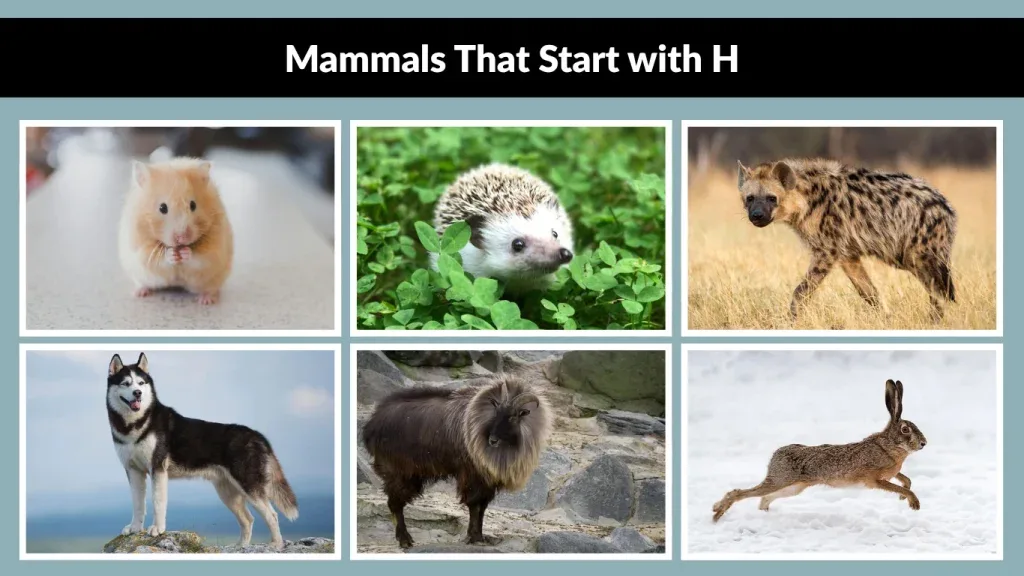
Image source: Bing (Web (fair-use with source credit))
Quick Answer
The most recognized mammals that start with h are the hamster, horse, hippopotamus, hedgehog, humpback whale, hyena, and howler monkey. Less common but still valid: harbor seal, harp seal, hartebeest, and Himalayan marmot. All are genuine mammals, meaning warm-blooded, hair-bearing, milk-producing vertebrates.
Whales and seals qualify despite living in water. The full list spans 11 main species across pets, giants, ocean dwellers, and overlooked oddities.
Why This List Is Harder Than It Looks
The alphabetical approach trips people up for three reasons. First, lookalikes that start with other letters sneak into the conversation. Porcupines get grouped with hedgehogs, but porcupines start with P.
Gerbils get mixed with hamsters, but gerbils start with G. The confusion is understandable, yet it muddies the actual H-list.
Second, water-dwelling mammals surprise people. Whales and seals are mammals, not fish. They breathe air, nurse their young, and maintain body temperature internally.
The humpback whale and both seal species absolutely belong on this list, but casual guessers often skip them because their brains default to "ocean animal equals fish." That's the marine mammal misconception that quietly ruins alphabetical animal quizzes everywhere.
Third, the list includes some genuine rarities. The hartebeest, a large African antelope, starts with H but rarely appears in casual conversation. The Himalayan marmot, a giant ground squirrel, lives at altitudes above 4,000 meters where most people never see one.
These obscure entries make the list feel incomplete unless you specifically research them.
One more layer complicates things: regional naming. The IUCN uses standardized English names, but local dialects vary. What some call a "harbor seal" others call a "common seal." The "spotted hyena" is sometimes labeled a "laughing hyena." These name variations mean the H-list shifts slightly depending on which authoritative source you consult.
Our research follows IUCN standard names, which keeps the list consistent and defensible.
A quick reference on the common confusions:
| Animal | Starts With | Frequently Mistaken For | Why They Get Mixed Up |
|---|---|---|---|
| Hedgehog | H | Porcupine (P) | Both have quills |
| Hamster | H | Gerbil (G) | Similar pet rodent size |
| Hyena | H | Wild dog (W) | Similar pack behavior |
| Humpback whale | H | Fish (F) | Lives in the ocean |
| Horse | H | Zebra (Z) | Similar body structure |
The Full List: Every H-Mammal Worth Knowing
Here's the complete rundown. We've organized it as a fast-scan table with the essentials you need for identification, trivia, or school projects. Note that the list follows the IUCN Red List standard names as of 2026.
| Species | Common Name | Region | Notable Fact |
|---|---|---|---|
| Cricetinae subfamily | Hamster | Middle East, Europe, Asia | Store food in cheek pouches up to half their body weight |
| Erinaceidae family | Hedgehog | Europe, Asia, Africa | Has 5,000 to 7,000 quills |
| Equus caballus | Horse | Domesticated worldwide | Can sleep standing up |
| Hippopotamus amphibius | Common hippo | Sub-Saharan Africa | Weighs up to 1,500 kg |
| Choeropsis liberiensis | Pygmy hippo | West Africa | Only 180 to 270 kg |
| Alouatta genus | Howler monkey | Central and South America | Loudest land animal, calls carry 3 miles |
| Crocuta crocuta | Spotted hyena | Sub-Saharan Africa | Females lead the pack hierarchy |
| Hyaena hyaena | Striped hyena | North Africa, Middle East, India | Less social than spotted hyenas |
| Parahyaena brunnea | Brown hyena | Southern Africa | Rarest of the hyena species |
| Megaptera novaeangliae | Humpback whale | Global oceans | Can dive up to 500 feet deep |
| Phoca vitulina | Harbor seal | North Atlantic, North Pacific | Can hold breath for 30 minutes |
| Pagophilus groenlandicus | Harp seal | Arctic and North Atlantic | Pups have white fur for camouflage |
| Alcelaphus buselaphus | Hartebeest | Sub-Saharan Africa | Can run 65 km/h |
| Marmota himalayana | Himalayan marmot | Himalayas | Whistles to warn the colony |
The list gives you fourteen solid entries. Some people add the "hutia" (a Caribbean rodent) and "hares" (though hares are lagomorphs, not rodents). We've excluded both to keep the list clean and defensible with standard classifications.
If you're building a school project, this table covers everything you need without venturing into taxonomic gray zones.
The Pet Picks: Hamsters and Hedgehogs

Image source: Web (Bing) / squeaksandnibbles.com (Web image (fair-use with source credit))
When people think about H-mammals as pets, two species dominate the conversation. Hamsters are the classic starter pet. Hedgehogs are the trendy exotic option.
Both work well in homes, but they ask for very different commitments.
Hamster: The Classic Starter Pet
Hamsters are nocturnal. That single fact drives every decision about ownership. They sleep all day and run on wheels all night.
If you're a light sleeper, the wheel noise will test your patience. A quiet wheel or a room away from your bedroom solves the problem.
Species selection matters more than most buyers realize. The Syrian hamster is the largest and most common. It grows to about 15 centimeters and adapts well to handling.
Dwarf hamsters, including Campbell's and Winter White, stay smaller around 8 centimeters. They're faster and more likely to nip. The Roborovski hamster is the smallest and quickest, making it a poor choice for young children who want to hold their pet.
Lifespan runs 2 to 3 years. That's short, and it's worth knowing before you bring one home. Kids bond deeply, and the goodbye comes fast.
Manufacturers like Kaytee and Oxbow produce nutritionally complete hamster pellets, but fresh vegetables and occasional protein treats round out the diet.
One alarming but normal behavior: hamsters can enter torpor. In cold conditions, they appear dead. Their breathing slows dramatically, their body stiffens, and they feel cold to the touch.
This is not death. It's a survival response. Warm the cage gradually and the hamster recovers.
Panicking owners have buried live hamsters, which is a tragedy that pet forums warn about repeatedly.
Hedgehog: The Spicier Option
Hedgehogs are not cuddly. They're solitary, nocturnal, and defensive. When scared, they roll into a ball of sharp quills.
That's their only defense mechanism, and it works well. You need patience and thick gloves for the first few weeks.
The African pygmy hedgehog is the species typically sold as a pet. It's smaller than its European cousin, topping out around 500 grams. They live 3 to 5 years in captivity with proper care.
Diet consists of high-protein cat food, insects, and specialized hedgehog kibble. They need a warm environment, ideally 24 to 27 degrees Celsius. Cold triggers hibernation attempts, which are dangerous for captive hedgehogs.
Legal restrictions are the biggest hurdle. Hedgehog ownership is illegal in California, Georgia, Hawaii, Pennsylvania, and Washington, D.C. Pet stores in those states don't carry them.
For a good starting point on alphabetically organized animal guides, our animal list from A through C covers related species in detail.
The Comparison
| Factor | Hamster | Hedgehog |
|---|---|---|
| Lifespan | 2 to 3 years | 3 to 5 years |
| Handling | Easy after taming | Requires patience and gloves |
| Nocturnal | Yes | Yes |
| Legal restrictions | Minimal | Banned in several states |
| Kid-friendly | Yes, with supervision | Not recommended for young kids |
| Daily cost | Low | Moderate |
| Bonding time | 1 to 2 weeks | 1 to 3 months |
The African Giants: Hippos and Hyenas

Image source: Web (Bing) / nickdalephotography.com (Web image (fair-use with source credit))
Africa produces some of the most dramatic H-mammals on the planet. The hippo earns respect through sheer mass. The hyena earns it through intelligence and social complexity.
Both species come wrapped in misconceptions that documentaries and pop culture refuse to correct.
Hippopotamus: Why "Gentle Giant" Is a Dangerous Myth
The word "hippopotamus" comes from Greek, meaning "river horse." The name undersells the danger. Hippos kill roughly 500 people per year in Africa. That puts them among the deadliest large animals on the continent.
They're territorial, aggressive, and fast.
A common hippo weighs 1,400 to 1,500 kilograms. Despite that bulk, it runs at 30 km/h on land. That's faster than most humans.
In water, they're fully submerged and can hold their breath for up to 5 minutes. They walk along the river bottom, eyes and nostrils above the surface, watching everything.
The pygmy hippo is a separate species, Choeropsis liberiensis. It lives only in West Africa, primarily Liberia and Sierra Leone. At 180 to 270 kilograms, it's drastically smaller than its cousin.
Pygmy hippos are reclusive and rarely seen in the wild. They spend more time on land than common hippos and produce a distinct reddish fluid that acts as sunscreen and antibiotic. Our parallel list starting with B offers similar wildlife context.
Hyena: The Matriarchal Hunter Everyone Gets Wrong
Hyenas suffer from the worst PR in the animal kingdom. The "Lion King" portrayal as cowardly scavengers is almost entirely fiction. Spotted hyenas are skilled hunters.
They kill up to 95% of their own food, taking down wildebeest, zebra, and even young giraffes. Lions scavenge from hyenas more often than the reverse.
Social structure is matriarchal. Female spotted hyenas are larger, more aggressive, and dominate every clan. They have pseudo-penises, a unique anatomical trait that makes sex identification difficult.
These structures serve multiple functions, including signaling dominance and establishing social rank through a process called "penis shaking."
Three species make up the hyena family. The spotted hyena is the largest and most social, living in clans up to 80 individuals. The striped hyena is smaller, more solitary, and primarily a scavenger.
The brown hyena is the rarest, found only in southern Africa's coastal regions. They're all more closely related to cats than dogs, despite their dog-like appearance. Genetically, they belong to the suborder Feliformia, which includes mongooses and civets.