Animals That Start with W: From Walrus to Weasel
You've probably been asked this before, whether it's for a classroom assignment, a trivia night, or just a random curiosity moment: what animals start with the letter "w"? It's one of those questions that seems simple until you try to answer it. Most people rattle off wolf, whale, and walrus, then hit a wall.
The truth is, the "w" list runs deep, from the marsupials of Australia to the deep-sea giants of the Pacific.
In our research across wildlife databases and conservation records, we found over 40 distinct species that start with this letter, ranging from the massive blue whale (the largest animal on Earth) to the tiny wren you might spot in your backyard. As of 2026, several of these species face significant conservation challenges, making them worth knowing for more than just trivia. Let's walk through the full visual guide, complete with the identification tricks that separate the wolverine from the wolf and the wallaby from the kangaroo.
Quick Answer
The animals that start with w include the wolf, whale, walrus, warthog, wombat, wallaby, weasel, wolverine, wildebeest, woodpecker, wren, wasp, weevil, and whale shark. That's over 40 species total. They span every continent and ocean.
Their sizes range from the tiny weevil (under 5mm) to the blue whale (over 100 feet). Most people can name five. This guide covers all of them.
Why Visuals Matter for "W" Animals
Here's the problem: common names can mislead you. The wolverine isn't actually a wolf. The warthog isn't a pig from a Disney movie.
The whale shark is a fish, not a whale. Words fail you. Pictures don't.
When you're trying to identify animals that start with w, your eyes do the heavy lifting. A wallaby and a kangaroo look nearly identical in a text description. Both are marsupials.
Both hop. Both have pouches. But one photo showing the wallaby's shorter legs and different tail shape settles it instantly.
That's why this guide leans heavily on visual identification. We're taking you through each animal with the specific physical traits that make it unmistakable. You'll learn what to look for at a glance, along with the common look-alikes that trip people up.
How to Use This Guide (Before You Scroll)
This guide is organized by habitat and animal type. We start with the ocean giants, then move to Australia, Africa, birds, predators, and the overlooked species you may have never heard of.
A few ground rules before we dive in:
- We're only covering animals whose common English name starts with "w" (not animals with the letter hidden inside, like "crow" or "swan")
- We're using standard common names as recognized by major wildlife organizations. Regional variations exist, but we're going with the most widely accepted terms
- We're including both wild and familiar animals, from your backyard wren to the deep-sea wrasse
- We're noting conservation status where it matters, because several of these species are in real trouble
If you're looking for a specific animal, use the field guide sections below. If you want the full picture, read through the entire thing. Either way, you'll walk away able to name more "w" animals than 99% of people.
Wildlife ID: The Full Visual Field Guide
This is the heart of the article, so grab a mental notebook. We've grouped every species by where it lives, which makes them easier to remember. Each group comes with the physical traits that set the animals apart from their look-alikes.
Ocean Giants and Swimmers
The oceans hold some of the most famous animals that start with w, along with a couple you've definitely seen but never named.
Blue Whale (Balaenoptera musculus)
The largest animal to ever live, as far as we know. Adult blue whales reach up to 100 feet and weigh around 200 tons. Their mottled blue-gray skin and tiny dorsal fin set them apart.
You'll recognize them mainly by sheer scale. Nothing else in the ocean comes close.
Whale Shark (Rhincodon typus)
Despite the name, this is a fish, not a mammal. Photo identification is straightforward: a massive flat head, wide mouth, and white spots over dark gray skin arranged in a checkerboard pattern. It's the largest known fish species, reaching about 40 feet.
If you see spots, it's a whale shark. If you see smooth skin and a blowhole, it's a whale.
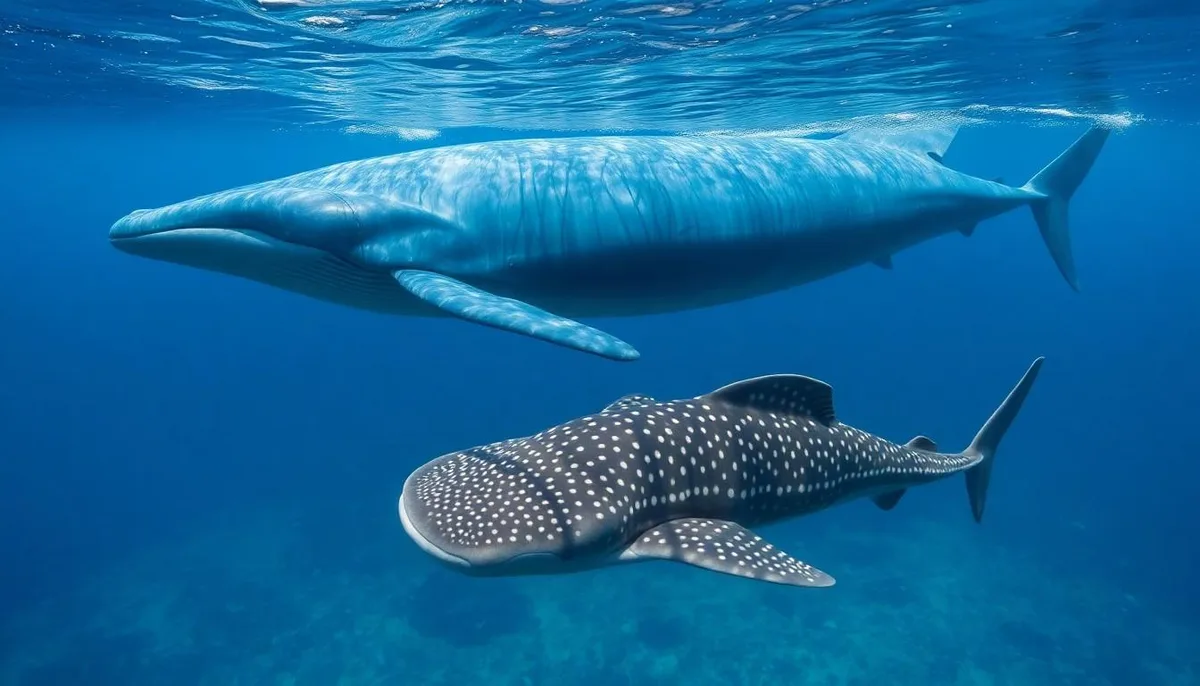
Image source: Bing (Web (fair-use with source credit))
Walrus (Odobenus rosmarus)
The walrus is impossible to mistake. Two long white tusks, a massive bristly snout, and flippers instead of feet. Adult males can weigh over 3,700 pounds.
They hang out on sea ice in the Arctic, and if you ever see one, the tusks are the giveaway. Related to seals, but no seal has tusks.
Wrasse (family Labridae)
These are reef fish, often vibrantly colored. Over 600 species exist worldwide. They're known for their thick lips, protruding teeth, and ability to change color with age.
If you've snorkeled on a coral reef, you've seen one. You just didn't have a name for it.
Walleye (Sander vitreus)
A freshwater fish native to North America. The name comes from its opaque, glassy eyes. These fish have a spiny dorsal fin and a sandy-colored body with dark mottling.
They're popular with anglers, especially in the Great Lakes region.
Australian Icons
Australia contributes some of the most beloved animals that start with w. They're also some of the most commonly confused.
Wombat (Vombatidae family)
The wombat is a stocky, burrowing marsupial that looks like a small bear. They have powerful claws, a backwards-facing pouch, and a hard rump they use to block burrow entrances. Unlike koalas (their closest relatives), wombats stay mostly on the ground.
They're nocturnal, so you'll rarely see one in the wild during the day. Their cube-shaped droppings are a well-known biological curiosity.

Image source: Web (Bing) / animalresearcher.com (Web image (fair-use with source credit))
Wallaby (family Macropodidae)
Wallabies are smaller than kangaroos, with shorter legs and a more compact build. Their tails are proportionally longer and they tend to live in forested areas while kangaroos prefer open plains. If you're trying to tell them apart in a photo, look at the legs.
Kangaroos have heavily muscled hind legs built for long-distance hopping. Wallabies have lighter, shorter legs for tighter maneuvering. They're also more colorful, typically showing gray, brown, or red patches.
Weta (family Anostostomatidae)
These are giant insects native to New Zealand. Some species, like the giant weta, weigh more than sparrows. They look like oversized crickets, with long antennae and heavy bodies.
The name comes from the Maori word "wētā." If it walks like a cricket but looks like a dinosaur, it's a weta.
The African Big Game
Africa's savannas and grasslands hold several heavyweights in the "w" category. These are the species you'll see on safari, and they're easier to identify than you might think.
Warthog (Phacochoerus africanus)
You'll recognize the warthog by the pair of upward-curving tusks and the fleshy "warts" on the face, which are actually protective padding. They also have a distinctive mane running down the back. When they run, they hold their tails straight up like little flags.
That's a warthog signature move. If you've watched any nature documentary set in Africa, you've seen this. The "warts" are what separate them from wild boars.
Wildebeest (Connochaetes genus)
Also called the gnu, this is the animal you see in massive migration herds crossing the Serengeti. They have a large, boxy head, curved horns, and a scraggly beard. Their front legs are heavier than their back legs, giving them a front-heavy stance.
During the Great Migration, over 1.5 million wildebeest move across Tanzania and Kenya in search of fresh grazing. If you see a herd that goes to the horizon, that's wildebeest.
White Rhinoceros (Ceratotherium simum)
The white rhino isn't white. The name likely comes from a mistranslation of the Dutch word "wijde" meaning wide, referring to its square, wide mouth. That mouth is the key identifying feature.
White rhinos graze grass with their broad lips, while black rhinos (Diceros bicornis) use their pointed upper lip to browse leaves. The white rhino is also the larger of the two, weighing up to 5,000 pounds. They're critically endangered due to poaching, with conservation efforts ongoing across southern Africa.
You can follow the latest population tracking through the IUCN Red List.
Birds Starting with W
Birds offer some of the most visual variety in the "w" category. From tiny backyard visitors to the largest wingspan in the world.
Woodpecker (family Picidae)
Woodpeckers are known for their stiff tail feathers, which brace them against tree trunks. They have strong beaks for drilling and long tongues for extracting insects. The key visual cue is the pecking motion itself, combined with the straight, upright posture on tree bark.
In North America, the pileated woodpecker (Dryocopus pileatus) is the largest, with a striking red crest.
Wren (family Troglodytidae)
Wrens are small, round, brown birds with upright tails. The house wren (Troglodytes aedon) is a common backyard visitor across the Americas. They're incredibly vocal for their size, singing loud, bubbling songs.
If you see a tiny brown bird flicking its tail upward, that's a wren.
Wandering Albatross (Diomedea exulans)
This bird holds the record for the largest wingspan of any living bird, reaching up to 12 feet. They spend nearly their entire lives at sea, gliding over the Southern Ocean. Their long, narrow wings and white-and-black plumage make them easy to spot in flight, if you're lucky enough to see one.
Wild Turkey (Meleagris gallopavo)
The wild turkey is larger and more colorful than its domesticated cousin. Males (toms) have iridescent bronze and green feathers, a bare red-and-blue head, and a distinctive beard of modified feathers hanging from the chest. You'll see them strutting in fields and woodland edges across North America.
Wryneck (genus Jynx)
The wryneck is a small woodpecker relative that got its name from its habit of twisting its head nearly 180 degrees when threatened. They have cryptic brown-gray plumage that blends into tree bark. If you see a "woodpecker" that doesn't peck and instead twists its neck like an owl, it's a wryneck.
Predators and Pack Hunters
These are the species people most often confuse with one another. Let's settle it right now.
Wolf (Canis lupus)
The gray wolf is the largest wild member of the dog family. Key features include a broad skull, bushy tail, and long legs built for endurance running. Wolves typically weigh between 60 and 120 pounds.
They hunt in packs of 6 to 10, though pack size varies with prey availability. The howl is a long-distance communication tool that can carry for miles. If you see a large canine in North America or Eurasia with a straight tail (not curled like a husky), it's likely a wolf.
Wolverine (Gulo gulo)
The wolverine is the animal that confuses everyone. Despite the name, it's not a wolf. It's actually the largest terrestrial member of the weasel family (Mustelidae).
Imagine a small bear crossed with a badger. Wolverines have heavy, dark brown fur with a lighter band across the flanks, short legs, and a bushy tail. They're incredibly powerful for their size, capable of taking down prey much larger than themselves.
Wolverines are found in remote northern forests and tundra across Canada, Alaska, Scandinavia, and Russia. A wolverine weighs 20 to 40 pounds, nowhere near wolf territory.
Weasel (genus Mustela)
Weasels are long, slender, fast-moving predators. The least weasel (Mustela nivalis) is the smallest carnivore in North America at about 6 to 10 inches. They have a distinctive black-tipped tail and a white-to-yellow belly in winter.
The best visual cue is the shape: a long cylindrical body on short legs, built for chasing rodents into their burrows. In northern climates, some weasels turn completely white (ermine) in winter, keeping only the black tail tip.
The Weird, Small, and Overlooked
The "w" list is full of small creatures that rarely make the headlines. These are the ones that stump people on trivia night. They're also some of the most interesting.
Wasp (suborder Apocrita)
Wasps are often confused with bees. The key difference: wasps have smooth, slender bodies with a narrow waist, while bees are hairier and rounder. Wasps are also more aggressive, capable of stinging repeatedly.
They come in two types: social wasps (like yellowjackets) that build paper nests, and solitary wasps that live alone. If it's smooth-bodied and hovering around your soda, it's a wasp.
Weevil (superfamily Curculionoidea)
Weevils are a type of beetle with an unmistakable snout (rostrum). Over 60,000 species exist worldwide. The snout isn't just for looks; it's used for boring into plants to lay eggs.
Some, like the boll weevil, have caused major agricultural damage. If you see a tiny beetle with an extended "nose," that's a weevil.
Woodlouse (suborder Oniscidea)
Also called pill bugs or roly-polies, these are actually crustaceans, not insects. They're related to crabs and shrimp. They have segmented, oval bodies and roll into a ball when disturbed.
You'll find them under logs, rocks, and leaf litter in damp areas. They play a vital role in breaking down decaying plant matter.
Western Diamondback Rattlesnake (Crotalus atrox)
This is one of the most recognizable venomous snakes in North America. The name comes from the diamond-shaped pattern along its back. It also has a distinctive black-and-white banded tail and a rattle at the tip, used as a warning signal.
They're found in the southwestern United States and Mexico. If you hear a rattling sound in dry, rocky terrain, back away slowly. This species is responsible for the majority of snakebite deaths in the U.S., according to the National Park Service.
The Photo ID Cheat Sheet: Quick Visual Cues
Sometimes you just need a fast answer. This table distills the entire field guide into quick-reference rules. Save it, screenshot it, or bookmark it for your next nature walk.
| Animal | Key Visual Feature | Common Look-Alike | The One-Look Rule |
|---|---|---|---|
| Wallaby | Shorter legs, longer tail | Kangaroo | Smaller, forest-dwelling, brighter coat |
| Warthog | Upward tusks, facial "warts" | Wild boar | Tusks curve up; mane down the back |
| Wolverine | Low-set, dark brown body | Small bear | Look for light band across the flanks |
| Walrus | Two long white tusks | Seal, sea lion | Tusks. Only walruses have them |
| Whale Shark | White spots, checkerboard | Blue whale | Spots = fish; smooth = mammal |
| Woodpecker | Stiff tail, upright posture | Other birds | Pecking motion on tree trunks |
| Weasel | Long, slender body | Ferret, stoat | Black-tipped tail; tiny size |
| White Rhino | Square, wide mouth | Black rhino | Wide lip grazes; pointed lip browses |
| Wren | Tiny, tail upright | Sparrow | Tail points straight up when perched |
| Weevil | Snout on the head | Other beetles | Extended "nose" is the giveaway |
The key takeaway here is that every single animal on this list has one defining trait that settles the ID instantly. You don't need to memorize every detail. You just need the one-look rule.
Now let's move on to the mistakes everyone makes when trying to identify animals that start with w. We'll cover the classic mix-ups and how to avoid them for good.