
Sea Animals That Start with D: Dolphins, Dugongs & More
You already know dolphins, but did you know there's a fish that shares their name? That's just one of the surprises waiting in this list of sea animals that start with d. Between deep-sea oddities, reef dragons, and a shark small enough to hold in one hand, the "D" list is genuinely packed with variety.
In our research, we've sorted through marine biology databases and NOAA species guides to bring you a clear, visual breakdown of every notable "D" animal. As of 2026, scientists recognize roughly 20 distinct species that commonly go by a "D" name, from the 8-inch dwarf lanternshark to the 1,100-pound dugong. Let's sort them out so you never confuse a mammal with a fish again.
Why Visual ID Matters
Here's the thing about marine animals: common names are a mess. The same species can have five different names depending on where you are, and totally unrelated animals sometimes share a name. That's precisely what makes the "D" list so tricky.
The bottlenose dolphin is a warm-blooded mammal that breathes air. The dolphinfish, which people also call mahi-mahi, is a cold-blooded fish with gills. They're not even distant cousins.
They just share a word in their name because early sailors thought the fish's dorsal fin looked like a dolphin's.
When you're trying to identify something you saw while snorkeling or on a whale-watching tour, pictures matter more than descriptions. You need to see the snout length, the fin shape, and the tail structure to get it right. That's why this guide leans heavily on visual cues and clear comparisons.
Before we dive in, take a quick look at our hero image below. That's a common bottlenose dolphin, the species most people picture when they hear the word "dolphin." Keep that image in your head because we'll be comparing it to lookalikes shortly.
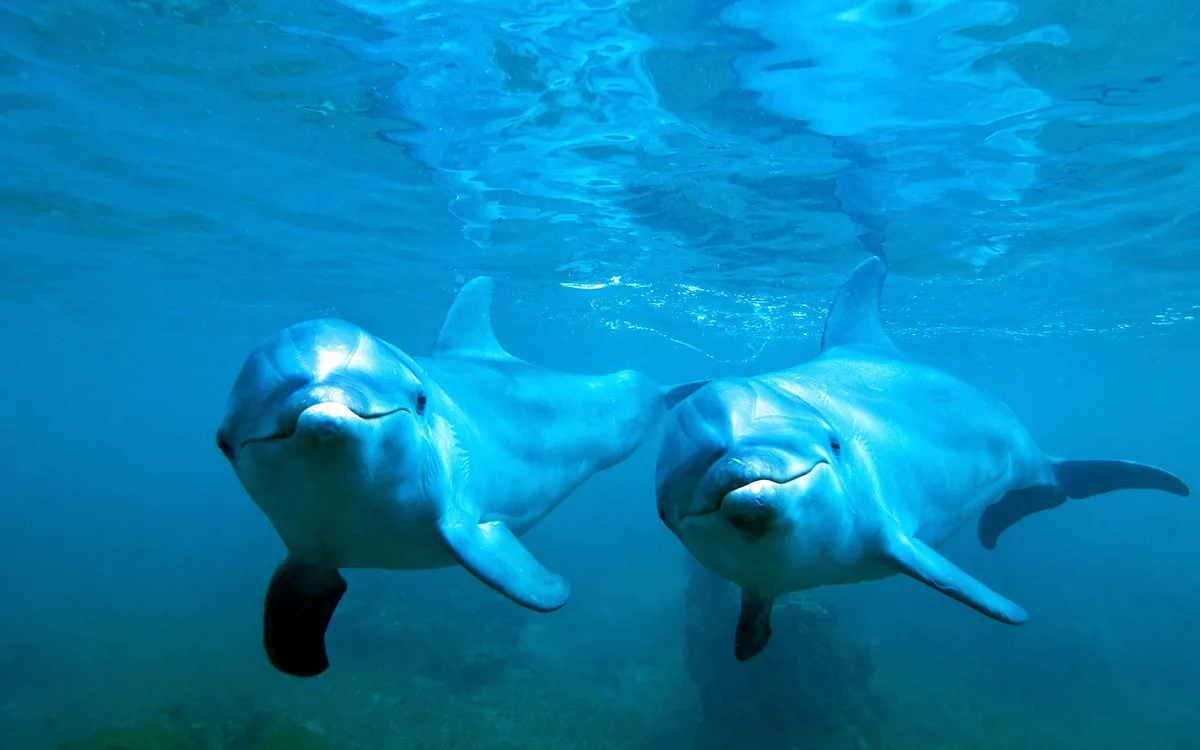
Image source: Web (Bing) / wallhere.com (Web image (fair-use with source credit))
Quick Answer
The main sea animals that start with d are dolphins, dolphinfish, dugongs, sea dragons, damselfish, and dogfish. There's also the dumbo octopus, the giant devil ray, the Dungeness crab, and the decorator crab. The dwarf lanternshark holds the title of the smallest shark species in the ocean.
Most of these live in tropical or temperate waters worldwide.
How to Use This Guide
This guide works best as a visual reference. Each section focuses on one or two species, highlights their key identifying features, and tells you where you're most likely to see them. We've grouped animals by category rather than alphabetical order so you can compare similar creatures side by side.
The marine mammals come first because they're the most recognizable and the most commonly confused. Then we'll move through fish, sharks, rays, and crustaceans. If you're just trying to identify something you saw on vacation, check the "Quick Reference Table" section near the end for a fast species-by-species breakdown.
One note on the star rating system we've used throughout: the difficulty score reflects how hard it is for a casual observer to identify the animal correctly in the wild. A one-star rating means it's unmistakable. A five-star rating means you'll need to look closely at multiple features.
We've also included conservation status for each species where relevant. Several animals on this list, including the dugong and the leafy sea dragon, face real threats in the wild. Knowing what you're looking at helps you understand why protecting their habitats matters.
The "Big Three" Marine Mammals
Three species of "D" mammals dominate the ocean's spotlight, and they're surprisingly easy to mix up if you're watching from a boat deck. The bottlenose dolphin, the spinner dolphin, and the common dolphin each have distinct physical traits once you know what to look for.
The bottlenose dolphin is the gray, robust animal you see at aquariums and in shows. It has a short, thick beak that looks like an old wine bottle. Its dorsal fin curves backward in a gentle hook, and it typically reaches 10 to 14 feet in length.
These dolphins are coastal and offshore creatures, and they're the species most likely to approach boats.
The spinner dolphin is slimmer and more acrobatic. Its snout is longer and thinner, more like a bird's beak than a bottle. Spinners earn their name by launching themselves out of the water and spinning along their long axis.
They're smaller than bottlenose dolphins, usually topping out around 7 feet, and they live in large pods in tropical and subtropical waters.
The common dolphin gets its name from being widespread, not from being ordinary. It has a distinct hourglass pattern on its sides in yellow, gray, and white. Its dorsal fin is taller and more triangular than the bottlenose's curved fin.
These dolphins are fast swimmers and often ride the bow waves of boats in large groups.
Quick-ID Table: Dolphin Species at a Glance
| Species | Snout Shape | Dorsal Fin | Average Length | Best ID Feature |
|---|---|---|---|---|
| Bottlenose Dolphin | Short, thick, bottle-like | Curved hook | 10–14 ft | Chunky body and gray color |
| Spinner Dolphin | Long, thin, beak-like | Slightly curved | 5–7 ft | Length of snout and acrobatic spinning |
| Common Dolphin | Medium, pointed | Tall, triangular | 6–8 ft | Hourglass color pattern on sides |
If you watch marine wildlife documentaries or catch a glimpse from a beach, the quickest way to tell them apart is the snout. Short and stubby means bottlenose. Long and slender means spinner.
Yellow or tan patches on the side means common dolphin.
For more on ocean mammals, you might enjoy our roundup of spectacular ocean creatures starting with S if you're already planning your next deep dive.
The Most Confusing Duo: Dolphin vs. Dolphinfish
This is the big one. The dolphinfish, also known as mahi-mahi, causes more identification confusion than any other "D" species. People see the name "dolphinfish" and assume it's a baby dolphin.
It's not. Not even close.
Dolphinfish are ray-finned fish with vibrant colors that shift from bright gold and blue to silver when they're out of water. They have a blunt, boxy head that drops almost vertically down to the mouth. The males, called bulls, develop a prominent forehead that hangs over the eyes.
They're fast, powerful swimmers that chase flying fish across tropical oceans.
So how do you tell them apart from an actual dolphin? Look at the tail. Dolphins have horizontal tail flukes that move up and down.
Fish like the mahi-mahi have vertical tails that move side to side. That's the quickest anatomical giveaway, and it works for almost any mammal-versus-fish comparison.
The second clue is the snout. A real dolphin has a beak or snout. A dolphinfish has a steep, sloping forehead with no beak at all.
The third clue is location. Dolphins surface to breathe and you'll see them rolling above the water line. Dolphinfish stay submerged and only appear when they're feeding near the surface.

Image source: Web (Bing) / storage.googleapis.com (Web image (fair-use with source credit))
Here's a memory hook that works: the fish is the one that looks like it has a boxer's jaw. A dolphinfish looks like it ran forehead-first into a wall. A dolphin looks elegant, sleek, and aerodynamic.
The confusion matters beyond casual curiosity. Dolphinfish are a popular commercial and recreational catch, prized for their firm, white flesh that many chefs compare to tuna. Dolphins, on the other hand, are protected marine mammals under the Marine Mammal Protection Act, and it's illegal to hunt or harass them.
In our research, we found that many restaurant menus in Hawaii and Florida list "dolphin" without the "fish" part. Tourists often order it thinking they're trying a new seafood, then panic when they realize what they've eaten. Rest assured, if you eat "dolphin" in a reputable restaurant, you're eating mahi-mahi.
The practice is legal and common, though it does create understandable confusion.
The Gentle Giants That Graze
The dugong is the ocean's gentle giant, a relative of the manatee that grazes on seagrass in warm coastal waters. It's the only marine mammal that's strictly herbivorous, meaning it eats only plants. An adult dugong can reach 10 feet in length and weigh up to 1,100 pounds, yet it's completely harmless to humans.
Dugongs live in the Indo-Pacific region, with significant populations around Australia, particularly in the Great Barrier Reef and Shark Bay. They're slow-moving animals that spend most of their day feeding on seagrass meadows. They surface every few minutes to breathe, and their breathing pattern makes them easy to spot from boats.
The biggest source of confusion here is the dugong versus the manatee. Both are part of the Sirenia order, but they have distinct differences. The dugong has a fluked tail that looks like a whale's tail, with two distinct lobes pointing backward like arrowheads.
Manatees have a single, paddle-shaped tail that's roundish and smooth.
The snout is another giveaway. A dugong has a downturned, trunk-like snout that helps it graze on the ocean floor. A manatee has a larger, more flexible snout that can grab vegetation from all angles.
Dugongs also tend to have a darker gray or brown color, while manatees lean toward a lighter gray or slate blue.

Image source: Bing (Web (fair-use with source credit))
Conservation status is a serious concern. The IUCN lists the dugong as vulnerable, with populations declining due to habitat loss, boat strikes, and entanglement in fishing nets. In Australian waters, dugongs are protected under multiple laws, and the Great Barrier Reef Marine Park Authority enforces strict speed limits in seagrass areas to reduce boat strikes.
If you're lucky enough to spot a dugong in the wild, keep your distance. These animals have poor eyesight but acute hearing, and they startle easily. A mother and calf pair is especially vulnerable.
Responsible wildlife tours in places like Moreton Bay near Brisbane offer the best chance to see them without disturbing their feeding routines.
Dugongs are also culturally significant in many coastal communities. In parts of the South Pacific, they feature prominently in oral traditions and are considered ancestors or messengers. That cultural weight adds another layer of importance to protecting them.
The Dragons of the Reef: Leafy and Weedy Sea Dragons
If you've ever seen a leafy sea dragon, you probably thought it was seaweed drifting in the current. That's exactly the point. These masters of camouflage belong to the same family as seahorses, but they've evolved leaf-like appendages that make them nearly invisible among kelp and seagrass.
The leafy sea dragon (Phycodurus eques) is the showier of the two species. It has elaborate, branching leaf-like protrusions covering its entire body. These appendages serve no swimming purpose.
They're purely for disguise. The weedy sea dragon (Phyllopteryx taeniola) has smaller, weed-like projections that are less ornate but just as effective.
Both species are endemic to southern Australia, meaning they live nowhere else on Earth. You'll find them in shallow coastal waters from Perth around to New South Wales, typically at depths between 10 and 50 feet. They're slow swimmers and rely almost entirely on camouflage to avoid predators.
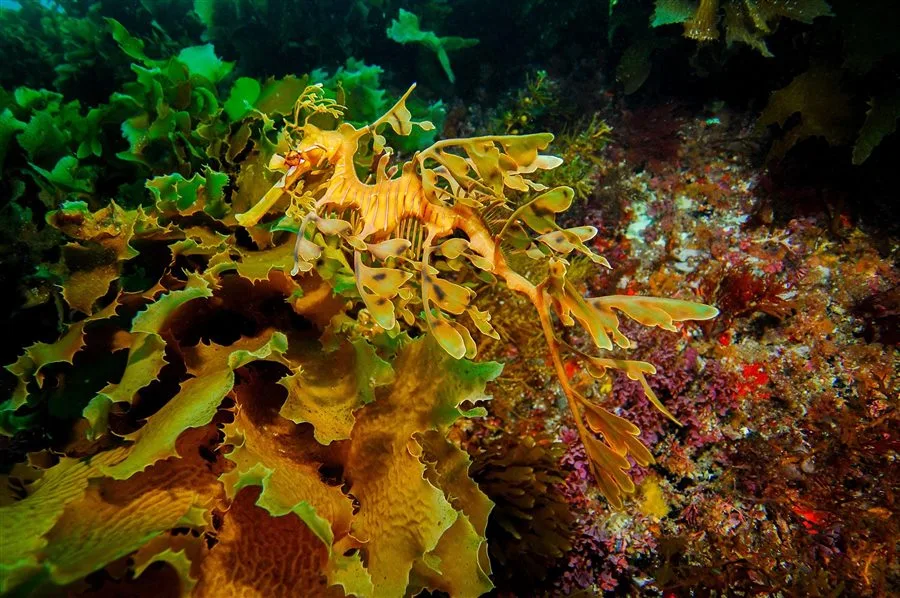
Image source: Bing (Web (fair-use with source credit))
Here's the quick way to tell them apart: leafy sea dragons have appendages that look like wide, flat leaves with visible veins. Weedy sea dragons have thinner, more spiky projections that resemble twigs or small branches. The leafy variety also tends to have a yellower or more golden hue, while weedies lean toward red or brown.
One of the most fascinating facts about sea dragons is their reproduction. Like seahorses, it's the males that carry the eggs. The female deposits her eggs onto the male's tail, where they remain until they hatch roughly four to six weeks later.
A single male can carry up to 250 eggs at once.
Sea dragons face significant threats from habitat degradation and collection for the aquarium trade. Both species are listed under Australia's Environment Protection and Biodiversity Conservation Act, and export is strictly regulated. In our research, we found that sustainable aquarium breeding programs are still in early stages, so most specimens in home aquariums are either illegal imports or very hard to obtain.
If you want to see them in the wild, your best bet is a guided snorkel or dive in South Australia's Rapid Bay or Victoria's Flinders Pier. Local dive operators know the exact spots where these animals tend to hold territory. They'll also brief you on how to approach without stressing the animals out.
Deep-Sea Oddities: Dumbo Octopus and Dragonfish
The open ocean surface gets all the attention, but the truly bizarre "D" animals live miles below. The dumbo octopus is a case in point. It gets its name from the two large, ear-like fins that protrude from its mantle.
Those fins flap as the octopus swims, which looks exactly like the elephant character from the Disney film.
Here's the surprise: dumbo octopuses are tiny. The largest recorded specimen measured just under 2 feet across, and most species in the genus Grimpoteuthis stay much smaller. They live at depths between 9,800 and 13,000 feet, where water pressure exceeds 1 ton per square inch.
They're also one of the deepest-living octopus species known to science.
Because they live so deep, dumbo octopuses are rarely observed in their natural habitat. Most of what we know comes from submersible footage and occasional specimens brought up in research trawls. They feed on small crustaceans, worms, and other invertebrates they find on the seafloor.
The dragonfish family, Stomiidae, is another deep-sea resident with a fearsome name and a tiny reality. Most species measure between 4 and 12 inches long. They have large mouths filled with needle-like teeth, and many species possess a barbel, a long, thin appendage hanging from their chin that glows with bioluminescent light.
That glow serves a dual purpose. It attracts prey in the pitch-black depths, and it may help dragonfish recognize members of their own species. Some dragonfish produce red light, which is unusual because most deep-sea creatures can't see red wavelengths.
This gives dragonfish a private hunting spotlight. Their prey can't see the red beam coming.
If you're hoping to spot either of these species in the wild, you'll need a deep-sea submersible. That's not practical for most people. Instead, your best chance is a public aquarium with a deep-sea exhibit.
The Monterey Bay Aquarium in California has featured deep-sea animals in special exhibits, and several research institutions offer live feeds from remotely operated vehicles exploring the abyss.
Sharks, Rays, and Crustaceans: The Rest of the "D" List
The "D" list doesn't stop at dolphins and dragons. A whole group of sharks, rays, crabs, and small reef fish also start with the letter. Let's work through them quickly so you have the full picture.
The spiny dogfish is one of the most abundant shark species in the ocean. It's a small shark, typically 3 to 4 feet long, with a venomous spine in front of each dorsal fin. Those spines are sharp enough to inflict a painful wound if you handle the shark carelessly.
Dogfish get their names because they hunt in packs, much like hunting dogs.
The giant devil ray is a truly impressive animal. It's related to manta rays but has a distinct, forward-projecting lobe on its head. That's where the "devil" name comes from.
Despite the intimidating look, devil rays are filter feeders. They swim with their mouths open, straining plankton from the water. They can reach wingspans of over 10 feet and are capable of leaping several feet out of the water.
The Dungeness crab is probably the most familiar "D" animal to seafood lovers. Named after Dungeness, Washington, this crab supports a major commercial fishery along the Pacific coast. Adults have a carapace width of about 6.25 inches and a sweet, delicate flavor that's become a West Coast staple.
The decorator crab earns its name from a clever survival strategy. It attaches bits of sponge, algae, and small invertebrates to its shell using hooked bristles. This camouflage helps it blend into the reef and avoid predators.
Some decorator crabs even use toxic sponges as a chemical defense, making them taste terrible to anything that tries to eat them.
The damselfish family includes hundreds of small, brightly colored reef fish. You'll see them on nearly every tropical reef dive, often darting among coral heads defending their tiny territories. Some species, like the domino damselfish, are bold enough to nip at divers who get too close to their nests.
Finally, the dwarf lanternshark holds the title of the world's smallest shark. Fully grown individuals measure about 8 inches long. They live in deep waters off South America's coast and emit a faint blue-green bioluminescence that may help them blend into the dim light from the surface or communicate with potential mates.
Quick Reference Table: All "D" Sea Animals by Size and Habitat
Here's a quick reference cheat sheet for all the main "D" sea animals. Use it when you're trying to remember which species lives where and how big it gets.
| Species | Type | Average Size | Habitat | Chance of Spotting |
|---|---|---|---|---|
| Bottlenose Dolphin | Mammal | 10–14 ft | Coastal and offshore, worldwide | High (boat tours) |
| Spinner Dolphin | Mammal | 5–7 ft | Tropical waters | Medium (acrobatic surfacing) |
| Common Dolphin | Mammal | 6–8 ft | Temperate and tropical oceans | Medium |
| Dugong | Mammal | 8–10 ft | Indo-Pacific seagrass beds | Low (protected, shy) |
| Leafy Sea Dragon | Fish | 8–14 in | Southern Australia, kelp beds | Very low (excellent camouflage) |
| Weedy Sea Dragon | Fish | 12–18 in | Southern Australia, rocky reefs | Very low |
| Dumbo Octopus | Cephalopod | 8–24 in | Deep sea, 9,800+ ft | Near impossible |
| Dragonfish | Fish | 4–12 in | Deep sea, 600–13,000 ft | Near impossible |
| Spiny Dogfish | Shark | 3–4 ft | Coastal waters worldwide | Medium (fishing bycatch) |
| Giant Devil Ray | Ray | Up to 10+ ft wingspan | Warm open ocean | Low |
| Dungeness Crab | Crustacean | 6.25 in carapace | Pacific coast, sandy bottoms | High (if you go crabbing) |
| Decorator Crab | Crustacean | 2–4 in | Tropical reefs | Medium (reef dives) |
| Damselfish | Fish | 2–6 in | Tropical reefs | Very high (every reef dive) |
| Dwarf Lanternshark | Shark | 8 in maximum | Deep water off South America | Near impossible |
Species to Watch For: Data and Specs
If you're tracking these animals seriously, whether for a school project or personal curiosity, a few numbers matter more than others.
The Dungeness crab has a hard carapace that must measure at least 5.75 inches in California and 6.25 inches in Washington to be legally harvested. Recreational crabbers also need a valid license, and there are strict limits on how many males you can keep per day. Females are almost always off-limits because they carry eggs.
The spiny dogfish has one of the longest lifespans of any shark species. Males live up to 35 years, but females can reach 75 to 100 years. They also have one of the longest gestation periods in the animal kingdom at 22 to 24 months.
That's nearly two full years of pregnancy.
The mahi-mahi grows faster than almost any other marine fish. In the wild, they can gain over 3 feet in their first year and reach sexual maturity in just 4 to 5 months. That rapid growth makes them a popular target for sport fishermen and a reliable food fish.
For the dumbo octopus, depth is the defining metric. These animals live between 9,800 and 13,000 feet below the surface. At that depth, the water temperature hovers just above freezing, and sunlight never penetrates.
They tolerate pressures that would crush a human instantly.
If you're looking to spot animals in the wild, we recommend the damselfish as your most reliable sighting. They're bold, colorful, and abundant on tropical reefs. Bring a camera and a willingness to wait.
They'll eventually come out to defend their territory, giving you a great photo opportunity.
Conservation Status and Warnings
Several animals on this list face real threats in the wild. The dugong is listed as vulnerable by the IUCN, with populations declining due to habitat loss and boat strikes. The leafy sea dragon and weedy sea dragon are protected under Australian law, and their export is strictly regulated.
The spiny dogfish was overfished for decades, though some populations are now recovering.
If you encounter marine wildlife, keep your distance. Under the Marine Mammal Protection Act, it's illegal to harass dolphins or dugongs in U.S. waters. That means no chasing, no feeding, and no swimming with them in the wild.
Tour operators who offer such experiences are often violating the law and stressing the animals.
Never buy souvenirs made from shark teeth, coral, or sea dragon specimens. Many of these items come from illegal harvesting operations that harm fragile populations. A responsible wildlife-watching tour or a donation to a marine conservation group is a far better way to support these species.
Common Mistakes People Make
Calling a mahi-mahi a "baby dolphin" tops the list. It's a fish, and it never becomes a mammal. Confusing a giant devil ray with a manta ray is another frequent error.
Look at the mouth position: devil rays have it on the underside of the head, while manta rays have it at the front.
Thinking a sea dragon is a type of seahorse is partly right. They share the same family, but sea dragons lack the prehensile tail that seahorses use to grip seaweed. Also, not all "dogfish" are dangerous.
The spiny dogfish has venomous spines, but it's a small, shy animal that rarely interacts with humans.
Assuming the Dungeness crab is always in season is a common seafood confusion. The commercial season runs from November to June in California, but dates shift each year based on population surveys and quality tests. Check local regulations before you go crabbing.
Frequently Asked Questions
Are there any poisonous "D" sea animals?
The spiny dogfish has venomous spines, and the decorator crab may carry toxic sponges on its shell. If you're handling either, wear thick gloves and avoid contact with your eyes or mouth.
What's the rarest animal on this list?
The dumbo octopus is the hardest to see because it lives at depths beyond 9,800 feet. The leafy sea dragon is also rare, found only in a small stretch of southern Australia.
Which "D" animal is best for a school project?
The damselfish is the most accessible. They're common on tropical reefs, well documented, and easy to photograph at any aquarium. Their territorial behavior also makes for a fascinating behavioral study.
Where to See Them: A Location-Based Guide
For dolphins, head to coastal boat tours in Hawaii, Florida, or the Bahamas. For dugongs, Moreton Bay near Brisbane, Australia, is one of the most reliable spots. For Dungeness crabs, try recreational crabbing along the Pacific Northwest coast.
Deep-sea species like the dumbo octopus and dragonfish are nearly impossible to see in the wild. Your best bet is a public aquarium with a deep-sea exhibit. The Monterey Bay Aquarium and several Japanese research institutions have displayed these animals in specially chilled, high-pressure tanks.